


Have you ever wondered how to talk about something that happened before another past event? The past perfect tense makes this easy. It uses the simple formula Subject + had + past participle (V3). For example, “She had finished her homework before dinner started.” This shows which action happened first.
Learning the past perfect tense rules helps you describe past events clearly and avoid common grammar mistakes. In this guide, you’ll discover the past perfect tense formula, sentence structures, 50 easy examples, and practical exercises. You’ll also learn when to use had + V3 and how the past perfect differs from other English tenses.
⚡ Quick Answer: What Is the Past Perfect Tense?
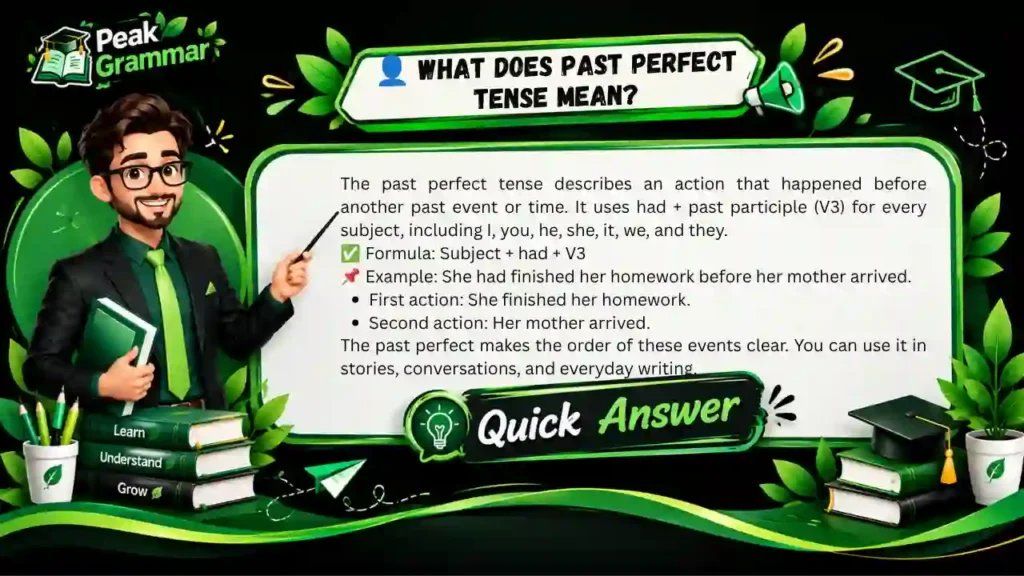
The past perfect tense describes an action that happened before another past event or time. It uses had + past participle (V3) for every subject, including I, you, he, she, it, we, and they.
✅ Formula: Subject + had + V3
📌 Example: She had finished her homework before her mother arrived.
- First action: She finished her homework.
- Second action: Her mother arrived.
The past perfect makes the order of these events clear. You can use it in stories, conversations, and everyday writing.
📋 TL;DR: Past Perfect Tense at a Glance
- 📘 Meaning: An action happened before another past event or time.
- 🧩 Formula: Subject + had + past participle (V3).
- ✅ Positive: I had finished my work.
- ❌ Negative: I had not finished my work.
- ❓ Question: Had you finished your work?
- ⏰ Time words: Before, after, already, just, never, and by the time.
- 🔄 Main difference: Simple past tells us about past actions; past perfect helps clarify an earlier past action.
- 💡 Memory trick: The past perfect often means the past before the past.
You Might Also Like That: Separate or Seperate
📘 What Is the Past Perfect Tense?
The past perfect tense, also called the pluperfect tense, helps us explain which action happened first in the past. We form it with had + the past participle of a verb. The tense often connects an earlier action to a later past event.
For example, “When I reached the station, the train had left.” The train left first, and I arrived afterward.
The past perfect also helps explain past experiences, causes, and situations. However, you do not always need two actions in the same sentence. Sometimes the surrounding conversation already makes the past reference point clear.
🧩 Past Perfect Tense Formula and Sentence Structure
The past perfect tense formula stays simple because we use had with every subject. Unlike the present perfect, we do not switch between have and has. We only change the sentence structure to make statements, negatives, or questions.
| Sentence type | Formula | Example |
| ✅ Positive | Subject + had + V3 | She had eaten. |
| ❌ Negative | Subject + had not + V3 | She had not eaten. |
| ❓ Question | Had + subject + V3? | Had she eaten? |
| 🔍 WH-question | WH-word + had + subject + V3? | Why had she left? |
✅ Affirmative Sentence Formula
Use Subject + had + V3 to describe an earlier past action.
Examples:
- I had completed the assignment.
- He had bought a new phone.
- They had visited the museum.
❌ Negative Sentence Formula
Use Subject + had not + V3 when an action did not happen before a past reference point. You can shorten had not to hadn’t.
Examples:
- She had not finished dinner.
- We hadn’t seen the movie.
- He hadn’t called before the meeting.
❓ Interrogative and WH-Question Formula
Place had before the subject to ask a yes/no question. For a WH-question, start with a question word.
Examples:
- Had you finished your homework?
- Had they arrived before noon?
- Why had she left early?
- Where had he parked the car?
📚 Past Perfect Tense Rules
The most important past perfect tense rule is to use had + V3, not had + V2. The past participle may look different from the simple past form, especially with irregular verbs.
For example, we say “She had gone home,” not “She had went home.”
| Base verb (V1) | Simple past (V2) | Past participle (V3) |
| Go | Went | Gone |
| Eat | Ate | Eaten |
| Write | Wrote | Written |
| See | Saw | Seen |
| Finish | Finished | Finished |
⏳ Rule 1: Describe an Earlier Past Event
Use the past perfect when you want to make an earlier action clear.
Example: The movie had started when we arrived.
The movie started first. We arrived later.
🔗 Rule 2: Explain the Reason for a Later Past Event
The past perfect can show why something happened in the past.
Example: She felt tired because she had worked all night.
Her earlier work explains why she felt tired.
🌟 Rule 3: Show Experiences Before a Past Time
Use the past perfect to discuss experiences someone had or had not completed before a certain time.
Example: Before 2020, I had never traveled abroad.
The sentence describes an experience before a past reference point.
⏰ When Do We Use the Past Perfect Tense?
We use the past perfect tense when we look back from one past moment to an earlier action. This helps readers understand the sequence of events, especially when the sentence does not mention events in the order they happened.
For example, “I couldn’t open the door because I had lost my key.” Losing the key happened first.
We can also use the past perfect for an action that continued up to a past moment: “By 2022, she had lived there for five years.” Context helps us understand the meaning.
🕒 Past Perfect Tense With Before, After, When, and By the Time
Time expressions often help us understand the past perfect tense usage. Words such as before, after, when, and by the time connect past events and show their relationship.
The past perfect is not always necessary with before and after because these words already show the order. However, it can add emphasis or clarity.
| Time expression | Example |
| Before | I had eaten before she arrived. |
| After | After he had studied, he slept. |
| When | When I arrived, they had left. |
| By the time | By the time we arrived, it had started. |
| Already | She had already called. |
| Just | He had just finished. |
| Never | I had never seen snow before that trip. |
✨ 50 Past Perfect Tense Examples
Learning through past perfect tense examples makes grammar easier to understand. The following sentences show how to use had + V3 in positive statements, negative statements, questions, and everyday situations.
Pay attention to the main verb in each sentence. Every example uses a past participle after had.
✅ 15 Positive Past Perfect Sentences
- I had finished my homework.
- She had cooked dinner.
- They had visited New York.
- He had bought a bicycle.
- We had cleaned the kitchen.
- The train had departed.
- Sarah had written a letter.
- John had repaired his car.
- The children had eaten breakfast.
- My father had left for work.
- She had learned English.
- They had completed the project.
- I had watched that movie.
- He had forgotten his password.
- We had reached the hotel.
❌ 10 Negative Past Perfect Sentences
- I had not finished my work.
- She hadn’t eaten breakfast.
- They hadn’t arrived on time.
- He had not studied enough.
- We hadn’t visited that city.
- Sarah hadn’t called me.
- John had not cleaned his room.
- The students hadn’t completed the test.
- My brother hadn’t seen the message.
- I had not heard the news.
❓ 10 Past Perfect Questions
- Had you finished your homework?
- Had she eaten lunch?
- Had they reached home?
- Had he called you?
- Had we met before?
- Had Sarah completed the project?
- Had John visited Chicago?
- Had the movie started?
- Had your parents arrived?
- Had you seen that place before?
💬 15 Everyday Past Perfect Examples
- I had locked the door before leaving.
- She had prepared breakfast before school.
- We had booked tickets before the prices increased.
- He had saved money before buying a laptop.
- They had ordered food before we arrived.
- I had charged my phone before traveling.
- She had washed the dishes before bedtime.
- We had finished shopping before sunset.
- He had practiced before the game.
- They had moved before winter started.
- I had read the instructions before starting.
- She had packed her bags before breakfast.
- We had checked the weather before leaving.
- He had sent the email before the meeting.
- They had decorated the house before the guests arrived.
🔄 Past Perfect vs. Simple Past
The simple past describes a completed past action. The past perfect looks back to an action before another past event or time.
Compare these sentences:
- Simple past: I ate dinner at 7 p.m.
- Past perfect: I had eaten dinner before she arrived.
Both sentences describe completed actions, but the second highlights the earlier event.
| Simple past | Past perfect |
| She left at 8. | She had left before I arrived. |
| He finished his work. | He had finished before lunch. |
| They ate breakfast. | They had eaten before school. |
🔍 Past Perfect vs. Present Perfect
The difference between past perfect and present perfect depends on the reference time. Present perfect connects a past action to the present. Past perfect connects an earlier action to a past moment.
Present perfect: I have finished my homework.
Past perfect: I had finished my homework before dinner.
| Feature | Present perfect | Past perfect |
| Formula | Have/has + V3 | Had + V3 |
| Reference time | Present | Past |
| Example | She has left. | She had left before noon. |
The present perfect generally avoids finished past-time expressions such as yesterday. The past perfect can refer to an earlier action before a specified past time.
⌛ Past Perfect vs. Past Perfect Continuous
The past perfect often focuses on an earlier completed action or result. The past perfect continuous highlights an activity that continued before another past moment.
Compare:
- Past perfect: She had studied before the test.
- Past perfect continuous: She had been studying for two hours before the test.
The second sentence emphasizes the duration of studying.
| Tense | Formula | Example |
| Past perfect | Had + V3 | I had worked. |
| Past perfect continuous | Had been + verb-ing | I had been working. |
Both tenses can describe earlier situations, but their focus differs.
⚠️ Common Past Perfect Tense Mistakes
Many learners make mistakes when choosing verb forms or using the past perfect unnecessarily. The easiest way to avoid these errors is to check the past participle and the sentence’s past reference point.
Remember that had never changes according to the subject. Also, do not assume that every sentence about two past events requires the past perfect.
| ❌ Incorrect | ✅ Correct |
| She had went home. | She had gone home. |
| He had ate lunch. | He had eaten lunch. |
| They has finished. | They had finished. |
| Had she went there? | Had she gone there? |
| I had saw him. | I had seen him. |
🤔 Do You Always Need Two Past Actions?
No. The past perfect tense does not always need two actions in the same sentence. Sometimes a past reference point appears in an earlier sentence or comes from the conversation.
Example:
“Why was Sarah upset?”
“She had lost her phone.”
The second sentence contains only one stated action, but the question provides the past situation.
You can also use a time reference: “By midnight, I had finished everything.”
💡 Remember: The past perfect needs a meaningful earlier-than-past relationship, but you do not always need to state two separate actions.
📖 How Past Perfect Works in Stories and Flashbacks
Writers use the past perfect tense to explain events that happened before the main story. It helps readers move backward in time without losing track of the action.
Example:
“Emma opened the old box. She smiled because her grandmother had given it to her many years earlier.”
The story starts when Emma opens the box, then looks back to an earlier event.
Writers may return to the simple past after clearly establishing the earlier time. This keeps a story natural and avoids repeating had in every sentence.
🚫 When Should You Avoid the Past Perfect?
Do not use the past perfect simply because a sentence describes the past. When you list events in their natural order, the simple past often works better.
Natural: I woke up, brushed my teeth, and ate breakfast.
Unnecessary: I had woken up, had brushed my teeth, and had eaten breakfast.
You should also avoid using had with the simple past form of an irregular verb.
❌ Incorrect: She had wrote a letter.
✅ Correct: She had written a letter.
Use the past perfect when it adds a useful time relationship.
💡 Why Are Both Simple Past and Past Perfect Sometimes Correct?
Sometimes simple past and past perfect both work because time expressions already make the order clear.
Example 1: After she finished dinner, she watched TV.
Example 2: After she had finished dinner, she watched TV.
Both sentences make sense. The second places more emphasis on the completed earlier action.
The best choice depends on the context, the meaning you want to highlight, and how clearly readers can follow the events. Good grammar means choosing the tense that communicates your meaning naturally, not using the most complex tense.
💬 Past Perfect in Real Conversations, Emails, and Stories
The past perfect tense appears naturally in everyday communication when people explain earlier events.
🏠 Conversation: “I was hungry because I had skipped breakfast.”
💼 Work email: “We had completed the report before the deadline.”
✈️ Travel: “Our flight had departed by the time we reached the airport.”
📚 School: “The teacher had explained the lesson before the test.”
These examples show why the tense matters. It connects past events and helps listeners or readers understand what happened first, without requiring long or complicated sentences.
📝 Past Perfect Tense Exercises With Answers
Practice helps you remember the past perfect tense formula and recognize correct verb forms. Complete these sentences using the appropriate past perfect form.
✏️ Fill in the Blanks
- She ______ (finish) her homework before dinner.
- They ______ (leave) before we arrived.
- I ______ (not see) that movie before.
- He ______ (eat) before the meeting.
- We ______ (complete) the work by noon.
- ______ you ______ (visit) Boston before?
- Sarah ______ (write) the email before lunch.
- They ______ (not hear) the news.
- The train ______ (depart) before we reached the station.
- Why ______ he ______ (go) home early?
✅ Answer Key
| Question | Correct answer |
| 1 | Had finished |
| 2 | Had left |
| 3 | Had not seen |
| 4 | Had eaten |
| 5 | Had completed |
| 6 | Had, visited |
| 7 | Had written |
| 8 | Had not heard |
| 9 | Had departed |
| 10 | Had, gone |
💡 Explanation: Each answer follows had + V3. Negative sentences add not, while questions place had before the subject.
❓ Frequently Asked Questions About the Past Perfect Tense
What is the past perfect tense in simple words?
The past perfect tense describes an action that happened before another past event or time. Example: “I had eaten before she arrived.”
What is the main rule of the past perfect tense?
Use Subject + had + past participle (V3). For example, “He had finished his work.”
Can we use past perfect with yesterday?
Yes, when the sentence establishes an earlier action before a past reference point. Example: “By noon yesterday, I had finished my homework.”
What is the difference between had gone and went?
Went is the simple past of go. Had gone is the past perfect form and places the action before another past reference point.
What is the difference between had been and had gone?
Had been can describe a past state or experience. Had gone describes an earlier movement to another place. Their exact meanings depend on context.
Can we use past perfect without before or after?
Yes. You can use the past perfect with when, by the time, or an understood past reference point.
Is past perfect necessary in every story?
No. Writers mainly use simple past for the main sequence of events and past perfect when they need to explain earlier actions.
How can I identify the past perfect tense?
Look for had + past participle and check whether the sentence refers to an action before a past moment.
📚 Trusted Grammar Resources
For further grammar learning, explore these helpful educational resources:
- 📘 Grammarly’s Past Perfect Tense Guide — Learn grammar rules, sentence forms, and examples.
- 🎓 British Council Past Perfect Lesson — Explore grammar explanations and interactive exercises.
- 📖 British Council Grammar Reference — Review additional past perfect uses and sentence patterns.
- 🔍 Britannica Dictionary: Past Perfect and Present Perfect — Explore the differences between related perfect tenses.
🎯 Final Thoughts
The past perfect tense helps you explain what happened before another past event or time. Once you remember had + past participle (V3), you can create positive sentences, negative sentences, and questions more confidently.
The most important skill is knowing when to use the past perfect rather than adding had to every past sentence. Review the examples, compare it with the simple past and present perfect, and complete the practice exercises. With regular practice, you can use the past perfect tense rules naturally in conversations, schoolwork, emails, and stories.