
Have you received a text or seen a social media comment containing IMHO and wondered what it means? The IMHO meaning is “in my humble opinion.” It is an informal abbreviation people use when they want to share a personal opinion, judgment, preference, or point of view. Cambridge and Oxford both define IMHO as a written or internet abbreviation for “in my humble opinion.”
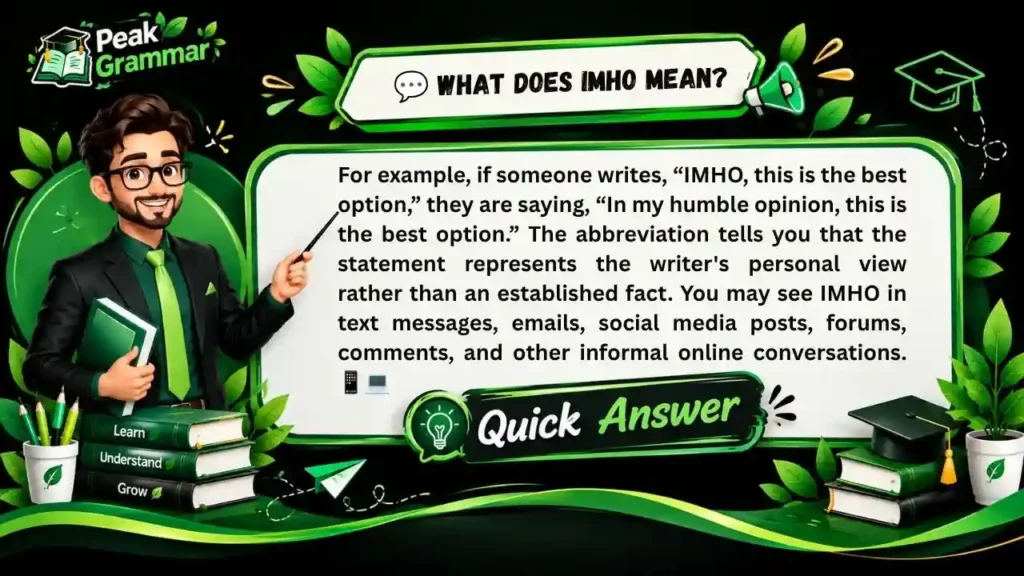
For example, if someone writes, “IMHO, this is the best option,” they are saying, “In my humble opinion, this is the best option.” The abbreviation tells you that the statement represents the writer’s personal view rather than an established fact. You may see IMHO in text messages, emails, social media posts, forums, comments, and other informal online conversations.
Quick Answer
IMHO means “in my humble opinion.” 💭
It is used to introduce or emphasize a personal opinion in texting, online chats, emails, social media, and other informal written communication.
✨ Example: “IMHO, the second movie was better.”
In simple English:
IMHO = In My Humble Opinion
It can also sometimes be interpreted as “in my honest opinion,” but “in my humble opinion” is the standard and most widely recognized meaning.
TL;DR
- IMHO means “in my humble opinion.”
- It is commonly used in texts, chats, emails, forums, and social media.
- It tells readers that someone is expressing a personal viewpoint.
- IMHO can appear at the beginning or end of a sentence.
- It is usually informal and conversational.
- The word “humble” can make an opinion sound modest, but the abbreviation does not always sound humble in real conversations.
- IMHO and imho generally have the same meaning.
- IMO means “in my opinion” and is very similar to IMHO.
- MHO is usually better suited to casual communication than formal academic or professional writing.
- IMHO does not automatically make a statement polite.
- In most texting contexts, IMHO means “in my humble opinion,” but context can change how abbreviations are understood.
You Might Also Like That: FRFR Meaning
What Does IMHO Mean?
IMHO stands for “in my humble opinion.” It is used when a person wants to make it clear that they are giving their own opinion.
Think of it as a short way of saying:
- 💭 “This is what I think.”
- 🗣️ “This is my personal view.”
- 🤔 “From my perspective…”
- ✨ “This is how I see it.”
- 😊 “In my humble opinion…”
For example:
“IMHO, this restaurant has the best food.”
The writer is not claiming that everyone agrees. They are sharing their personal judgment.
You can also put it at the end:
“This restaurant has the best food, IMHO.”
The meaning remains the same.
What Does IMHO Stand For?
The letters in IMHO come directly from the words in “In My Humble Opinion.”
| 🔤 Letter | 📝 Word |
| I | In |
| M | My |
| H | Humble |
| O | Opinion |
So the formula is simple:
I + M + H + O = In My Humble Opinion 💡
The extra H is what separates IMHO from IMO, which means “in my opinion.”
What Does IMHO Mean in Texting?
In texting, IMHO is a quick way to signal that what follows is someone’s personal opinion. It can be used when discussing movies, food, relationships, products, games, school, work, travel, or almost any topic where people can have different views.
For example:
“IMHO, you should choose the blue one.” 🎨
This means:
“In my humble opinion, you should choose the blue one.”
Another example:
“That was the funniest episode, IMHO.”
The writer is simply making their personal judgment clear.
Why Do People Use IMHO?
People use IMHO for several reasons.
To Introduce an Opinion
“IMHO, this is the better choice.”
It immediately tells the reader that the sentence is an opinion.
To Show That Others May Disagree
“IMHO, the first version was better.”
The writer is presenting a viewpoint rather than insisting that everyone must agree.
To Sound Less Absolute
Compare:
“This is the best restaurant.”
with:
“IMHO, this is the best restaurant.”
The second sentence clearly presents the statement as personal judgment.
To Keep Online Communication Short
Typing IMHO is much faster than repeatedly writing “in my humble opinion.”
That makes it convenient for chats, comments, and online discussions.
You Might Also Like That: IYKYK Meaning
Does IMHO Mean Humble or Honest?
This is one of the most interesting points about the abbreviation.
The standard meaning of IMHO is:
“In My Humble Opinion.”
Cambridge and Oxford both give this as the main definition.
However, some dictionaries and usage sources also recognize “in my honest opinion” as an alternative interpretation. Collins and Dictionary.com both record this variation in some usage contexts.
So you may encounter:
IMHO = In My Humble Opinion
or sometimes:
IMHO = In My Honest Opinion 🔎
If someone asks for the standard meaning, the safest answer is:
👉 IMHO means “in my humble opinion.”
Does the “H” Really Make the Opinion Humble?
Not always!
The word “humble” suggests modesty, but people don’t necessarily use IMHO because they genuinely want to sound humble.
For example:
“IMHO, this is easily the worst movie ever made.”
The writer may have a very strong opinion.
So IMHO can be:
- 😊 Sincere
- 🤝 Modest
- 💭 Neutral
- 😂 Playful
- 😏 Sarcastic
- 🔥 Strong or blunt
The surrounding words and context determine the actual tone.
Oxford specifically notes that IMHO is often humorous, which is another reason not to assume that every use is deeply humble.
Is IMHO Polite or Rude?
IMHO itself is neither rude nor automatically polite.
It is mainly an opinion marker.
For example:
“IMHO, you made the right decision.”
This sounds supportive.
😐 “IMHO, the first option is better.”
This sounds neutral.
“IMHO, that idea makes no sense.”
This sounds critical.
So the abbreviation doesn’t determine the entire tone. The words around IMHO matter more.
IMHO vs IMO
The most important comparison is IMHO vs IMO.
IMO = In My Opinion
IMHO = In My Humble Opinion
Both introduce a personal opinion. Cambridge explicitly lists IMO as a comparison for IMHO.
| 💬 Abbreviation | 🧠 Meaning | 🎭 General Feel |
| IMO | In my opinion | Neutral |
| IMHO | In my humble opinion | More modest or playful |
| I think | Personal thought | Natural everyday English |
| In my view | Personal viewpoint | More formal |
| I believe | Personal belief | Neutral/formal |
Which One Sounds More Neutral?
IMO is generally the simpler and more neutral option.
IMHO adds the word “humble,” which can create a slightly softer, more modest, humorous, or old-fashioned internet tone.
However, context can completely change that impression.
You Might Also Like That: TS Meaning in Text
IMHO vs “I Think”
These expressions can communicate a similar idea, but they belong to different styles.
“IMHO, the second option is better.”
“I think the second option is better.”
“I think” sounds natural in everyday speech.
IMHO feels more like written internet shorthand.
That means:
Texting → IMHO works well.
Conversation → I think sounds more natural.
📄 Formal writing → In my opinion or I believe may be better.
IMHO vs TBH
TBH means “to be honest.” 💬
It is not exactly the same as IMHO.
IMHO: focuses on a personal opinion.
TBH: emphasizes honesty or frankness.
Compare:
“IMHO, this is the best option.”
The writer is giving an opinion.
“TBH, I don’t really like this option.”
The writer is emphasizing honesty.
You can even see both together:
“TBH, IMHO, the first version was better.”
But in many cases, using just one is clearer.
IMHO vs FWIW
FWIW means “for what it’s worth.” 💡
It can introduce information, experience, or an opinion that the writer thinks may be useful.
IMHO: “This is my personal opinion.”
FWIW: “This information or opinion may be useful to you.”
Example:
“IMHO, the first design looks better.”
versus:
“FWIW, I used the first design last year and it worked well.”
The meanings overlap sometimes, but they are not identical.
IMHO Meaning at a Glance
| 🔎 Search/Expression | 💡 Meaning | 📱 Common Context |
| IMHO | In my humble opinion | Texts, chats, social media |
| imho | In my humble opinion | Casual online writing |
| IMO | In my opinion | Digital conversations |
| IMHO, … | Introduces an opinion | Beginning of sentence |
| …, IMHO | Adds an opinion marker | End of sentence |
| IMHO vs IMO | Humble vs regular opinion | Comparing tone |
| IMHO vs TBH | Opinion vs honesty | Informal chats |
| In my opinion | Full form | General/formal writing |
| I think | Personal thought | Speech and writing |
| In my view | Personal viewpoint | More polished writing |
How Do You Use IMHO in a Sentence?
There are several natural ways to use IMHO.
IMHO at the Beginning
This is probably the clearest structure:
“IMHO, this movie deserves more attention.”
“IMHO, you made the right decision.”
“IMHO, the blue design looks cleaner.”
The abbreviation immediately tells the reader that the sentence contains a personal opinion.
IMHO at the End
You can also place it after the opinion:
“This movie deserves more attention, IMHO.”
“The blue design looks cleaner, IMHO.”
“You made the right decision, IMHO.”
This can sound slightly more conversational.
IMHO in the Middle
IMHO can also appear inside a sentence:
“The second option is, IMHO, the most practical.”
This is grammatically possible, but it can feel more formal or deliberate than the common beginning/end placement.
You Might Also Like That: What Does WYF Mean
Should You Write IMHO or imho?
Both IMHO and imho generally carry the same meaning. 📱
You might see:
“IMHO, that’s the better choice.”
or:
“imho that’s the better choice.”
Uppercase IMHO makes the abbreviation more noticeable.
Lowercase imho can feel more relaxed and casual.
The choice is mostly about style and presentation, not meaning.
Oxford specifically lists imho as another form of IMHO.
How Do You Pronounce IMHO?
IMHO is normally pronounced by saying the individual letters:
“eye-em-aitch-oh.” 🔊
Oxford gives the pronunciation as /ˌaɪ em eɪtʃ ˈəʊ/.
You generally don’t pronounce IMHO as one ordinary English word.
The humor comes from the statement itself, not from the abbreviation.
IMHO Examples in Everyday Texts
Here are additional natural examples you might see in everyday messaging:
- 📱 “IMHO, we should leave early.”
- 🚗 “The other route is faster, IMHO.”
- 🏠 “IMHO, this apartment is worth the price.”
- ✈️ “You should visit in spring, IMHO.”
- 📚 “IMHO, this book is worth reading.”
- 🎵 “Their older songs were better, IMHO.”
- 💻 “The laptop is overpriced, IMHO.”
- 📺 “IMHO, that show deserves another season.”
- 🏖️ “This is the best beach nearby, IMHO.”
- 🌧️ “IMHO, rainy days are relaxing.”
Common Mistakes When Using IMHO
Thinking IMHO Means Everyone Should Agree
IMHO signals a personal opinion.
“IMHO, this is the best option.”
doesn’t mean:
“Everyone must agree with me.”
It simply communicates the writer’s view.
Assuming IMHO Always Sounds Humble
The abbreviation contains the word “humble,” but people can use it with very strong opinions.
“IMHO, this is the worst design ever.”
So context matters.
Using IMHO With Every Opinion
Repeating it in every sentence can make writing awkward.
Instead of:
“IMHO, this is good. IMHO, the color is nice. IMHO, the price is fair.”
Write:
“IMHO, this is a great option. The color is nice, and the price is fair.”
Thinking IMHO Automatically Makes Criticism Polite
Compare:
“IMHO, you’re completely clueless.”
The word IMHO does not make the insult friendly.
A better version would be:
“IMHO, there may be another way to look at this.”
Confusing IMHO With IMO
Remember:
IMO = In My Opinion
IMHO = In My Humble Opinion
The meanings are extremely close, but IMHO contains the extra H.
How to Choose Between IMO and IMHO
Use IMO when you want a simple, neutral way to introduce your opinion.
Use IMHO when you want a slightly more modest, conversational, humorous, or internet-style expression.
For example:
Neutral: “IMO, the first option is better.”
Softer/playful: “IMHO, the first option is better.”
Neither is automatically more polite. The surrounding sentence determines the actual tone.
When Should You Use IMHO?
IMHO is a good choice when:
- 📱 You’re texting friends.
- 💬 You’re chatting casually.
- 🌐 You’re commenting online.
- 🎮 You’re discussing a game.
- 🎬 You’re reviewing a movie.
- ⭐ You’re giving a recommendation.
- 🍕 You’re discussing personal preferences.
- 🤝 You’re offering casual advice.
- 😂 You’re making a playful opinion.
- 🧵 You’re participating in an online discussion.
When Should You Avoid IMHO?
You may want to avoid it in:
- 🎓 Formal academic papers
- 📄 Official reports
- ⚖️ Legal documents
- 💼 Highly formal business writing
- 📑 Professional applications
- 🏛️ Official correspondence
- 📊 Formal research
In these situations, use precise standard English instead.
For example:
IMHO, the results are important.
could become:
“In my view, the results are significant.”
Or, when evidence supports it:
“The results indicate that the change was significant.”
IMHO and Facts: An Important Difference
One useful rule is that IMHO is best suited to subjective statements.
For example:
“IMHO, this movie is amazing.”
That’s clearly an opinion.
“IMHO, the blue design looks better.”
That’s a preference.
But:
⚠️ “IMHO, water freezes at 0°C.”
The temperature at which water freezes under specified conditions is a scientific fact, not simply a personal opinion.
Adding IMHO does not turn an objective fact into an opinion.
So use the abbreviation mainly for:
preferences + judgments + interpretations + recommendations + personal views. 💡
IMHO for English Learners
If you’re learning English, understanding IMHO can help you recognize informal online communication.
For example:
“IMHO, this book is easier.”
means:
“In my humble opinion, this book is easier.”
The important thing is to understand the difference between standard English and internet shorthand.
📖 Standard:
“In my opinion, this is better.”
📱 Informal digital:
“IMHO, this is better.”
Both communicate a personal viewpoint, but the style is different.
Quick Writing Guide for IMHO
When you want to use IMHO naturally, follow these simple rules:
✨ Use it for opinions.
Place it before or after the opinion. Use it mainly in informal digital communication.
😊Don’t assume it automatically makes your message polite.
🧠 Remember that “humble” is the standard expansion.
Use IMO when you want a simpler and more neutral alternative.
📄 Use “in my opinion” instead in formal writing.
🚫 Don’t add IMHO to every sentence.
You Might Also Like That: What Does SMH Mean in Text
❓ Frequently Asked Questions
What does IMHO mean in text?
IMHO means “in my humble opinion.” It is used in text messages and other informal written communication when someone wants to share a personal opinion.
What does IMHO stand for?
IMHO stands for “In My Humble Opinion.”
What does IMHO mean in slang?
The IMHO slang meaning is “in my humble opinion.” It is commonly used as internet or text shorthand for introducing a personal viewpoint.
What does IMHO mean in chat?
In chat, IMHO means “in my humble opinion.” It tells the reader that the person is sharing their own judgment or preference.
Is IMHO the same as IMO?
They are very similar.
IMO = In My Opinion
IMHO = In My Humble Opinion
The extra H in IMHO adds “humble,” which can make the expression sound more modest, playful, or conversational.
Does IMHO mean “in my honest opinion”?
Sometimes people use or interpret the H as “honest.” However, “in my humble opinion” is the standard meaning given by major dictionaries. Collins and Dictionary.com also record “honest” as an alternative in some usage.
Is IMHO rude?
No. IMHO is not inherently rude. The tone depends on the rest of the sentence.
Is IMHO polite?
It can make an opinion sound modest, but it does not automatically make a statement polite. A harsh statement can still sound harsh even when it begins with IMHO.
Conclusion
The IMHO meaning is simple:
💬 IMHO = In My Humble Opinion
It is an informal abbreviation used to introduce a personal opinion, preference, judgment, recommendation, or viewpoint. You can find it in text messages, emails, social media, forums, gaming chats, and other forms of digital communication.
Remember that IMO is the shorter and more neutral “in my opinion,” while IMHO adds the idea of humility, although people sometimes use the abbreviation humorously, sarcastically, or interpret the H as “honest.”
For casual online communication, IMHO is short, recognizable, and useful. For formal academic or professional writing, however, “in my opinion,” “in my view,” or “I believe” will usually sound more appropriate.