Next Friday vs. this Friday can seem like a small language question, but these phrases often cause confusion in everyday conversations, messages, and schedules. In general, “this Friday” refers to the upcoming Friday, while “next Friday” often refers to the Friday of the following week. Still, people do not always use next Friday in the same way, so its meaning can depend on context. This difference makes next Friday meaning less clear than it first appears.
If you have searched “when is next Friday?” or wondered whether next Friday means the upcoming Friday or Friday next week, this guide will make the distinction simple. You will learn the difference between next Friday and this Friday, understand common usage, explore real examples, and discover how to avoid confusion by using an exact date when necessary.
Quick Answer: ✅
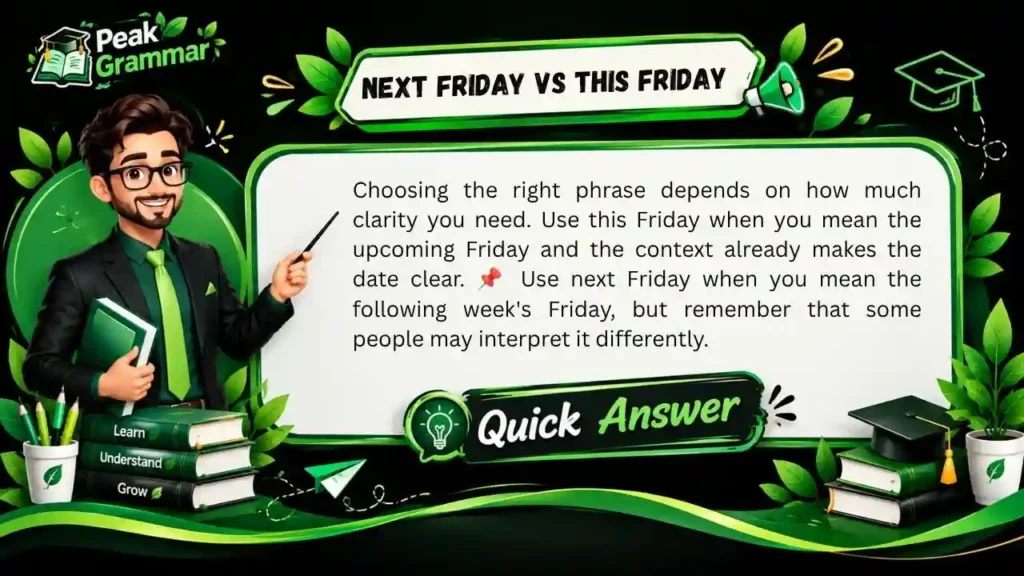
Choosing the right phrase depends on how much clarity you need. Use this Friday when you mean the upcoming Friday and the context already makes the date clear. 📌 Use next Friday when you mean the following week’s Friday, but remember that some people may interpret it differently.
For stronger clarity, choose this coming Friday for the nearest upcoming Friday and Friday next week for the following week’s Friday. 🗓️ When the date matters, give the exact calendar date instead. This approach works in casual speech and becomes even more valuable in professional communication, appointments, deadlines, and important plans.
TL;DR: 📌
Next Friday vs This Friday explains the difference between the two phrases, while “when is next Friday” helps readers determine the correct date. The article should focus on meaning, ambiguity, examples, and clear date communication 📅
- 📅 This Friday usually means the upcoming Friday in the current week
- ➡️ Next Friday commonly means the Friday of the following week
- ⚠️ Next Friday can be ambiguous because people may use it differently
- 🔎 “When is next Friday?” depends on today’s date and the speaker’s intended meaning
- 🗓️ This coming Friday usually makes the upcoming Friday clearer
- 📆 Friday next week clearly points to the following week
- 💬 Context can change how people understand next Friday
- ✍️ Use an exact calendar date when accuracy matters
- 💼 Exact dates are especially useful for meetings, appointments, deadlines, and emails
- 🎯 The safest approach is to avoid guessing and state the date clearly
You Might Also Like That: HU Meaning
Next Friday vs This Friday at a Glance 🔎
“This Friday” and “next Friday” both talk about Friday, but people can use them differently. Usually, this Friday means the upcoming Friday in the current week. Next Friday commonly means the Friday in the following week. 📆 However, everyday English does not always follow one fixed rule, so next Friday can be ambiguous.
| Phrase | Common meaning | Example |
| 📌 This Friday | The upcoming Friday | “I’ll call you this Friday.” |
| 📌 Next Friday | Usually Friday of next week | “Let’s meet next Friday.” |
| 📌 This coming Friday | The nearest upcoming Friday | “See you this coming Friday.” |
| 📌 Friday next week | Friday in the following week | “The meeting is Friday next week.” |
When the date really matters, use the exact calendar date. 🗓️ This simple habit can prevent scheduling confusion and make your message much clearer.
What Does “This Friday” Mean? 📅
“This Friday” usually means the Friday that comes within the current week. For example, if today is Monday, Tuesday, or Wednesday, people normally understand this Friday as the upcoming Friday. 👉 You can use it when the date feels clear from the conversation or calendar.
The phrase can become less clear when Friday has already passed. If today is Saturday or Sunday, people may interpret this Friday differently depending on context. In these situations, “this coming Friday” or an exact date can make your meaning clearer. ✅ This Friday is therefore a useful everyday expression, but context still matters.
What Does “Next Friday” Mean? 📆
The common next Friday meaning is the Friday of the following week. For example, if today is Monday and you say, “I’ll see you next Friday,” many people will understand that you mean the Friday after the upcoming one. 👉 In this sense, next Friday does not simply mean the next Friday on the calendar.
However, English speakers do not always use the phrase in exactly the same way. Some people use next Friday to mean the closest upcoming Friday. ⚠️ That is why next Friday usage can cause confusion. If you need complete accuracy, say “Friday next week” or provide the exact date.
Next Friday vs This Friday: Key Difference 🔄
The main difference between next Friday and this Friday comes from how we connect each phrase to the current week. This Friday normally points to the Friday in the week we are currently in. Next Friday commonly points to the Friday in the following week. 📅
For example, if today is Tuesday, you could say, “The test is this Friday” for the Friday only a few days away. If you say, “The test is next Friday,” many listeners will expect it one week later. 📝 Still, because next Friday has more than one common interpretation, the surrounding context can change how people understand it.
Why Is “Next Friday” Ambiguous? ⚠️
The phrase “next Friday” is ambiguous because English speakers can connect next to different points in time. One person may use it for the upcoming Friday, while another may use it for the Friday of next week. Both people may feel that their interpretation sounds natural. 🗣️
This issue becomes more noticeable in texts, emails, and quick conversations because the listener cannot always see the speaker’s intended timeline. 🌐 Regional habits and personal usage can also affect interpretation. Instead of treating one meaning as an absolute grammar rule, it is better to recognize the ambiguity and clarify the date whenever the timing is important.
When Is Next Friday? 🗓️
If you ask “When is next Friday?”, the answer depends on today’s date and the way the speaker uses the phrase. In the common interpretation, next Friday means the Friday after the upcoming Friday. 📅 For example, if today is Monday, this Friday comes first, and next Friday usually comes one week later.
If someone uses next Friday to mean the nearest Friday, the answer can change. That is why a simple phrase can create a date problem. 🔎 When you need an exact answer, check the calendar and name the date directly. This approach removes uncertainty and makes the conversation easier for everyone.
If Today Is Monday 📌
If today is Monday, this Friday normally means the Friday that comes in four days. Next Friday usually means the Friday one week after that. 📆 For example, if Monday falls on September 7, this Friday would be September 11, while next Friday would usually mean September 18. This example makes the difference easy to see.
However, some speakers may call September 11 next Friday because it is the next Friday that arrives. ⚠️ That is the main reason for the confusion. If you want to avoid any misunderstanding, say “this Friday, September 11” or “Friday next week, September 18.” ✅
You Might Also Like That: What Does SMH Mean in Text
If Today Is Tuesday 📌
On Tuesday, this Friday normally means the upcoming Friday later in the same week. Next Friday usually means the Friday in the following week. 📅 For example, if today is Tuesday, September 8, this Friday is September 11, while next Friday commonly means September 18.
This situation usually feels straightforward because both Fridays are still ahead. 👉 Even so, people may use next Friday differently. If you are discussing an important meeting, appointment, or deadline, do not rely only on the phrase. Use the exact date when possible. 🗓️ A clear date helps both the speaker and listener understand the same schedule.
If Today Is Wednesday 📌
If today is Wednesday, this Friday normally points to the Friday that is only two days away. Next Friday commonly points to the Friday of the following week. 📆 For example, if Wednesday is September 9, this Friday is September 11, and next Friday usually means September 18.
The short distance between today and this Friday makes the phrase this Friday especially natural. However, some people may still use next Friday for September 11 because they understand “next” as the next Friday that occurs. ⚠️ When the date affects travel, work, or an appointment, state the day and date together. ✅
If Today Is Thursday 📌
On Thursday, this Friday normally means tomorrow. 📅 This makes the phrase fairly easy to understand in many conversations. For example, if today is Thursday, September 10, saying “I’ll see you this Friday” normally points to September 11.
The phrase next Friday can create more uncertainty because some speakers may use it for tomorrow, while others mean the Friday after tomorrow. ⚠️ If you mean the later Friday, “Friday next week” gives a clearer message. If you mean tomorrow, simply saying “tomorrow” can work better. 👍 Clear wording is especially useful for professional communication.
If Today Is Friday 📌
If today is Friday, this Friday can mean today, especially when the conversation already makes the timing clear. For example, “The deadline is this Friday” may mean the deadline falls today. 📅 However, the phrase can also create confusion if the speaker and listener discuss the date at different times.
Next Friday usually points to the following Friday, but some speakers may still use it to describe the next Friday after the current moment. ⚠️ Because Friday creates a special case, use the exact date for important plans. 🗓️ Saying “Friday, September 18” is much clearer than relying on a relative time expression.
If Today Is Saturday or Sunday 📌
The weekend can make this Friday vs next Friday even harder to understand. If Friday has already passed, people may disagree about whether this Friday refers to the Friday that just passed or the upcoming Friday. ⚠️ The same problem can affect next Friday because people may think about the current calendar week or the next full week.
For this reason, weekend conversations benefit from clear wording. 👉 Use “this coming Friday” for the nearest upcoming Friday, or say “Friday next week” when you mean the Friday of the following week. 🗓️ An exact date remains the safest option.
You Might Also Like That: OMP Meaning
This Friday vs This Coming Friday 🔄
“This coming Friday” usually gives a clearer sense of an upcoming Friday than simply saying “this Friday.” 📅 For example, if today is Wednesday, “this coming Friday” normally points to the Friday only two days away. This expression can help when the listener might otherwise question which Friday you mean.
However, this coming Friday does not remove every possible language issue. Context still matters, especially around the weekend. 👉 If the date is important, combine the phrase with the date: “this coming Friday, September 11.” This approach gives the reader both the natural expression and the exact calendar information. ✅
Next Friday vs Friday Next Week 📆
“Next Friday” and “Friday next week” can point to the same date when the speaker uses next Friday to mean the Friday of the following week. However, “Friday next week” usually creates less confusion because it directly names the week. 👍
For example, imagine today is Monday. Saying “Let’s meet next Friday” may cause someone to ask, “Do you mean this Friday or the Friday after?” Saying “Let’s meet Friday next week” gives a much clearer answer. 📌 This wording works especially well in emails, work messages, appointments, and other situations where a misunderstanding could cause problems.
What Does “Friday After Next” Mean? ➡️
“Friday after next” usually refers to the Friday that comes after next Friday. 📅 In simple terms, it describes a Friday farther into the future. For example, if this Friday is September 11 and next Friday is September 18, Friday after next would normally mean September 25.
People sometimes confuse this phrase with next Friday, but they describe different points on the calendar. 👉 Because these expressions can feel confusing, always consider the context. If you are making an important plan, giving the exact date remains the clearest choice. 🗓️ This prevents the listener from having to guess which Friday you mean.
Examples of Next Friday vs This Friday ✍️
Real examples make the difference easier to understand. Here are a few simple examples:
- 📌 This Friday: “I have a dentist appointment this Friday.”
- 📌 Next Friday: “I have a dentist appointment next Friday.”
- 📌 This coming Friday: “We will finish the project this coming Friday.”
- 📌 Friday next week: “The meeting will take place Friday next week.”
- 📌 Exact date: “The meeting will take place on Friday, September 18.”
The first two examples can create confusion because people may interpret next Friday differently. ⚠️ The final example gives the clearest information because everyone can identify the same date without guessing.
How to Avoid Confusion About Next Friday 🛡️
The easiest way to avoid confusion with next Friday is to replace the relative expression with an exact date when the timing matters. 🗓️ Instead of saying, “The interview is next Friday,” you can say, “The interview is Friday, September 18.” This leaves no room for different interpretations.
You can also use clearer phrases such as “this coming Friday” for the nearest Friday or “Friday next week” for the Friday of the following week. 👍 These options work well in professional communication, texts, emails, and scheduling. When a date affects travel, work, money, or an appointment, always choose clarity over convenience.
How to Use These Phrases in Emails and Messages 💬
In casual messages, this Friday and next Friday usually work well when everyone shares the same context. For example, “Are we meeting this Friday?” sounds natural when both people know the schedule. 📱 However, professional communication often needs more precision.
For an email, meeting invitation, deadline, or appointment, include the exact date whenever possible. You can write, “Our meeting is scheduled for Friday, September 18.” 🗓️ If you need to use next Friday, add the date after it. This simple habit prevents scheduling confusion and saves time. Clear date writing also helps people who read the message later.
You Might Also Like That: EYP Meaning in Text
Frequently Asked Questions ❓
Is next Friday the same as this Friday?
Usually, no. 📅 This Friday normally refers to the upcoming Friday in the current week, while next Friday commonly refers to the Friday in the following week. However, some English speakers use next Friday to mean the upcoming Friday. ⚠️ Because of this difference, the two phrases can sometimes refer to the same date depending on the speaker.
Does next Friday mean 7 days from today?
Not always. 📆 If today is Friday, many people understand next Friday as seven days later. But if today is Monday, next Friday commonly means the Friday of the following week, which is more than seven days away. Some speakers may use the phrase for the upcoming Friday instead. 👉 Always consider context or give the exact date.
Is “next Friday” ambiguous?
Yes. ⚠️ “Next Friday” can be ambiguous because people use the phrase in different ways. Some mean the closest upcoming Friday, while others mean the Friday of the following week. The safest solution is to state the exact date or say “Friday next week” when you mean the later Friday.
Is “this coming Friday” clearer?
Usually, yes. 👍 “This coming Friday” commonly points to the nearest upcoming Friday and can make your intention clearer than simply saying “next Friday.” However, context still matters. If there is any chance of confusion, add the exact date. 🗓️
How can I clarify which Friday I mean?
Use a phrase such as “this Friday,” “this coming Friday,” or “Friday next week,” depending on your intended date. For complete clarity, give the calendar date. 📌 For example, “Friday, September 18” removes all uncertainty.
Conclusion 🎯
The main difference between next Friday and this Friday is simple: this Friday usually means the upcoming Friday, while next Friday commonly means the Friday of the following week. 📅 Yet next Friday is not completely universal, and different speakers may interpret it differently.
If someone asks “when is next Friday?”, check the current date and the context before assuming the answer. When the timing matters, do not make the reader guess. 🗓️ Use Friday next week, this coming Friday, or, best of all, the exact calendar date. Clear wording makes everyday conversations, emails, appointments, and schedules much easier to understand. ✅