
Have you ever wondered whether to write to, too, or two? These three words sound alike, but each has a different meaning and purpose. Knowing the difference between to vs too vs two can help you avoid common grammar mistakes and make your writing clearer. Whether you’re texting a friend, writing an email, or completing a school assignment, choosing the right word matters.
The easiest way to understand to, too, and two is to learn how each word works in a sentence. To often shows direction or introduces a verb, too means also or excessively, and two represents the number 2. Once you understand these simple rules and see a few examples, you’ll know when to use each word correctly.
⚡ Quick Answer: To vs Too vs Two
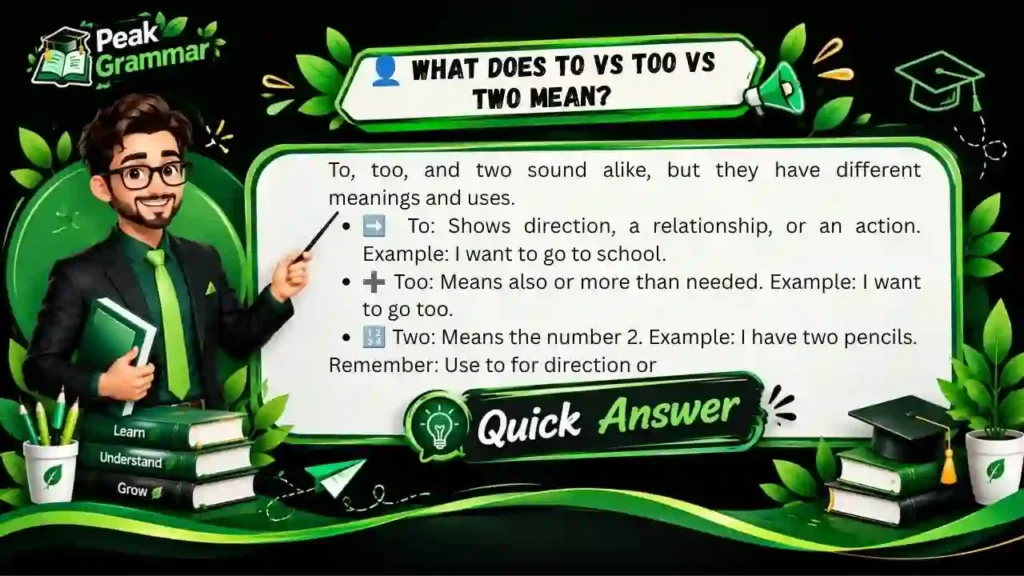
To, too, and two sound alike, but they have different meanings and uses.
- ➡️ To: Shows direction, a relationship, or an action. Example: I want to go to school.
- ➕ Too: Means also or more than needed. Example: I want to go too.
- 🔢 Two: Means the number 2. Example: I have two pencils.
Remember: Use to for direction or before a verb, too for also or excessively, and two when you mean the number.
📝 TL;DR: To vs Too vs Two
- ➡️ To connects words and often shows where someone is going or what someone wants to do.
- ➕ Too means also or more than necessary.
- 🔢 Two represents the number 2.
- 💡 All three words sound alike, so check the meaning of your sentence before choosing the spelling.
You Might Also Like That: RD Meaning
📘 What Does To Mean?
To is a common English word that often shows direction, destination, or a connection between people and things. It also appears before verbs to describe an action someone wants or plans to do. For example, in She went to the store, to shows direction. In He wants to play, it introduces the action. Understanding these uses helps you know when to write to instead of too or two.
➡️ To as a Preposition
Use to as a preposition when you talk about movement, direction, a destination, or a relationship. It can also show who receives something.
Examples:
- I walked to the park.
- She gave the book to her brother.
- We traveled to Lahore.
- Please listen to your teacher.
In these sentences, to connects different parts of the sentence and helps explain where something goes or who receives it.
✍️ To as an Infinitive Marker
Use to before the basic form of a verb to create an infinitive. This structure often explains what someone wants, needs, hopes, or plans to do.
Examples:
- I want to learn English.
- She needs to sleep early.
- They decided to leave.
- We hope to win the game.
Here, to does not mean direction. It helps introduce an action. When you see to followed by a basic verb, check whether the sentence describes an intended or possible action.
📌 Examples of To in Sentences
Here are some everyday examples that show how to works in different situations:
- I need to finish my homework.
- He went to the market.
- Please send this message to Ali.
- We like to watch movies.
- She walked to the door.
Good information: Don’t assume that every to shows movement. It can also introduce an infinitive, as in to read, to write, and to speak.
➕ What Does Too Mean?
Too is an adverb with two common meanings: also and more than necessary. You can use it when you want to add another person or thing to a statement, or when something has an excessive amount or degree. For example, I want to come too means you also want to come. The tea is too hot means the tea is hotter than you want. These meanings help you distinguish too from to.
😊 Too Meaning Also or As Well
Use too when you want to say that something applies to another person or thing. It often appears at the end of a sentence, although you can use it in other positions.
Examples:
- I love chocolate too.
- She wants to join us too.
- Are you coming too?
- He speaks English too.
In these examples, too means also or as well. If you can replace the word with also without changing the main meaning, too may be the right choice.
🌡️ Too Meaning Excessively
Use too when something has more of a quality or amount than you want, need, or consider suitable. It often appears before an adjective or adverb.
Examples:
- This coffee is too hot.
- The bag is too heavy.
- You’re driving too fast.
- The room is too small.
Here, too expresses excess. It often suggests a problem or an amount beyond a useful limit. Remember the difference between very hot and too hot: the second usually means the heat causes a problem.
📌 Examples of Too in Sentences
Use these examples to see both meanings in everyday writing:
- I want to go too. (also)
- The shoes are too expensive. (more than acceptable)
- She is too tired to study. (excessively)
- My brother likes football too. (also)
- It’s too late to call. (later than suitable)
Quick tip: When too means also, it often adds information. When it means excessively, it usually describes a degree that goes beyond what is suitable.
🔢 What Does Two Mean?
Two is the number 2. Use it when you count people, objects, places, or things. Unlike to and too, two does not connect words or describe how much of something you have. It simply tells you the number. For example, I have two sisters means you have exactly two sisters. You can use two in everyday conversations, schoolwork, shopping lists, and any sentence where you need to write the number 2 in words.
🔢 Two as the Number 2
Use two whenever you mean the number after one and before three. It can describe people, objects, time, or quantities.
Examples:
- I have two brothers.
- She bought two dresses.
- We waited for two hours.
- They have two cats.
Remember: If you can replace the word with the digit 2 and the sentence still makes sense, you probably need two.
📌 Examples of Two in Sentences
Here are a few more examples of two in everyday writing:
- I need two tickets for the movie.
- We ordered two cups of tea.
- He has two important questions.
- The school is two miles away.
You can also use two in phrases such as two days, two people, and two different ideas. It always refers to a quantity or number, not an action or an extra meaning.
📊 To vs Too vs Two: Key Differences
The main difference between to, too, and two is their meaning and grammatical job. Although they sound alike, you can choose the correct spelling by checking what your sentence means. To often connects ideas or introduces a verb, too adds the meaning of also or excessively, and two gives a number. Use this comparison table whenever you feel unsure about which word to write.
| Word | Meaning | Example |
| ➡️ To | Direction, connection, or infinitive | I want to eat. |
| ➕ Too | Also or excessively | I am too tired. |
| 🔢 Two | The number 2 | I ate two apples. |
🧠 How to Choose the Right Spelling
Ask yourself these three questions:
- Do I mean the number 2? Use two.
- Do I mean also or excessively? Use too.
- Am I showing direction, a connection, or introducing a verb? Use to.
For example, in I have two bags to carry too, two tells you the number of bags, to introduces the action, and too means also. Checking the meaning of each word makes the choice much easier.
⚠️ Common Mistakes When Using To, Too, and Two
People often confuse these words because they share the same pronunciation. However, each spelling has its own job. A small spelling mistake can change the meaning of a sentence or make it look incorrect. The easiest way to avoid these errors is to read your sentence again and check what you want to say. Pay special attention to phrases such as too much, to go, and two people, because they appear often in everyday writing.
❌ To vs Too Before Verbs
A common mistake is using too before a verb when the sentence needs to.
- Incorrect: I want too sleep.
- Correct: I want to sleep.
- Incorrect: She needs too study.
- Correct: She needs to study.
However, too can appear before an adjective or adverb, as in too tired or too quickly. Don’t choose the word just because it comes before another word. Check whether the sentence needs an infinitive or expresses excess.
❌ Too vs Two When Describing Quantity
Writers sometimes confuse too and two when they describe amounts.
- Incorrect: I have too dogs.
- Correct: I have two dogs.
- Incorrect: There are two many people.
- Correct: There are too many people.
Use two for the number 2. Use too in too many when the amount exceeds what is suitable. The phrase too much works in the same way when you describe an excessive amount.
💡 Easy Tricks to Remember To, Too, and Two
You don’t need to memorize long grammar rules every time you write. A few simple tricks can help you remember which spelling belongs in your sentence. Think about the meaning first, then use a quick substitution test. These tricks work especially well when you’re writing quickly, sending messages, or checking your school assignments. With practice, you’ll start choosing the correct word without stopping to think about every rule.
➕ The Extra O Trick
Too has an extra o, which can remind you of something extra. When you mean also, you’re adding information. When you mean excessively, you’re describing more than necessary.
Examples:
- I want some too. (also, though the sentence needs context)
- The soup is too salty. (more than wanted)
For two, remember that it starts with tw, like twenty. Both words connect to numbers. For to, remember its common use in phrases such as to school and to read.
🔢 The Number 2 Substitution Test
When you’re unsure whether to write two, replace the word with the digit 2.
- We have two chairs. → We have 2 chairs.
- She bought two books. → She bought 2 books.
If the sentence still makes sense, two is probably correct. For too, try replacing it with also or excessively. For to, check whether it connects a destination or introduces a verb. These simple tests can help you catch mistakes before you finish writing.
✍️ Examples of To, Too, and Two in the Same Sentence
The easiest way to understand all three words is to see them working together. Read this sentence: The two friends wanted to come too. Here, two tells you how many friends there are, to introduces the action come, and too means also. Each word has a different job, even though all three sound alike. Reading examples like this helps you understand how context changes the meaning and makes it easier to choose the correct spelling.
More examples:
- The two children want to play too.
- I have two things to tell you too.
- We invited two friends to dinner too.
📚 Good Information: A Few Extra Rules to Remember
Keep these useful points in mind when you write:
- To can show a destination (go to school) or introduce an action (to learn).
- Too can mean also or more than necessary.
- Two always represents the number 2 when you spell it out.
- Too much and too many describe an excessive amount.
- To and too can appear in the same sentence with different meanings.
One important detail: too doesn’t always mean something bad. In I like your idea too, it simply adds another person who likes the idea.
📋 Collective Data: Quick Grammar Reference
| If you want to say… | Use | Example |
| Toward a place | To | Walk to the door. |
| An action | To | I want to read. |
| Also | Too | Come too. |
| More than enough | Too | It’s too cold. |
| The number 2 | Two | Buy two pens. |
Easy reminder: Meaning matters more than sound. All three words generally sound alike, so listen to the whole sentence in your mind and check what you want the word to express.
❓ FAQs: To vs Too vs Two
Is it to or too?
Use to for direction, connections, or infinitive verbs. Use too when you mean also or excessively. For example, write I want to go but I want to go too when you mean you also want to go.
Why do to, too, and two sound alike?
These words are homophones, which means they share the same pronunciation but have different meanings or spellings. Their sounds cannot reliably tell you which spelling to choose, so you need to check the sentence’s meaning.
Can to and too be used in the same sentence?
Yes! For example: I want to come too. Here, to introduces the verb come, while too means also. Both words are correct because they perform different jobs.
Is too always used to mean excessively?
No. Too has two common meanings. It can mean excessively, as in too loud, or also, as in I want one too. Check the sentence to understand which meaning it expresses.
🎯 Conclusion
Understanding to vs too vs two becomes much easier when you focus on what each word means. Use to for direction, connections, and infinitive verbs. Choose too when you mean also or excessively. Write two when you mean the number 2. These simple rules can help you avoid common mistakes in schoolwork, emails, messages, and everyday writing.
Before you finish a sentence, take a moment to check the meaning of each word. With a little practice and the examples in this guide, you’ll feel more confident using all three correctly. 😊