

Have you ever wondered whether to write receive or recieve? The correct spelling is receive ✅, while recieve ❌ is a common spelling mistake. The same rule applies to received or recieved—always use received. Remember the simple spelling trick: “i before e, except after c.” In receive, the letters ei come after c.
Whether you’re writing an email, completing homework, or sending a message, knowing how to spell receive correctly helps you avoid mistakes. This guide explains the receive spelling rule, common errors, easy memory tricks, and practical examples so you can use receive, received, and receiving with confidence.
⚡ Quick Answer: Receive or Recieve?
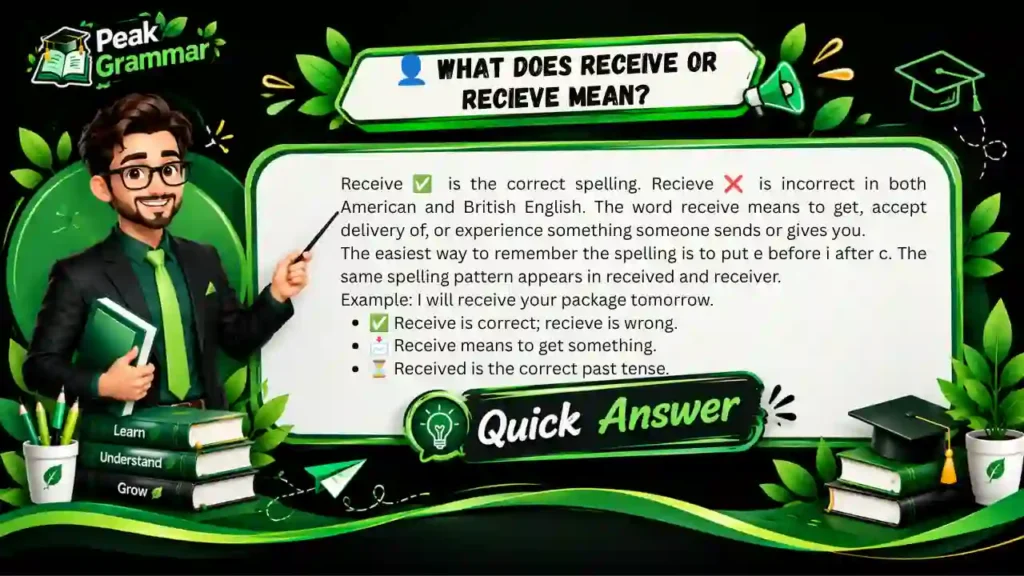
Receive ✅ is the correct spelling. Recieve ❌ is incorrect in both American and British English. The word receive means to get, accept delivery of, or experience something someone sends or gives you.
The easiest way to remember the spelling is to put e before i after c. The same spelling pattern appears in received and receiver.
| ✅ Correct | ❌ Incorrect |
| Receive | Recieve |
| Received | Recieved |
| Receiving | Recieving |
| Receives | Recieves |
| Receiver | Reciever |
Example: I will receive your package tomorrow.
📌 TL;DR: Key Spelling Rules
- ✅ Receive is correct; recieve is wrong.
- 📩 Receive means to get something.
- ⏳ Received is the correct past tense.
- ✍️ Receiving is the correct -ing form.
- 🧠 Remember: i before e, except after c.
- 🇺🇸🇬🇧 American and British English use receive.
- ❌ Avoid recieve, recieved, and recieving.
- 💡 Remember the letter order: r-e-c-e-i-v-e.
Memory tip: After the letter c, write ei, not ie, in receive.
You Might Also Like That: Word Vocab
📖 What Does Receive Mean in English?
The word receive is a verb that means to get something someone sends, gives, or provides. You can receive a gift, email, payment, message, or package. It can also describe experiencing something, such as receiving help, attention, or support.
For example, when someone sends you an invitation, you receive it when it reaches you. The word works in everyday conversations, school assignments, and professional writing.
✨ Receive Meaning and Sentence Examples
Here are some easy examples:
- 📩 I receive emails every morning.
- 🎁 She will receive a birthday gift.
- 📦 We received the package yesterday.
- 💰 He receives his salary every Friday.
- ❤️ They received support from their friends.
Remember: Receive describes getting something, not necessarily agreeing to it.
🔊 How Do You Pronounce Receive?
The correct pronunciation of receive is ri-SEEV (/rɪˈsiːv/). The word has two syllables, and you stress the second syllable. The first part sounds like a short ri, while the second part sounds like seev.
Both receive and the incorrect spelling recieve may look confusing, but the spelling mistake does not create a new English word. Focus on the correct written form when learning pronunciation.
Example: Did you receive my message?
Tip: Say the word aloud, then remember that its spelling contains ei after c.
❓ Why Do People Spell Receive as Recieve?
Many people write recieve because they mix up the letters i and e. English contains words such as believe, piece, and field, where ie appears together. Writers sometimes apply that pattern to receive by mistake.
However, receive uses ei after the letter c. This difference causes confusion, especially when someone types quickly or relies on how a word sounds.
The mistake is common, but the correction is simple. Learn the correct letter order and practice writing receive a few times.
🧠 Does Receive Follow the I Before E Rule?
Yes! Receive follows the familiar spelling reminder: “i before e, except after c.” In this word, the letter c comes immediately before ei, so you write receive, not recieve.
However, this memory rule does not work for every English word. Words such as weird, science, and their show why you should treat it as a helpful trick rather than a universal rule.
| Word | Letter pattern | Correct? |
| Receive | c + ei | ✅ |
| Ceiling | c + ei | ✅ |
| Deceive | c + ei | ✅ |
| Believe | ie | ✅ |
| Recieve | c + ie | ❌ |
Quick trick: When spelling receive, look for c + ei.
⏳ Recieved or Received: Which Is Right?
The correct spelling is received ✅. The spelling recieved ❌ is incorrect because it reverses the letters e and i. To form the past tense of receive, simply add d to the base word because receive already ends in e.
You use received when someone got something in the past. It also works as a past participle with helping verbs such as have and has.
Examples:
- 📦 I received my order yesterday.
- 📩 She received your email.
- ✅ We have received the payment.
- 🎓 He received an award.
Memory tip: If you can spell receive, you can spell received.
✍️ Receiving or Recieving: Which Is Correct?
Receiving ✅ is correct, while recieving ❌ is a spelling mistake. When you add -ing to receive, you remove the final silent e before adding the ending.
This creates the word receiving, which describes an action happening now or continuing over time. The important ei letter order stays the same.
Examples:
- 📩 I am receiving your messages.
- 📦 They are receiving new supplies.
- 💰 She is receiving monthly payments.
- ❤️ We are receiving helpful advice.
Easy rule: Receive − e + ing = receiving.
📚 How Receive Changes in Different Verb Tenses
The verb receive changes depending on when an action happens. Use receive for the base form, receives with he, she, or it in the simple present, and received for the simple past.
You can also use receiving with helping verbs to describe an ongoing action. Understanding these forms helps you write clearer sentences and avoid spelling mistakes.
| Verb form | Correct word | Example |
| Base form | Receive | I receive emails. |
| Third-person present | Receives | She receives letters. |
| Simple past | Received | He received a gift. |
| Past participle | Received | I have received it. |
| Present participle | Receiving | We are receiving calls. |
🔍 Receive vs Receipt: Why Are They Spelled Differently?
Receive and receipt are related words, but they have different spellings and uses. Receive is a verb that describes getting something. Receipt is usually a noun that means written or digital proof of a payment or purchase.
The word receipt contains a silent p, which can make its spelling harder to remember. Both words have a historical connection through Latin, but modern English uses them differently.
Examples:
- 📦 I will receive my order tomorrow.
- 🧾 Please keep your receipt.
- 💳 She received a receipt after paying.
Remember: You receive a package, but you keep a receipt as proof.
🤝 Receive vs Accept: Are They the Same?
Receive and accept have similar meanings, but they are not always interchangeable. Receive usually means something reaches you or someone gives it to you. Accept often means you willingly agree to take or approve something.
For example, you might receive a job offer but decide not to accept it. This difference matters in emails, business messages, and everyday conversations.
| Receive | Accept |
| Get an invitation | Agree to an invitation |
| Get a job offer | Agree to take the job |
| Get a package | Agree to take delivery |
| Get feedback | Agree with the feedback |
Key point: Receiving something does not always mean accepting it.
📧 How to Spell Receive in Emails and Messages
The correct spelling receive matters in emails, text messages, and professional communication. A spelling error may distract readers, especially when you discuss payments, documents, orders, or important updates.
Use receive for something you expect to get and received for something that has already arrived. You can also use receiving when describing an ongoing action.
✅ Correct Email Examples
- 📩 Did you receive my email?
- 📄 I received the attached document.
- 💰 We have received your payment.
- 📦 You will receive your order soon.
- ✉️ Thank you for receiving my request.
Writing tip: Check the spelling before sending an important message.
❌ Common Receive Spelling Errors and How to Fix Them
Writers often make mistakes with receive, received, and receiving because the letters e and i appear close together. Other errors happen when someone leaves out a letter or adds the wrong ending.
The easiest way to avoid these mistakes is to learn the base spelling first. Then apply the correct ending without changing the ei pattern.
| ❌ Common mistake | ✅ Correct spelling |
| Recieve | Receive |
| Recieved | Received |
| Recieving | Receiving |
| Recieves | Receives |
| Reciever | Receiver |
| Recive | Receive |
| Recived | Received |
| Receving | Receiving |
Tip: Check the ei pattern whenever you write a form of receive.
💡 Easy Memory Tricks for Receive
Remembering the correct spelling of receive becomes easier when you connect it to a simple pattern. Instead of memorizing every letter separately, focus on the important part: c + ei.
You can also compare receive with words such as deceive and perceive. These words share the same -ceive ending.
🧠 Three Simple Spelling Tricks
- Trick 1: Remember e before i after c.
- Trick 2: Break the word into re + ceive.
- Trick 3: Connect receive with deceive and perceive.
Practice: Write receive → received → receiving three times. Repeating the correct forms can help you remember them.
🇺🇸🇬🇧 Receive Spelling in American and British English
The spelling receive stays the same in American and British English. You should not write recieve in either variety. Both use received for the past tense and receiving for the -ing form.
Some English words change spelling between the United States and the United Kingdom, such as color/colour and center/centre. However, receive is not one of those words.
| Word form | American English | British English |
| Base verb | Receive | Receive |
| Past tense | Received | Received |
| -ing form | Receiving | Receiving |
| Third-person present | Receives | Receives |
Remember: Use receive wherever you write English.
📝 Test Yourself: Receive Spelling Quiz
Now test your spelling skills with a short quiz. Choose the correct word in each sentence before checking the answer key. These questions cover receive or recieve, recieved or received, and receiving or recieving.
✏️ Practice Questions
- Did you (receive / recieve) my letter?
- She (received / recieved) the award yesterday.
- We are (receiving / recieving) new orders.
- He (receives / recieves) emails daily.
- I have (received / recieved) your payment.
- They will (receive / recieve) their results tomorrow.
✅ Answer Key With Explanations
- Receive — The correct base spelling uses ei.
- Received — Add d to receive.
- Receiving — Drop the final e before adding -ing.
- Receives — Add s to the base form.
- Received — Use the past participle after have.
- Receive — Use the base verb after will.
Score tip: If you answered all six correctly, you understand the main spelling patterns!
❓ Frequently Asked Questions About Receive
Is It Receive or Recieve?
Receive is the correct spelling. Recieve is incorrect because it places i before e after c. Use receive in all standard English writing.
Is It Recieved or Received?
Received is correct. It is the past tense and past participle of receive. For example, “I received your email yesterday.”
Why Is Receive Spelled With EI?
The spelling receive follows the familiar i-before-e-except-after-c pattern. Its letters appear in the order c-e-i, not c-i-e.
Is Receiving or Recieving Correct?
Receiving is correct. Remove the final e from receive before adding -ing. Never write recieving.
What Is the Past Tense of Receive?
The simple past tense is received. For example, “She received a package.” The past participle is also received.
How Do You Remember How to Spell Receive?
Remember e before i after c. You can also practice the spelling pattern re + ceive and compare it with deceive.
Is Receive Spelled Differently in British English?
No. Both American and British English use receive, received, and receiving. The spelling does not change between these varieties.
What Is the Difference Between Receive and Accept?
Receive means to get something, while accept often means to agree to take it. You can receive an offer without accepting it.
🎯 Final Thoughts
The difference between receive or recieve is simple: receive ✅ is always the correct spelling. The same applies to received and receiving. Once you remember the ei pattern after c, you can avoid these common spelling mistakes.
Whether you’re writing an email, completing schoolwork, or sending an important message, correct spelling makes your writing clearer and more professional. Keep practicing the forms receive → received → receiving, and use the simple memory trick whenever you feel unsure.
Final reminder: After c, use ei in receive!