

If you have ever wondered whether to write weather or whether, you are not alone. These words sound the same, but they have completely different meanings and uses. Weather usually refers to conditions such as rain, sunshine, wind, or temperature, while whether helps show a choice, question, or uncertainty. There is also a third word, wether, which is a real word but has a much less common meaning.
Understanding the difference between weather and whether becomes easier when you look at how each word works in a sentence. In this guide, you’ll learn weather vs whether, whether or wether, simple examples, common mistakes, and easy ways to remember which word to use. By the end, you’ll know exactly when to choose weather, whether, or wether.
Quick Answer: Weather vs Whether 🌦️
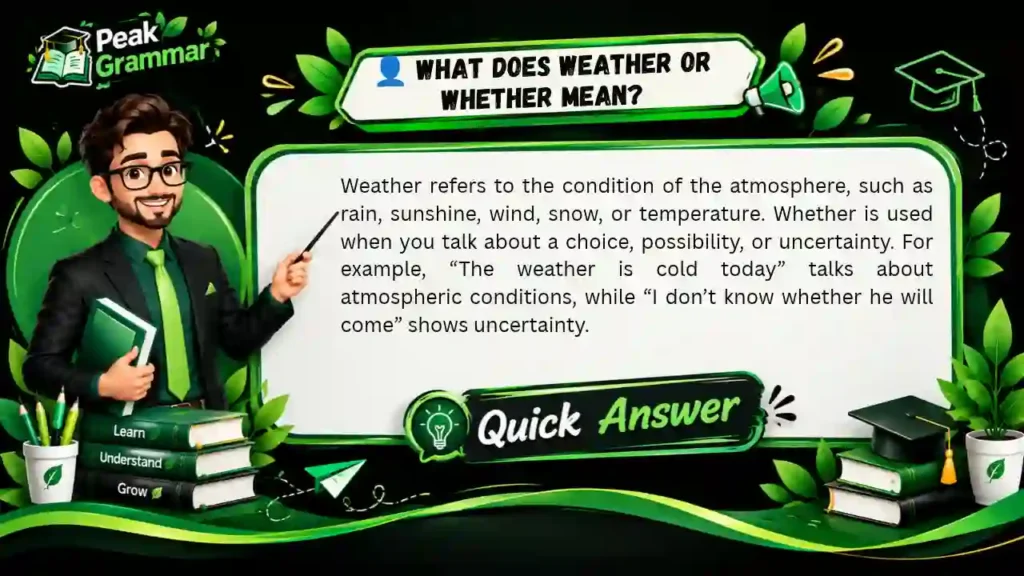
Weather refers to the condition of the atmosphere, such as rain, sunshine, wind, snow, or temperature. Whether is used when you talk about a choice, possibility, or uncertainty. For example, “The weather is cold today” talks about atmospheric conditions, while “I don’t know whether he will come” shows uncertainty.
There is also wether, which is a real English word but has a very different meaning. A wether is a castrated male sheep or goat. So, if you are talking about the sky, use weather. If you are talking about a choice or uncertainty, use whether. 📝
TLDR: Weather, Whether, or Wether? 📌
- 🌦️ Weather = conditions outside, such as rain, wind, and temperature.
- 🤔 Whether = a word used for choices, alternatives, or uncertainty.
- 🐑 Wether = a castrated male sheep or goat.
- ✍️ Weather or whether depends on the meaning of your sentence.
- ❌ “I don’t know weather he will come” is incorrect.
- ✅ “I don’t know whether he will come” is correct.
- 💡 Remember: weather relates to the atmosphere, while whether often relates to a choice.
You Might Also Like That: DWBI Meaning
Weather vs Whether vs Wether: At a Glance 📊
The easiest way to understand these commonly confused words is to compare them side by side. Although weather, whether, and wether sound alike, they do not share the same meaning. Their spelling tells you which word you need in a sentence.
| Word | Meaning | Part of Speech | Example |
| 🌦️ Weather | Conditions in the atmosphere | Noun/Verb | The weather is warm today. |
| 🤔 Whether | Shows a choice or uncertainty | Conjunction | I wonder whether she will come. |
| 🐑 Wether | A castrated male sheep or goat | Noun | The farmer raised a wether. |
What Does Weather Mean? 🌦️
Weather describes what the atmosphere is like at a particular time and place. It can include rain, sunshine, wind, snow, clouds, temperature, and storms. We commonly use the word when talking about daily conditions or checking a weather forecast. For example, “The weather is pleasant today” means the conditions outside feel pleasant.
The word weather can also work as a verb. As a verb, it means to survive, endure, or get through something difficult. For example, “The company weathered the difficult year.” This meaning appears in phrases such as weather the storm, where the storm can refer to a real or difficult situation. 🌧️
Weather as a Noun and Verb 📝
As a noun, weather describes atmospheric conditions: “The weather changed suddenly.” As a verb, weather means to survive or endure something: “She weathered the difficult situation.” Knowing both uses can help you avoid mistakes when writing. The context usually makes the meaning clear.
What Does Whether Mean? 🤔
Whether is mainly a conjunction that introduces a choice, alternative, or uncertainty. You often use it when you are unsure about something or when two possible outcomes exist. For example, “I don’t know whether they will arrive today” shows uncertainty. Another example is, “She asked whether I wanted tea or coffee,” which presents two choices.
You will often see whether or not in English. For example, “We will go whether or not it rains.” You can also use whether before an option: “I need to decide whether to stay.” When you see a sentence about a choice or uncertain answer, whether is usually the word you need. 💡
Whether as a Conjunction 🔎
Whether connects a statement with an alternative or uncertain idea. It can introduce choices such as “whether to stay or leave.” It can also appear in questions and indirect questions. In many cases, you can think of whether as a signal that the writer is considering more than one possible answer.
What Does Wether Mean? 🐑
Wether is a real English word, so it is not simply a spelling mistake. It usually refers to a castrated male sheep, although dictionaries may also use the word for a castrated male goat. You are unlikely to see wether in everyday conversations unless you are reading about farming, animals, or agriculture.
Because wether sounds exactly like weather and whether, people can easily confuse the three words. However, its meaning is completely different. If you are talking about rain or sunshine, do not use wether. If you are talking about a choice, use whether. 📝
Wether vs Weather 🐑🌦️
The difference is simple: wether refers to an animal, while weather refers to atmospheric conditions or the act of enduring something. For example, “The weather is rainy” is correct, but “The wether is rainy” changes the meaning completely.
Weather or Whether: How Can You Tell Which One to Use? 💡
A quick meaning check can help you choose the correct word. If your sentence talks about rain, wind, sunshine, temperature, clouds, or storms, choose weather. If your sentence talks about a choice, possibility, or uncertainty, choose whether. This simple test works in most everyday situations.
You can also look at the words around the blank. Phrases such as “I wonder,” “I don’t know,” “decide,” and “whether or not” often point toward whether. Words connected with outdoor conditions usually point toward weather. 🧠
An Easy Memory Trick 🧩
Think of weather when you look outside and think about the sky. Think of whether when you have to make a choice. For example, “I don’t know whether to go” involves a decision. “I don’t know what the weather will be like” involves outdoor conditions.
Weather vs Whether Examples in Sentences ✍️
Examples make the difference between weather and whether much easier to understand. Compare these sentences: “The weather is getting colder” and “I wonder whether it will snow.” The first sentence describes atmospheric conditions, while the second expresses uncertainty.
Here are more examples:
- 🌦️ “The weather looks beautiful today.”
- 🌧️ “Bad weather delayed the flight.”
- 🤔 “I’m not sure whether she will come.”
- 🤔 “He asked whether I needed help.”
- 📝 “We must decide whether to stay or leave.”
These examples show why the words cannot replace each other.
Whether vs If: Are They Always Interchangeable? 🤔
Whether and if can sometimes express similar ideas, but you should not always treat them as identical. For example, “I don’t know whether he will come” and “I don’t know if he will come” can both work in many situations. However, whether works especially well when you clearly present alternatives.
For example, “I need to decide whether to stay or leave” sounds natural because the sentence presents two choices. You can also use whether or not to show that the result does not depend on the choice. This distinction helps make your writing more precise. ✍️
When Whether Is Better Than If 🔎
Use whether when you want to emphasize alternatives or use a structure such as “whether to go.” For example, “She cannot decide whether to accept the offer.” In these situations, whether clearly shows that the person considers different possibilities.
Common Expressions With Weather and Whether 🌧️
English contains several common expressions that use weather or whether. The most familiar include “under the weather,” “weather the storm,” and “whether or not.” These expressions can confuse learners because the words sound identical when spoken.
“Under the weather” usually means feeling unwell. “Weather the storm” means to survive or endure a difficult period. Meanwhile, whether or not introduces a choice or possibility. Learning these expressions as complete phrases can make them easier to remember and use correctly. 💡
Whether or Not and Weather the Storm 📝
Remember that whether or not relates to a choice or possibility, while weather the storm uses weather as a verb. For example, “We will continue whether or not it rains” is correct. “The team managed to weather the storm” is also correct.
Common Weather vs Whether Mistakes to Avoid ⚠️
One of the most common mistakes occurs when writers use weather instead of whether in sentences about uncertainty. For example, “I don’t know weather he will come” is incorrect because the sentence talks about uncertainty. The correct version is, “I don’t know whether he will come.”
Another common mistake involves the phrase whether or not. Writers sometimes spell it “weather or not” because both words sound the same. However, when you mean a choice or possibility, always use whether. Checking the meaning before choosing the spelling can prevent these mistakes. ✍️
How to Remember Weather vs Whether vs Wether 🧠
Use a simple three-word memory trick. 🌦️ Weather relates to what happens outside, such as rain or sunshine. 🤔 Whether relates to a choice or uncertainty. 🐑 Wether relates to an animal. These three simple connections can help you choose the correct spelling quickly.
You can also remember that weather has an “a,” which can remind you of the atmosphere. For whether, think about which choice you might make. For wether, think about a sheep. These are memory aids rather than strict grammar rules, but they can make the difference easier to remember.
Weather or Whether: Mini Practice Quiz 📝
Test yourself by choosing weather, whether, or wether for each sentence:
- I don’t know ___ she will attend.
- The ___ is sunny today.
- The farmer bought a ___.
- We will go ___ or not it rains.
- They managed to ___ the storm.
Answers:
- whether 🤔
- weather 🌦️
- wether 🐑
- whether 🤔
- weather 🌧️
This quick test can help you check whether you understand the difference.
Good Information: Weather, Whether, and Wether 📚
The three words are easy to confuse because they have the same pronunciation in standard English but different spellings and meanings. Words like these are called homophones. Their sound may be the same, but their meanings and uses are different.
You do not need to memorize complicated grammar rules to use them correctly. Instead, focus on meaning. If you describe the atmosphere, choose weather. If you describe a choice or uncertainty, choose whether. If you mean the animal term, choose wether. 🌟
Collective Data: Key Differences at a Glance 📊
| Feature | 🌦️ Weather | 🤔 Whether | 🐑 Wether |
| Main meaning | Atmospheric conditions | Choice or uncertainty | Castrated male sheep/goat |
| Grammar | Noun/Verb | Conjunction | Noun |
| Common use | Very common | Very common | Uncommon |
| Related phrase | Weather the storm | Whether or not | Wether sheep |
| Example | The weather is cold. | I wonder whether he knows. | The wether is in the field. |
The key point is simple: sound alone cannot tell you which spelling to use. Look at the meaning and role of the word in your sentence.
Frequently Asked Questions ❓
Is it weather or whether? 🌦️🤔
It depends on the meaning. Use weather for atmospheric conditions and whether for choices or uncertainty. For example, “The weather is cold” and “I don’t know whether he will come.”
Is wether a real word? 🐑
Yes. Wether is a real but uncommon word for a castrated male sheep, and it can also refer to a castrated male goat.
Is “weather or not” correct? ❌
When you mean regardless of whether something happens, the correct phrase is “whether or not.” For example, “I will go whether or not it rains.”
Is whether the same as if? 🤔
Sometimes whether and if can have similar meanings, especially in indirect questions. However, whether works better when you clearly present alternatives or use structures such as “whether to stay.”
What does “weather the storm” mean? 🌧️
Weather the storm means to survive or endure a difficult situation. It can describe a real storm or a difficult period in life or business.
What does “under the weather” mean? 🤒
Under the weather is an expression that usually means feeling unwell or sick. It uses weather, not whether.
Conclusion 🌟
The difference between weather, whether, and wether becomes simple once you focus on meaning. Use weather when you talk about atmospheric conditions or surviving a difficult situation. Use whether when you introduce a choice, alternative, or uncertainty. Use wether only when you mean the animal term.
If you remember just three ideas, remember these: 🌦️ weather = atmosphere, 🤔 whether = choice or uncertainty, and 🐑 wether = animal. This simple rule will help you choose the correct word in everyday writing and avoid common spelling mistakes.