

Have you ever wondered how to describe something you will finish before a certain time in the future? The future perfect tense helps you express actions that will be complete by a future deadline. It follows a simple formula: Subject + will have + past participle (V3). For example, “I will have finished my homework by 8 PM.” This means your homework will be complete by that time.
Learning the future perfect tense rules becomes easier when you understand its structure and practice real sentences. In this guide, you’ll discover the future perfect tense meaning, formula, and examples, including positive, negative, and interrogative sentences. You’ll also learn common time expressions, avoid grammar mistakes, and practice with simple exercises.
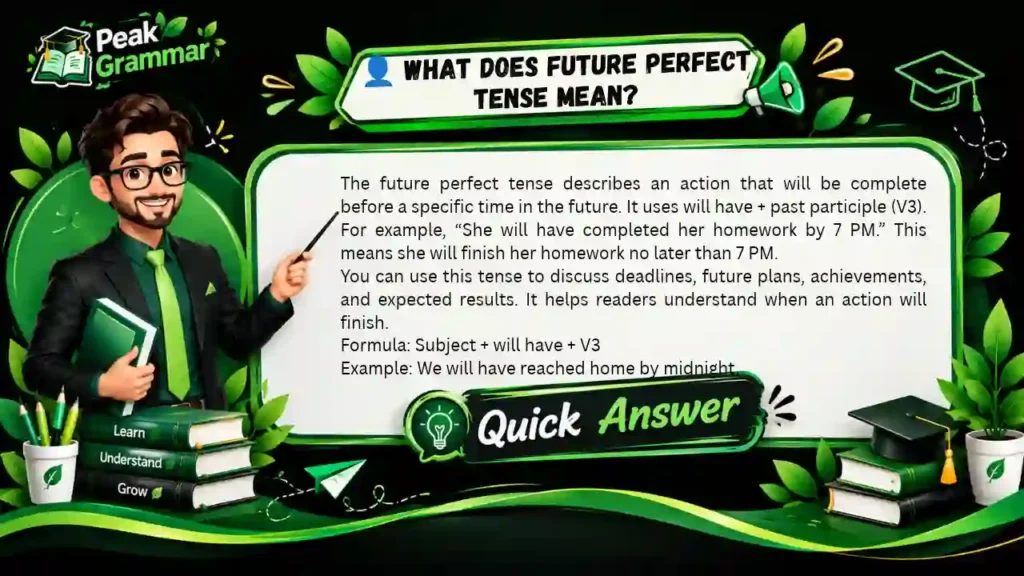
Quick Answer: What Is the Future Perfect Tense? ⚡
The future perfect tense describes an action that will be complete before a specific time in the future. It uses will have + past participle (V3). For example, “She will have completed her homework by 7 PM.” This means she will finish her homework no later than 7 PM.
You can use this tense to discuss deadlines, future plans, achievements, and expected results. It helps readers understand when an action will finish.
Formula: Subject + will have + V3
Example: We will have reached home by midnight.
TL;DR: Future Perfect Tense at a Glance 📌
The future perfect tense helps you explain what someone will have finished by a future time. It uses the same helping verbs with every subject, making the basic structure easy to remember.
Keep these important rules in mind:
- ✅ Formula: Subject + will have + past participle.
- ⏰ Usage: Actions completed before a future deadline.
- ✍️ Positive: I will have finished my work.
- ❌ Negative: I will not have finished my work.
- ❓ Question: Will you have finished your work?
- 📅 Time words: By tomorrow, by Friday, before noon.
- 💡 Remember: Use the past participle, not the simple past.
You Might Also Like That: Sigma Meaning
What Is the Future Perfect Tense? 📖
The future perfect tense is a verb tense that shows an action will be complete by a certain point in the future. It connects a future action with a future deadline. For example, “By next month, I will have saved enough money.”
This sentence tells us that the saving will be complete by next month. The tense focuses on completion, not how long the action takes.
Future Perfect Tense Meaning
The word future points to a later time, while perfect shows completion. Together, they describe an action that will already be complete at a future reference point.
Future Perfect Tense Formula and Structure 📝
The future perfect tense formula is simple: Subject + will have + past participle (V3). Every subject uses will have, including I, you, he, she, it, we, and they. Only the main verb changes.
You can also make negative sentences by adding not after will. For questions, place will before the subject. These three patterns help you form most future perfect sentences correctly.
| Sentence type | Structure | Example |
| ✅ Positive | Subject + will have + V3 | She will have arrived. |
| ❌ Negative | Subject + will not have + V3 | She will not have arrived. |
| ❓ Question | Will + subject + have + V3? | Will she have arrived? |
Understanding the Past Participle
The past participle is the third form of a verb. Examples include go → gone, write → written, and finish → finished. Always use this form after will have.
When Do We Use the Future Perfect Tense? ⏰
We use the future perfect tense when an action will finish before a future deadline or another future event. For example, “I will have completed the report by Monday.” The report will be ready no later than Monday.
This tense also helps us describe expected progress. You might say, “By December, she will have worked here for five years.” This describes a period of work that will reach five years by December.
Common Future Perfect Tense Uses
- 🎯 Completing tasks before deadlines.
- 📅 Describing achievements by a future date.
- 🏠 Talking about expected results.
- ⏳ Describing how long something will have continued by a future point.
How to Identify the Future Perfect Tense 🔍
You can usually identify the future perfect tense by finding will have + past participle in a sentence. For example, “They will have left before dinner.” The words will have left show that the action will be complete before dinner.
However, do not rely only on time expressions. Words such as tomorrow or next week can appear with other future tenses. Always check the verb structure and the meaning of the sentence.
Easy Identification Trick
Look for three parts: will, have, and V3. Then ask, “Will this action be complete by a future time?” If yes, the sentence likely uses the future perfect tense.
Future Perfect Tense Examples 📚
Learning through future perfect tense examples makes the rules easier to understand. These sentences show how people describe future achievements, completed tasks, and deadlines in everyday English.
Read each example and notice the words will have followed by a past participle. Also notice how the time expression tells you when the action will be complete.
10 Easy Future Perfect Tense Examples
- I will have finished breakfast by 8 AM.
- She will have cleaned her room before lunch.
- They will have arrived by Friday.
- We will have completed the project by June.
- He will have learned the lesson by tomorrow.
- You will have received the package by Monday.
- The train will have departed before noon.
- My brother will have bought a car by December.
- The children will have gone to bed by 9 PM.
- I will have read the book by Sunday.
Positive, Negative, and Question Forms ✍️
The future perfect tense structure changes slightly depending on whether you make a statement, express something that will not happen, or ask a question. Positive sentences use will have, while negative sentences use will not have.
Questions begin with will, followed by the subject and have. Understanding these patterns helps you create accurate sentences without memorizing separate formulas for every subject.
Future Perfect Tense Sentence Examples
| Form | Example |
| ✅ Positive | I will have cooked dinner by 7 PM. |
| ✅ Positive | She will have passed the exam by June. |
| ❌ Negative | They will not have finished by noon. |
| ❌ Negative | He won’t have arrived by 6 PM. |
| ❓ Question | Will you have completed the task by Friday? |
| ❓ Question | Will she have returned before dinner? |
WH-Questions and Short Answers ❓
You can use what, when, where, how many, and why to ask more detailed future perfect questions. Place the question word before will, followed by the subject, have, and the past participle.
Short answers usually use will or won’t without repeating the full verb phrase. This keeps conversations natural and easy to follow.
Future Perfect Questions and Answers
| Question | Example answer |
| What will you have finished by noon? | I will have finished my homework. |
| When will she have arrived? | She will have arrived by 6 PM. |
| How many books will you have read? | I will have read five books. |
| Will they have left by 9 PM? | Yes, they will. |
| Will he have completed the task? | No, he won’t. |
Time Expressions: By, Before, and By the Time 📅
Future perfect tense time expressions help readers understand the deadline for an action. Common expressions include by tomorrow, by Friday, before noon, by next year, and by the time.
The word by means no later than a certain time. Before means earlier than that time. By the time connects two events. These small differences matter when you want to describe future completion accurately.
Common Time Expressions
| Expression | Example |
| By tomorrow | I will have finished by tomorrow. |
| By next week | She will have returned by next week. |
| Before noon | We will have eaten before noon. |
| By the time | I will have left by the time you arrive. |
| By 2030 | They will have built the bridge by 2030. |
💡 Grammar tip: After by the time, use the present simple when referring to a future event: “By the time he arrives, we will have finished.”
Regular and Irregular Past Participles 🔤
The past participle (V3) plays an important role in future perfect sentences. Most regular verbs form their past participle by adding -ed. For example, work → worked and clean → cleaned.
Irregular verbs follow different patterns. You must learn forms such as go → gone, write → written, and eat → eaten. Using the wrong verb form creates a grammar mistake, even when the rest of the sentence is correct.
Regular and Irregular Verb Examples
| Base verb | Past participle | Future perfect example |
| Work | Worked | I will have worked. |
| Clean | Cleaned | She will have cleaned. |
| Write | Written | He will have written. |
| Go | Gone | They will have gone. |
| Eat | Eaten | We will have eaten. |
| See | Seen | You will have seen. |
Future Perfect Tense Timeline ⏳
A future perfect tense timeline shows that an action will finish before a later point in the future. Imagine you plan to complete your homework at 5 PM, and your friend will visit at 7 PM.
You can say, “I will have finished my homework by 7 PM.” The sentence looks forward from the present and describes the homework as complete by that future time.
Understanding the Timeline
Now → Finish homework at 5 PM → Friend arrives at 7 PM
- 🕒 Now: The task may still need work.
- ✅ 5 PM: You finish the homework.
- 🎯 7 PM: The homework will already be complete.
The future perfect focuses on the completed result at the later point.
Future Perfect vs Other Future Tenses ⚖️
The future perfect tense focuses on an action that will be complete by a future point. The simple future describes a future action, while the future continuous describes an action in progress at a future time.
The future perfect continuous emphasizes how long an activity will have continued. Learning these differences helps you choose the correct tense and express your meaning clearly.
Future Tense Comparison Table
| Tense | Example | Main focus |
| Simple future | I will study tomorrow. | Future action |
| Future continuous | I will be studying at 8 PM. | Action in progress |
| Future perfect | I will have studied by 8 PM. | Completed action |
| Future perfect continuous | I will have been studying for two hours by 8 PM. | Duration |
For additional grammar explanations, visit Grammarly’s future perfect guide.
Common Mistakes and How to Fix Them ⚠️
Many English learners make mistakes with the future perfect tense formula, especially when choosing past participles. One common error is using the simple past after will have. For example, “She will have went” is incorrect.
Another mistake is using will in a future time clause after by the time. The correct sentence is “By the time she arrives, I will have finished.” Learning these rules helps you write clearer sentences.
Common Future Perfect Tense Errors
| ❌ Incorrect | ✅ Correct |
| I will have went. | I will have gone. |
| She will has finished. | She will have finished. |
| They will have ate. | They will have eaten. |
| Will you has arrived? | Will you have arrived? |
| By the time he will arrive, I will have left. | By the time he arrives, I will have left. |
Future Perfect in Everyday Conversations 💬
People use the future perfect tense in daily life when talking about plans, deadlines, and expected achievements. For example, a student might say, “I will have finished my assignment by tonight.” This sentence tells someone when the work will be complete.
You can also use contractions to sound more natural. I’ll have, she’ll have, and we’ll have are common shortened forms. In negative sentences, won’t have replaces will not have.
Everyday Conversation Examples
At school:
A: Will you have finished your homework by 6 PM?
B: Yes, I’ll have finished it by then.
At work:
A: Will the report be ready tomorrow?
B: Yes, we’ll have completed it by noon.
At home:
A: Will Dad be home before dinner?
B: Yes, he’ll have arrived by 7 PM.
For more grammar patterns, explore EF’s future perfect lesson.
Future Perfect Tense Exercises with Answers 🧠
Practicing future perfect tense exercises helps you remember the structure and choose the correct past participle. Start by identifying the subject, then add will have and the correct V3 form.
Try the questions below before checking the answers. These exercises cover affirmative sentences, negatives, and questions. They also test common irregular verbs.
Multiple-Choice Questions
- She ___ finished by Monday.
A) will has B) will have C) will having
Answer: B - They will have ___ before noon.
A) leave B) leaving C) left
Answer: C - ___ you have completed the work?
A) Will B) Have C) Do
Answer: A - I will have ___ dinner by 8 PM.
A) eat B) eaten C) eating
Answer: B - He ___ have arrived by midnight.
A) won’t B) doesn’t C) hasn’t
Answer: A
Sentence Correction Practice
Correct these five sentences:
- She will have wrote the letter.
- They will has completed the work.
- I will have went home.
- Will she has finished the report?
- By the time he will come, we will have eaten.
Correct answers:
- She will have written the letter.
- They will have completed the work.
- I will have gone home.
- Will she have finished the report?
- By the time he comes, we will have eaten.
For more practice, explore Grammar Monster’s future perfect tense guide.
Frequently Asked Questions About the Future Perfect Tense ❓
The following future perfect tense FAQs answer common questions about sentence structure, usage, examples, and grammar rules. They can help you review the main ideas without reading the entire lesson again.
Each answer uses simple English and a short example. Focus on understanding will have + V3 and the future deadline, because these two ideas explain most future perfect sentences.
1. What is the future perfect tense?
The future perfect tense describes an action that will be complete by a future time. Example: “I will have finished my work by Friday.”
2. What is the future perfect tense formula?
The formula is Subject + will have + past participle (V3). Example: “She will have written the letter.”
3. What are five examples of the future perfect tense?
- I will have eaten by noon.
- She will have arrived by Friday.
- They will have finished by 5 PM.
- We will have left before dinner.
- He will have completed the task by Monday.
4. When should we use the future perfect tense?
Use it when you want to describe an action that will be complete before a future deadline or event.
5. Can we use the future perfect tense without a time expression?
Yes. The future reference point may already be clear from the conversation. For example: “Don’t worry. I’ll have finished.”
6. What is the difference between future perfect and simple future?
The simple future describes a future action. The future perfect emphasizes completion by a future point.
7. What is the negative form of future perfect tense?
Use Subject + will not have + V3. Example: “She will not have finished by noon.”
8. Is “will have been” future perfect?
Yes, will have been can be the future perfect form of be, as in “She will have been a teacher for ten years by June.” However, will have been working uses the future perfect continuous tense.
Final Thoughts 🌟
The future perfect tense helps you describe actions that will be complete by a specific future time. Remember the basic formula: Subject + will have + past participle (V3). This structure works for every subject and helps you create clear positive, negative, and question sentences.
The best way to master this tense is through daily practice. Write sentences about your plans, schoolwork, career goals, and future deadlines. Use expressions such as by tomorrow, before Friday, and by the time. With regular practice, you will become more confident using the future perfect tense in everyday English.