
The past continuous tense describes an action that was happening at a specific time in the past. The basic past continuous tense formula is Subject + was/were + verb-ing. For example, “I was studying at 8 p.m.” shows an ongoing past action, while “She was cooking when the phone rang” shows an action that another event interrupted.
Learning this tense becomes easy when you understand its structure and uses. In this guide, you’ll discover simple past continuous tense examples, positive and negative sentences, question forms, and important grammar rules. You’ll also learn how to use was and were correctly and understand the difference between past simple and past continuous in everyday English.
⚡ Quick Answer: What Is the Past Continuous Tense?
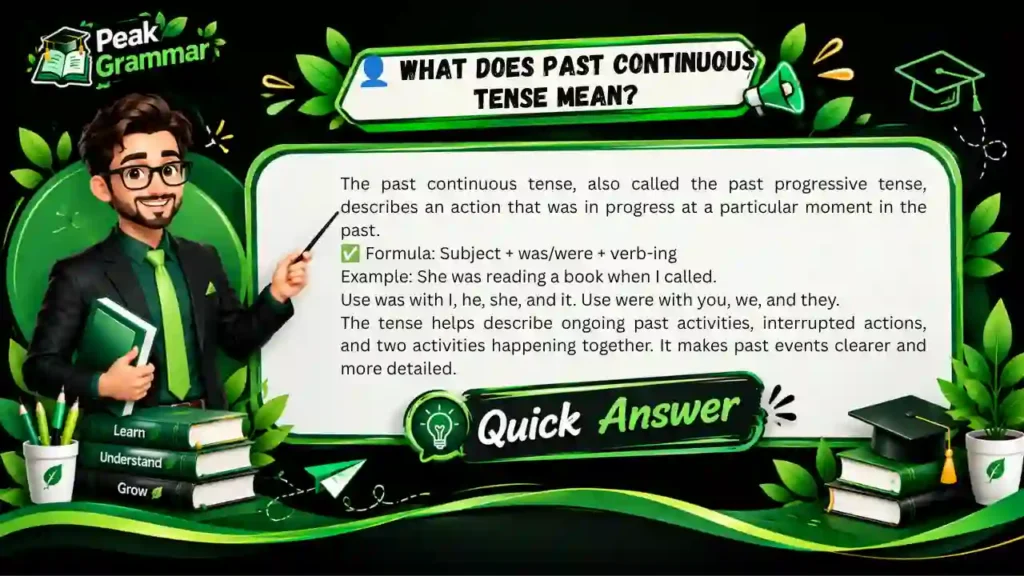
The past continuous tense, also called the past progressive tense, describes an action that was in progress at a particular moment in the past.
✅ Formula: Subject + was/were + verb-ing
Example: She was reading a book when I called.
Use was with I, he, she, and it. Use were with you, we, and they.
The tense helps describe ongoing past activities, interrupted actions, and two activities happening together. It makes past events clearer and more detailed.
📌 TL;DR: Past Continuous Tense at a Glance
The past continuous tense helps explain what someone was doing at a specific time in the past. It uses was or were with the -ing form of a verb.
Remember these simple rules:
- ✅ Positive: I was studying.
- ❌ Negative: I wasn’t studying.
- ❓ Question: Were you studying?
- ⏰ Past action: She was sleeping at midnight.
- 🔄 Interrupted action: I was cooking when he arrived.
- 🔗 Two actions: He was reading while she was writing.
You Might Also Like That: Present Continuous Tense
📘 What Is the Past Continuous Tense?
The past continuous tense meaning is simple: it describes an activity that was happening at a certain point in the past. We use was/were + verb-ing to form this tense.
For example, “They were playing soccer at 5 p.m.” tells us that the game was in progress at that moment.
English speakers also call it the past progressive tense. Both names refer to the same grammar structure. This tense helps readers understand the timing and background of past events.
🧮 Past Continuous Tense Formula and Structure
The past continuous tense formula combines a subject, the helping verb was or were, and the -ing form of the main verb.
The structure changes slightly when you form negative sentences or questions. However, the main verb keeps its -ing ending in each form.
Basic Formula Chart
Use this past continuous tense formula chart to build correct sentences.
| Sentence type | Formula | Example |
| ✅ Positive | Subject + was/were + verb-ing | She was dancing. |
| ❌ Negative | Subject + was/were + not + verb-ing | She wasn’t dancing. |
| ❓ Question | Was/Were + subject + verb-ing? | Was she dancing? |
| 🔎 WH-question | WH-word + was/were + subject + verb-ing? | Why was she dancing? |
You can explore additional structures in EF’s past continuous grammar guide.
✅ How to Use Was and Were in Past Continuous
Choosing between was and were depends on the subject. Use was with singular subjects such as he, she, and it. Use were with plural subjects such as we and they.
The pronoun you always takes were in standard past continuous sentences, whether it refers to one person or several people.
| Subject | Helping verb | Example |
| I | Was | I was working. |
| He / She / It | Was | She was singing. |
| You | Were | You were talking. |
| We | Were | We were studying. |
| They | Were | They were playing. |
Remember this rule when writing past continuous tense sentences.
✍️ Affirmative, Negative, and Interrogative Sentences
The past continuous tense structure changes according to the sentence type. Positive sentences describe an action, negative sentences show that an action was not happening, and questions ask about an ongoing past activity.
These three forms help you communicate clearly in everyday English.
Positive, Negative, and Question Forms
✅ Affirmative: She was preparing dinner. This sentence describes an ongoing activity.
❌ Negative: She was not preparing dinner. Add not after was or were.
❓ Interrogative: Was she preparing dinner? Move the helping verb before the subject.
For negative questions, say, “Wasn’t she preparing dinner?”
❓ How to Make WH-Questions and Short Answers
Past continuous WH-questions begin with words such as what, where, why, when, and how. Place the question word before was or were.
For example, “What were you doing yesterday?” asks about an activity in progress at a past time.
WH-Question Examples
| Question | Short answer |
| What was he doing? | He was reading. |
| Where were they going? | To the park. |
| Were you sleeping? | Yes, I was. |
| Was she cooking? | No, she wasn’t. |
Use was/were, not did, to form standard past continuous questions.
⏰ When Do We Use the Past Continuous Tense?
The main uses of past continuous tense involve actions that were in progress in the past. This tense can describe interrupted activities, simultaneous actions, or background details in a story.
It can also describe repeated behavior, especially with words like always, when the speaker wants to express a feeling about that behavior.
Interrupted Actions
Use past continuous for the ongoing action and simple past for the event that interrupts it. For example, “I was watching TV when the lights went out.” The sentence does not tell us whether the first action resumed.
Two Actions Happening Together
Use past continuous to describe two activities in progress at the same time: “Mom was cooking while Dad was cleaning.”
For more examples, read Grammarly’s explanation of past continuous uses.
🔗 Using When, While, and As in Past Continuous
When, while, and as help connect past events. They show how actions happened in relation to one another.
We often use when before a short event and while before an ongoing action. However, these are common patterns, not fixed rules.
| Connecting word | Example |
| When | I was sleeping when he called. |
| While | She was cooking while I was studying. |
| As | As we were leaving, it started raining. |
💡 Tip: Use the tense that matches the action’s meaning, not just the connecting word.
📚 50 Past Continuous Tense Examples
These past continuous tense examples show how people use the tense in conversations, school, work, and everyday situations.
Notice the combination of was/were + verb-ing in each example. Reading different sentence types helps you understand the rules naturally.
✅ Positive Sentences
- I was reading a book.
- She was making coffee.
- He was watching television.
- We were playing outside.
- They were studying English.
- You were talking loudly.
- The baby was sleeping.
- Dad was washing the car.
- Mom was preparing lunch.
- The children were laughing.
🏫 School and Work Examples
- I was writing an essay.
- She was answering questions.
- They were attending a meeting.
- We were learning grammar.
- He was fixing a computer.
- The teacher was explaining a lesson.
- Students were taking notes.
- My friend was practicing English.
- Workers were repairing the road.
- I was checking my homework.
❌ Negative Sentences
- I wasn’t sleeping.
- She wasn’t crying.
- He wasn’t driving.
- They weren’t shouting.
- We weren’t arguing.
- You weren’t listening.
- The dog wasn’t barking.
- My parents weren’t traveling.
- The children weren’t fighting.
- It wasn’t raining.
❓ Question Examples
- Were you studying?
- Was she singing?
- Were they playing?
- Was he sleeping?
- Were we talking too loudly?
- What were you doing?
- Where was he going?
- Why were they laughing?
- Was your phone ringing?
- Were the students writing?
🔄 When and While Examples
- I was cooking when you arrived.
- She was walking when it started raining.
- He was reading while I was drawing.
- They were sleeping when I called.
- We were eating when the doorbell rang.
- I was driving while she was navigating.
- The birds were singing as the sun rose.
- Mom was cleaning while Dad was cooking.
- I was studying when my friend arrived.
- She was smiling while everyone was singing.
⚖️ Past Simple vs Past Continuous Tense
The simple past tense describes a completed past event. The past continuous tense focuses on an activity that was in progress at a past moment.
Compare “I cooked dinner” with “I was cooking dinner at 6 p.m.” The first reports a completed action. The second focuses on what was happening at that time.
| Past simple | Past continuous |
| She wrote a letter. | She was writing a letter. |
| They played soccer. | They were playing soccer. |
| He watched a movie. | He was watching a movie. |
Choose the tense that communicates your intended meaning.
🔍 Past Continuous vs Past Perfect Continuous
The past continuous describes an action in progress at a past time. The past perfect continuous describes an activity that started before another past point and often emphasizes its duration.
Compare these sentences:
- Past continuous: I was studying at 8 p.m.
- Past perfect continuous: I had been studying for two hours when she arrived.
The first highlights an ongoing activity. The second emphasizes how long the activity had continued before another event.
Both are useful, but they express different time relationships.
⏳ Time Expressions and Signal Words
Past continuous time expressions help show when an activity was happening. Common phrases include at that moment, yesterday evening, at 7 p.m., all morning, and while.
For example, “I was working at 9 a.m.” identifies a particular past time.
Signal words provide clues, but they do not automatically determine the tense. Choose the correct form based on meaning.
The Cambridge past continuous grammar reference explains how past time expressions work in different contexts.
✏️ Spelling Rules for Past Continuous Verbs
To form the present participle, add -ing to the main verb. Some verbs need small spelling changes.
Most verbs simply take -ing, but verbs ending in a silent e usually lose that letter. Some short verbs double their final consonant.
| Spelling rule | Example |
| Add -ing | work → working |
| Drop silent e | make → making |
| Double final consonant | run → running |
| Change ie to y | lie → lying |
✅ Example: She was running in the park.
These spelling rules also apply to other continuous tenses.
🚫 Common Past Continuous Tense Mistakes
Learners often forget was or were, use the wrong helping verb, or leave out the -ing ending.
Another mistake involves stative verbs such as know and believe. These verbs do not normally appear in continuous forms when they describe states.
| ❌ Incorrect | ✅ Correct |
| She were cooking. | She was cooking. |
| I was play. | I was playing. |
| They was running. | They were running. |
| Did you working? | Were you working? |
| I was knowing him. | I knew him. |
For additional grammar practice, see LSI’s past continuous lesson.
🔄 Past Continuous vs Present Continuous
The present continuous tense describes actions happening now or around the present time. The past continuous tense describes actions in progress at a past time.
Both use the -ing form, but their helping verbs differ.
| Present continuous | Past continuous |
| I am eating. | I was eating. |
| She is reading. | She was reading. |
| They are playing. | They were playing. |
💡 Memory trick: Use am/is/are for the present and was/were for the past.
🕒 Past Continuous Timeline and 3-Step Tense Checker
A past continuous timeline helps you imagine an activity happening around a past moment.
For example, “At 7 p.m., I was doing homework” places the activity in progress at 7 p.m.
Visual Timeline
6 p.m. → Homework in progress → 7 p.m. → 8 p.m.
The activity was happening at 7 p.m. The sentence does not tell us exactly when it started or ended.
✅ Three-Step Tense Checker
- Check the time: Does the sentence describe a past moment?
- Check the action: Was the activity in progress?
- Check the formula: Did you use was/were + verb-ing?
📝 Quick Practice Quiz
Choose the correct answers.
- She ___ reading. (was/were)
- They ___ playing. (was/were)
- I was ___ dinner. (cook/cooking)
- ___ he sleeping? (Was/Did)
- We ___ studying. (wasn’t/weren’t)
Answer key: 1. was — singular subject; 2. were — plural subject; 3. cooking — needs -ing; 4. Was — starts a past continuous question; 5. weren’t — agrees with we.
❓ Frequently Asked Questions About Past Continuous
These answers cover common questions about the past continuous tense formula, examples, rules, and correct usage.
Use them as a quick reference when you need help remembering a structure or choosing the correct tense.
What Is the Formula of Past Continuous Tense?
The formula is Subject + was/were + verb-ing. Example: “She was studying.”
What Are 10 Examples of Past Continuous Tense?
Examples include was reading, were playing, was cooking, were studying, was sleeping, were talking, was walking, were singing, was driving, and were working.
When Should We Use Past Continuous Tense?
Use it for actions in progress at a past time, background activities, interrupted actions, and simultaneous events.
Can We Use Did in Past Continuous Questions?
No. Use was or were for standard past continuous questions. For example, “Were you sleeping?”
What Is the Difference Between Past Simple and Past Continuous?
Past simple reports completed past events. Past continuous emphasizes activities in progress at a past moment.
What Are the Signal Words of Past Continuous Tense?
Common clues include while, at that moment, at 8 p.m., yesterday evening, and all morning.
Is Past Progressive the Same as Past Continuous?
Yes. Past progressive and past continuous are two names for the same tense.
🌟 Final Thoughts
The past continuous tense helps you describe actions that were happening at a specific time in the past. Remember the simple formula: Subject + was/were + verb-ing. Use it to explain ongoing activities, interrupted actions, and events happening together.
The best way to learn this tense is through regular practice. Review the past continuous tense examples, write your own positive and negative sentences, and practice asking questions. With time, you’ll use this important English grammar tense more naturally and confidently.