
The present perfect tense connects past actions or experiences to the present. We form it using has or have + past participle (V3). For example, “I have finished my homework” shows a completed action with a result that matters now. We use this tense to describe life experiences, recent actions, and situations that started in the past and continue today.
Learning the present perfect tense rules, formula, and examples helps you speak and write English with confidence. In this guide, you’ll discover how to form positive, negative, and question sentences, use since and for correctly, avoid common mistakes, and practice with easy exercises.
⚡ Quick Answer: What Is the Present Perfect Tense?
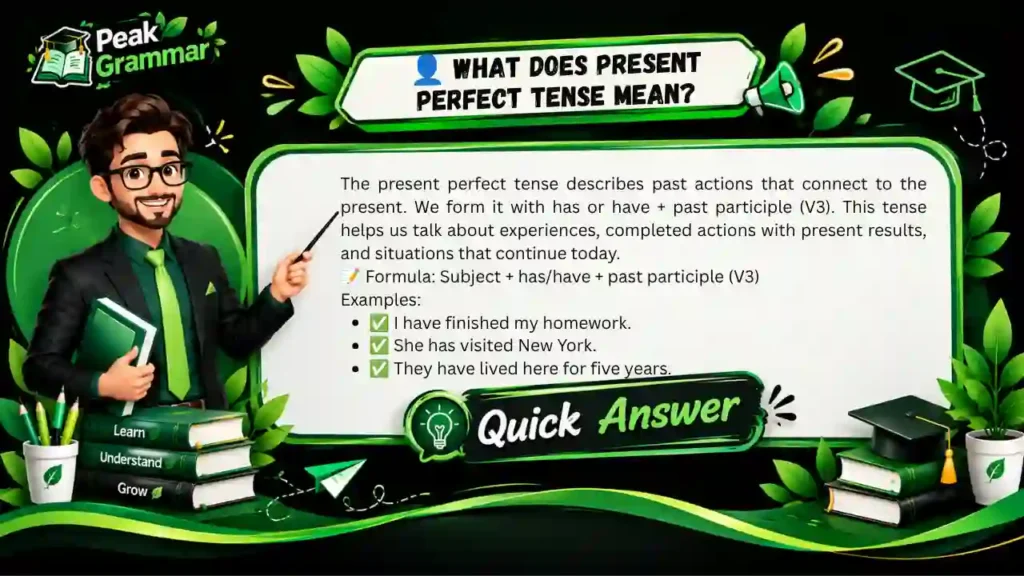
The present perfect tense describes past actions that connect to the present. We form it with has or have + past participle (V3). This tense helps us talk about experiences, completed actions with present results, and situations that continue today.
📝 Formula: Subject + has/have + past participle (V3)
Examples:
- ✅ I have finished my homework.
- ✅ She has visited New York.
- ✅ They have lived here for five years.
💡 Easy Tip: Use has with he, she, and it. Use have with I, you, we, and they.
📌 TL;DR: Present Perfect Tense at a Glance
The present perfect tense connects the past with the present. Here are the most important rules to remember:
- ✅ Formula: Subject + has/have + V3.
- 📘 Positive: She has completed her work.
- ❌ Negative: She has not completed her work.
- ❓ Question: Has she completed her work?
- ⏰ Since: Shows when something started.
- ⏳ For: Shows how long something has continued.
- 🔄 Main uses: Experiences, present results, and continuing situations.
- ⚠️ Common mistake: Avoid using present perfect with finished past times such as yesterday.
You Might Also Like That: Present Tense
📘 What Is the Present Perfect Tense?
The present perfect tense is a verb tense that connects a past action or situation to the present. It often describes something that happened before now without giving an exact past time.
For example, “I have lost my keys” tells us that losing the keys matters now. The speaker may still need to find them. Similarly, “She has worked here since 2020” describes a situation that started in the past and continues today.
The key idea is simple: the past has a connection to the present.
🧩 Present Perfect Tense Formula and Structure
The present perfect tense formula uses a helping verb and the third form of the main verb.
Formula: Subject + has/have + past participle (V3)
| Subject | Helping verb | Example |
| I | Have | I have eaten. |
| You | Have | You have finished. |
| He | Has | He has arrived. |
| She | Has | She has called. |
| It | Has | It has stopped. |
| We | Have | We have learned. |
| They | Have | They have left. |
The past participle often ends in -ed for regular verbs, but irregular verbs use different forms, such as gone, eaten, and written.
✅ Affirmative Sentences
Positive present perfect sentences describe actions or experiences without using not. Use has or have followed by the past participle.
Examples:
- I have cleaned my room.
- She has written a letter.
- We have watched that movie.
- He has bought a new phone.
- They have completed the project.
In everyday English, people often use contractions such as I’ve, you’ve, she’s, he’s, we’ve, and they’ve. These forms make conversations sound natural.
❌ Negative Sentences
To create negative present perfect sentences, add not after has or have.
Formula: Subject + has/have + not + V3
Examples:
- I have not finished dinner.
- She has not called me.
- We have not visited Chicago.
- He has not completed the task.
- They have not arrived yet.
You can also use haven’t instead of have not and hasn’t instead of has not. Both forms express the same meaning.
❓ Questions and Short Answers
To form present perfect tense questions, place has or have before the subject.
Formula: Has/Have + subject + V3 + ?
Examples:
- Have you finished your homework?
- Has she visited London?
- Have they eaten breakfast?
- Has he called his mother?
- Have we met before?
Short answers:
- ✅ Yes, I have.
- ❌ No, I haven’t.
- ✅ Yes, she has.
- ❌ No, she hasn’t.
For Wh-questions, start with words such as what, where, how long, or why.
⏰ When Do We Use the Present Perfect Tense?
We use the present perfect tense when a past event has a meaningful connection to the present. The action may have finished, or the situation may still continue.
For example, “I have broken my glasses” focuses on the present result. Meanwhile, “I have lived here for ten years” describes a situation that continues.
The following four uses explain when to choose this tense.
🌍 Life Experiences
Use the present perfect to describe experiences that happened at an unspecified time before now.
Examples:
- I have visited California.
- She has tried Japanese food.
- We have traveled by train.
- He has never ridden a horse.
You can use ever in questions and never when describing experiences you have not had. The exact date usually does not matter.
🎯 Past Actions With Present Results
Use the present perfect when a completed action affects the current situation.
Examples:
- I have lost my wallet.
- She has broken her phone.
- They have finished the report.
- He has forgotten his password.
Each sentence connects an earlier action with a present result. This use helps explain what has changed or why something matters now.
⏳ Actions That Started in the Past and Continue Now
The present perfect also describes situations that began earlier and still continue.
Examples:
- I have known Sarah for years.
- She has lived here since 2019.
- We have owned this house for a decade.
- He has worked here since January.
Use since for a starting point and for for a length of time. This pattern commonly appears with verbs such as know, live, own, and work.
🔄 Repeated Actions and Unfinished Time Periods
Use the present perfect for repeated actions during a period that continues into the present.
Examples:
- I have called her three times today.
- She has visited twice this month.
- We have practiced every day this week.
- He has watched that movie several times.
Words such as today, this week, this month, and so far can describe unfinished time periods, depending on the context.
📝 50 Present Perfect Tense Examples
These 50 present perfect tense examples show how people use this grammar in everyday English. The sentences include positive statements, negative statements, questions, and common situations.
✅ 15 Positive Sentence Examples
- I have completed my assignment.
- She has cooked dinner.
- They have visited Boston.
- He has cleaned his desk.
- We have learned a new lesson.
- You have improved your English.
- My brother has bought a bicycle.
- The teacher has explained the rule.
- I have read this book.
- She has opened the window.
- They have built a house.
- We have finished our work.
- He has found his keys.
- The children have eaten lunch.
- My parents have traveled abroad.
❌ 10 Negative Sentence Examples
- I haven’t finished my homework.
- She hasn’t answered my message.
- They haven’t arrived yet.
- He hasn’t cleaned his room.
- We haven’t seen that movie.
- You haven’t completed the form.
- My sister hasn’t called today.
- The students haven’t submitted their work.
- I haven’t visited Florida.
- The bus hasn’t arrived yet.
❓ 10 Question Examples
- Have you eaten breakfast?
- Has she finished her homework?
- Have they visited New York?
- Has he called you?
- Have we met before?
- Have you seen my phone?
- Has the teacher arrived?
- Have your parents returned?
- Has she read this book?
- Have they completed the project?
🏠 15 School, Work, and Conversation Examples
- I have studied English for two years.
- She has worked here since 2021.
- We have already submitted the report.
- He has just entered the classroom.
- They have never missed a meeting.
- I have recently started exercising.
- She has prepared the presentation.
- We have known each other for years.
- My friend has moved to Chicago.
- The manager has approved the plan.
- I have learned five new words today.
- She has taken the final exam.
- We have saved enough money.
- He has helped several customers today.
- They have finished their science project.
👥 Has vs. Have: How to Choose the Correct Helping Verb
Choosing between has and have becomes easy when you look at the subject.
Use has with he, she, it, and singular nouns. Use have with I, you, we, they, and plural nouns.
| Use HAS | Use HAVE |
| She has eaten. | I have eaten. |
| He has arrived. | We have arrived. |
| It has stopped. | They have stopped. |
| Emma has called. | The students have called. |
💡 Memory Trick: Remember he, she, it = has. Most other subjects use have.
⏳ Present Perfect With Since and For
The words since and for help explain how long a situation has continued.
Use since with a specific starting point, such as Monday, 2020, or last summer. Use for with a duration, such as two days, five months, or several years.
| Since | For |
| Since Monday | For three days |
| Since 2020 | For six years |
| Since January | For two months |
| Since childhood | For many years |
Examples:
- I have lived here since 2020.
- She has studied English for three years.
🔑 Just, Already, Yet, Ever, and Never in Present Perfect
These present perfect signal words help explain the timing or experience behind an action.
| Word | Meaning | Example |
| Just | Very recently | I have just arrived. |
| Already | Before now or sooner than expected | She has already eaten. |
| Yet | Up to now | Have you finished yet? |
| Ever | At any time | Have you ever traveled abroad? |
| Never | At no time before now | I have never tried sushi. |
💡 Tip: We commonly use yet in questions and negative sentences. We often use ever in experience questions and never to describe experiences we have not had.
⚖️ Present Perfect vs. Simple Past
The present perfect vs. simple past difference mainly concerns how speakers view time and its connection to the present.
Use the simple past for completed events at a finished past time. Use the present perfect when an earlier event connects to now without focusing on a finished time.
| Present perfect | Simple past |
| I have eaten lunch. | I ate lunch at noon. |
| She has visited Paris. | She visited Paris in 2022. |
| We have finished the work. | We finished it yesterday. |
| He has lost his keys. | He lost his keys last night. |
⚠️ Remember: Normally, say “I saw her yesterday,” not “I have seen her yesterday.”
📘 Present Perfect vs. Simple Present
The simple present tense describes habits, routines, facts, and general situations. The present perfect tense connects earlier actions or situations with the present.
Compare these examples:
| Simple present | Present perfect |
| I work here. | I have worked here for five years. |
| She visits her grandmother. | She has visited her grandmother. |
| They play soccer. | They have played soccer today. |
| He reads books. | He has read that book. |
💡 Easy Rule: Use the simple present for regular habits. Use the present perfect when the past-to-present connection matters.
🔄 Present Perfect vs. Present Perfect Continuous
Both tenses connect the past with the present, but they often emphasize different things.
The present perfect can focus on results, experiences, or completed amounts. The present perfect continuous often emphasizes an activity or its duration.
| Present perfect | Present perfect continuous |
| I have written three emails. | I have been writing emails. |
| She has cleaned the kitchen. | She has been cleaning the kitchen. |
| We have studied this topic. | We have been studying this topic. |
💡 Tip: Use have/has been + verb-ing to form the present perfect continuous. Some verbs, such as know, usually take the simple present perfect instead.
✈️ Have Been vs. Have Gone
The expressions have been and have gone can describe travel, but they often communicate different meanings.
Have been to usually means someone visited a place and returned. Have gone to often means someone went somewhere and has not returned yet.
Examples:
- ✅ She has been to London twice.
- ✅ He has gone to London for work.
- ✅ I have been to Canada.
- ✅ My brother has gone to the store.
💡 Memory Trick: Been to = visited and returned. Gone to = went and may still be away.
🇺🇸 How Does Present Perfect Sound in American English?
American English speakers use the present perfect tense regularly, especially when talking about experiences, ongoing situations, and results.
However, Americans also commonly use the simple past with words such as just, already, and yet, where British English may prefer the present perfect.
Examples:
- 🇺🇸 I just finished my homework.
- ✅ I’ve just finished my homework.
- 🇺🇸 Did you eat yet?
- ✅ Have you eaten yet?
Both patterns can sound natural in American English. Choose the form that fits your meaning and situation.
🗣️ How to Ask Natural Present Perfect Questions
You can use present perfect questions to ask about experiences, completed tasks, and ongoing situations.
Start yes/no questions with have or has. For more information, place a question word before the helping verb.
Examples:
- Have you ever visited Texas?
- What have you learned today?
- How long have you lived here?
- Has your friend arrived yet?
💡 Conversation Tip: Follow an experience question with a simple past question when asking about a specific time.
Example: “Have you visited New York?” → “When did you go?”
⚠️ 10 Common Present Perfect Tense Mistakes
Many learners make present perfect tense mistakes because they confuse helping verbs, past participles, and time expressions.
| ❌ Incorrect | ✅ Correct |
| She have finished. | She has finished. |
| I has eaten. | I have eaten. |
| He has went home. | He has gone home. |
| I have saw him. | I have seen him. |
| She has wrote a letter. | She has written a letter. |
| I have visited him yesterday. | I visited him yesterday. |
| Have she arrived? | Has she arrived? |
| He hasn’t ate lunch. | He hasn’t eaten lunch. |
| I have lived here since five years. | I have lived here for five years. |
| She has never went abroad. | She has never gone abroad. |
💡 Tip: Always check the helping verb, past participle, and time expression before finishing your sentence.
🧠 Present Perfect Tense Exercises With Answers
Practice these present perfect tense exercises to check your understanding.
✍️ Fill in the Blanks
- She ___ finished her homework.
- I ___ visited California.
- They have ___ (eat) dinner.
- He has ___ (write) a letter.
- We have lived here ___ 2021.
❓ Choose the Correct Answer
- She (has/have) completed the task.
- I have (saw/seen) that movie.
- They (has/have) arrived.
- He has worked here (since/for) three years.
- Have you ever (went/gone) skiing?
✅ Answer Key
| Question | Answer |
| 1 | has |
| 2 | have |
| 3 | eaten |
| 4 | written |
| 5 | since |
| 6 | has |
| 7 | seen |
| 8 | have |
| 9 | for |
| 10 | gone |
💡 Remember: Use has/have + V3, since for a starting point, and for for a duration.
❓ Frequently Asked Questions About Present Perfect Tense
What is the present perfect tense in simple words?
The present perfect tense connects a past action or situation to the present. For example, “I have finished my homework” shows a completed action that matters now.
What is the formula for present perfect tense?
The formula is Subject + has/have + past participle (V3). Example: “She has written a letter.”
What are five examples of present perfect tense?
“I have eaten,” “She has arrived,” “We have finished,” “He has called,” and “They have left” are five correct examples.
When should I use present perfect tense?
Use it for life experiences, past actions with present results, continuing situations, and repeated actions during unfinished time periods.
Can I use yesterday with present perfect?
Normally, no. Yesterday refers to a finished past time. Say “I saw him yesterday” instead of “I have seen him yesterday.”
What is the difference between since and for?
Since introduces a starting point, while for introduces a duration. Example: “since Monday” versus “for three days.”
How do I identify present perfect tense?
Look for has or have + past participle. Then check whether the sentence connects an earlier event or situation to the present.
Is present perfect the same as simple past?
No. Simple past describes past events, often at finished times. Present perfect connects earlier actions or situations to now.
🎯 Present Perfect Tense Cheat Sheet
Use this quick present perfect tense chart whenever you need to review the rules.
| Grammar point | Easy rule |
| Formula | Subject + has/have + V3 |
| Positive | She has finished. |
| Negative | She hasn’t finished. |
| Question | Has she finished? |
| Since | Starting point |
| For | Duration |
| Ever | Experience question |
| Never | No experience before now |
| Already | Earlier than expected |
| Yet | Up to now |
| Just | Very recently |
🧠 Memory Trick: Think Past + Present Connection = Present Perfect.
🌟 Final Thoughts
The present perfect tense becomes easier when you understand its main purpose: connecting the past with the present. Remember the basic formula, has/have + past participle, and practice using it for experiences, present results, and continuing situations.
Start with short sentences, learn common irregular verbs, and compare the present perfect with the simple past. Pay special attention to since, for, already, yet, ever, and never.
With regular practice, you can use the present perfect tense more naturally and confidently in everyday English conversations and writing.