Finding the right words to describe happiness can make your writing feel more colorful, warm, and memorable. Instead of simply saying someone is happy, you can use similes for being happy to create a clear picture of their feelings. A good comparison can show joy, excitement, peace, or even extreme happiness in a way readers can easily imagine.
In this guide, you’ll discover the best similes for being happy, from simple and beautiful comparisons to creative and funny examples. You’ll also find useful words for happy, along with meanings and examples, so you can choose the perfect expression for stories, essays, poems, conversations, or everyday writing.
Quick Answer
A good simile for happy compares happiness to something bright, exciting, peaceful, or enjoyable. For example, you can say someone is “as happy as a child on Christmas morning” when they feel extremely excited.
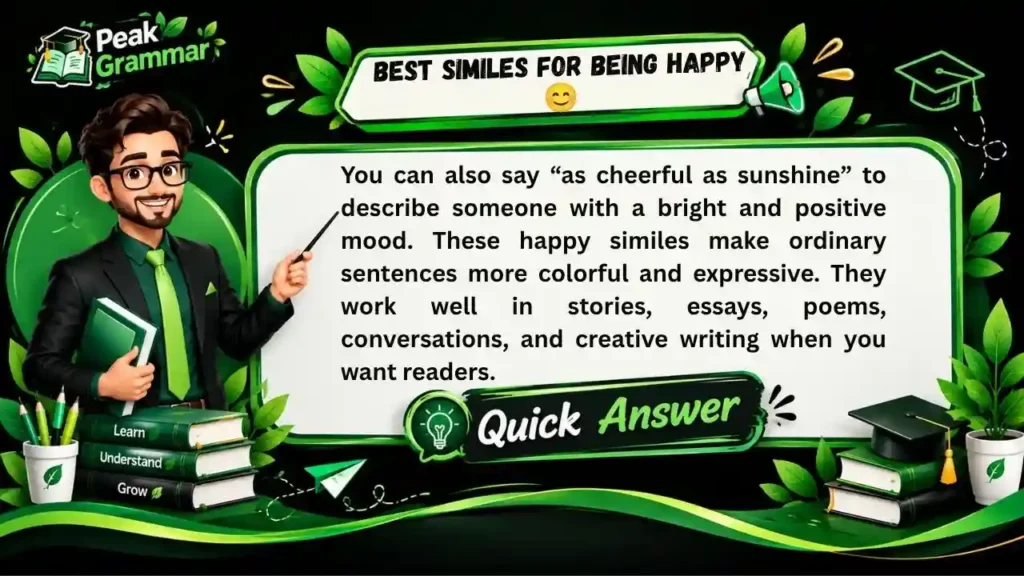
You can also say “as cheerful as sunshine” to describe someone with a bright and positive mood. These happy similes make ordinary sentences more colorful and expressive. They work well in stories, essays, poems, conversations, and creative writing when you want readers to clearly imagine a person’s feelings.
TL;DR
- Similes for being happy help readers picture happiness instead of simply reading the word “happy.”
- Popular comparisons include as happy as sunshine, as happy as a child, and as free as a bird.
- Use beautiful similes for happiness when writing poems, stories, captions, or emotional descriptions.
- Use creative happy similes to make your writing more original and memorable.
- Funny similes for being happy work well in casual writing, texts, and social media.
- For strong emotions, use similes for extreme happiness such as comparisons with fireworks, celebrations, or winning.
- Useful words for happy include joyful, cheerful, delighted, thrilled, blissful, elated, and ecstatic.
- You can use happy similes in essays, stories, poems, speeches, captions, and everyday writing.
- A simile normally uses “like” or “as,” while a metaphor makes a direct comparison.
- The strongest descriptions show happiness through smiles, actions, body language, and dialogue instead of repeating “happy.”
- Always match the simile to the type and strength of happiness you want to describe.
- Keep your comparisons simple, natural, and easy to understand.
You Might Also Like That: FOMO Meaning
Best Similes for Being Happy
The best similes for being happy help readers see or feel the emotion instead of simply reading the word “happy.” A strong comparison connects happiness with something familiar, such as sunshine, music, flowers, celebration, or freedom. For example, “She was as happy as sunshine after a rainy day” shows a bright feeling after a difficult time. Similarly, “He was as happy as a kid in a candy store” shows strong excitement and pleasure.
Here are some useful similes for happiness you can use in different situations: ✨
- As happy as a child on Christmas morning 🎁 — extremely excited
- As cheerful as sunshine ☀️ — bright and positive
- As happy as a bird singing in spring 🐦 — carefree and joyful
- As joyful as a child at a birthday party 🎂 — full of excitement
- As free as a bird 🕊️ — happy because of freedom
- As bright as a rainbow 🌈 — full of positive energy
- As happy as a butterfly in a garden 🦋 — peaceful and delighted
Simple Similes for Being Happy
Sometimes, the best similes for being happy are the easiest ones. Simple comparisons work especially well for students, everyday conversations, and basic creative writing. You do not need complicated vocabulary to express a strong emotion. A familiar image can make a sentence clear and memorable. For example, “She smiled like sunshine” quickly creates a warm picture in the reader’s mind.
Try these easy comparisons when you want simple happy similes:
- As happy as sunshine
- As cheerful as a singing bird
- As joyful as spring flowers
- As happy as a child with a new toy
- As bright as a rainbow
- As light as a feather
- As happy as someone hearing good news
These examples use everyday images, so readers can understand them quickly.
Beautiful Similes for Happiness
Beautiful similes for happiness often use nature, light, colors, and peaceful moments.These comparisons work well when you want your writing to sound warm and emotional without using difficult words. A sentence such as “Her happiness was like sunlight filling a dark room” creates a gentle image of hope and joy. You can use this style in poems, stories, personal essays, or emotional descriptions.
Here are a few beautiful similes for being happy:
- As warm as morning sunshine
- As bright as a summer morning
- As colorful as a rainbow
- As fresh as flowers in spring
- As peaceful as a quiet garden
- As free as a butterfly in the sky
- As bright as stars on a clear night
These comparisons give happiness a soft and beautiful feeling.
Creative Similes for Being Happy
Creative writing needs comparisons that feel fresh and natural. Creative similes for being happy can connect joy with unusual but easy-to-understand experiences. Instead of always comparing happiness with sunshine, you can use music, dancing, flying, surprises, or dreams coming true. 🎶 This approach helps your writing feel more personal and gives readers a stronger emotional picture.
Try these creative similes for happiness:
- As happy as a song that makes you dance
- As joyful as finding a forgotten gift
- As excited as a kite catching the wind
- As happy as a dream finally coming true
- As cheerful as music on a sunny morning.
- As delighted as a child discovering a new playground
These examples can make stories and personal writing feel more lively.
Funny Similes for Being Happy
Funny happy similes can make casual writing, conversations, and social posts more playful. They work best when the comparison feels familiar and slightly exaggerated. For example, saying someone is “as happy as a kid in a candy store” shows excitement in a fun way. You can also create your own humorous comparisons by connecting happiness with food, holidays, gifts, games, or unexpected good luck.
Here are some playful examples:
- As happy as a kid in a candy store
- As happy as a dog seeing its favorite person
- As excited as someone finding money in an old jacket
- As happy as a student hearing that class is canceled
- As cheerful as someone opening a surprise gift
- As excited as a fan watching their team win
You Might Also Like That: SMH Meaning
Similes for Extreme Happiness
Sometimes ordinary words like happy do not show enough emotion. When someone feels extremely happy, use stronger similes for extreme happiness to show excitement, surprise, or overwhelming joy. 🎉 For example, “She was as excited as someone winning their dream prize” shows much stronger emotion than simply saying she felt happy.
You can use these comparisons for major achievements, celebrations, wonderful news, or special moments:
- As excited as someone winning the biggest prize
- As happy as a child on the best day ever
- As joyful as fireworks lighting the night skys
- As thrilled as someone receiving their dream gift
- As delighted as someone hearing wonderful news
- As happy as being on top of the world
These expressions work especially well when describing strong joy and excitement.
Similes for a Happy Person
When you describe a happy person, focus on more than the word “happy.” Show their smile, eyes, voice, movement, and energy. 👀 A person might shine like the morning sun, laugh like a child, or move like someone who has just received wonderful news. These descriptions help readers understand the person’s mood through their actions.
You can write:
- Her smile was as bright as sunshine.
- His eyes sparkled like stars.
- She laughed like a child enjoying a favorite game.
- He moved as lightly as a feather.
- She was as cheerful as a bird in spring.
These similes to describe someone who is happy work well in stories and character descriptions
Similes for Different Types of Happiness
Not all happiness feels the same. Someone can feel peaceful, excited, proud, relieved, romantic, or carefree. 🌿 Choosing a simile that matches the exact feeling can make your writing much stronger. A calm person might feel “as peaceful as a quiet lake,” while someone celebrating a major success might feel “as excited as fireworks.” 🎆
| Type of happiness 😊 | Useful comparison |
| Peaceful joy 🌿 | As calm as a quiet lake |
| Childlike joy 🎈 | As happy as a child with a new toy |
| Excitement 🎉 | As bright as fireworks |
| Freedom 🕊️ | As free as a bird |
| Relief 😌 | As light as a feather |
| Romantic happiness ❤️ | As warm as a loving embrace |
| Success 🏆 | As joyful as winning a dream prize |
Words for Happy: Synonyms and Alternatives
If you want different words for happy, you have many choices. The best word depends on the strength and type of emotion. 😊 For mild happiness, use glad, pleased, content, or satisfied. For stronger feelings, choose joyful, cheerful, delighted, thrilled, or overjoyed. For very powerful happiness, words such as elated, blissful, ecstatic, and euphoric work better. These alternatives can prevent your writing from repeating the word “happy” too often.
Here are useful synonyms for happy:
- 😊 Glad — feeling pleased
- 🌷 Joyful — feeling strong joy
- ☀️ Cheerful — showing a bright mood
- 😄 Delighted — very pleased
- 🎉 Thrilled — extremely excited
- 💖 Blissful — deeply peaceful and happy
- 🏆 Elated — extremely happy and excited
- 🤩 Ecstatic — feeling overwhelming happiness
Stronger Words for Extremely Happy
When someone feels extremely happy, ordinary vocabulary may not fully express the emotion. Strong words can make your writing more accurate and powerful. 💥 For example, delighted suggests strong pleasure, while elated suggests a very high level of happiness. Ecstatic describes an even more intense feeling. Choosing the right word helps readers understand exactly how the person feels.
Use this simple scale:
- 🙂 Pleased — mildly happy
- 😊 Cheerful — happy and positive
- 😄 Delighted — very pleased
- 🎉 Thrilled — highly excited
- 🥰 Blissful — deeply happy and peaceful
- 🤩 Elated — extremely happy
- 🔥 Ecstatic — overwhelmingly happy
You Might Also Like That: HU Meaning in Text
How to Choose the Right Simile for Happiness
The right simile for happiness should match the situation, emotion, and audience. First, decide how strong the feeling is. A calm moment may need a peaceful comparison, while a huge celebration needs something more energetic. 🌿 Next, think about your reader. Simple comparisons work well for students, while creative or poetic images may suit stories and poems better.
Before choosing a simile, ask yourself:
- 🎯 Does it match the emotion?
- ✍️ Does it sound natural in the sentence?
- 👥 Will my audience understand it?
- 🌈 Does the image fit the situation?
- 💡 Does it add something instead of repeating the same idea?
How to Use Happy Similes in Writing
Happy similes can improve many types of writing when you use them naturally. In a story, they can reveal a character’s feelings. 📖 In an essay, they can make a description more interesting. In poetry, they can create a strong emotional image. You can also use short comparisons in captions and personal posts. However, avoid placing too many similes in one paragraph because they can make your writing feel crowded.
For example, instead of writing “Sara was very happy,” you could write, “Sara was as happy as sunshine after a rainy morning.” ☀️ This gives the reader a clearer image while keeping the sentence simple.
Common Mistakes When Using Happy Similes
Using similes for happiness is easy, but a few mistakes can weaken your writing. One common problem involves using a comparison that does not match the emotion. For example, a peaceful scene does not need an image connected with loud fireworks. 🎆 Another mistake involves using too many comparisons in a short space. Good writing gives each strong image room to work.
Avoid these mistakes:
- 🚫 Forcing a simile into a sentence
- 🔁 Repeating the same comparison too often
- ❌ Using confusing or unrelated images
- 📚 Making simple ideas unnecessarily complicated
- ⚠️ Mixing several figurative expressions at once
Keep your comparisons clear, natural, and useful.
Simile vs Metaphor for Happiness
A simile and a metaphor both compare ideas, but they work differently. A simile usually uses words such as “like” or “as” to make the comparison clear. For example, “She was as happy as sunshine.” ☀️ A metaphor makes the comparison more direct, such as “She was sunshine.” Both forms can describe happiness, but a simile often feels easier for beginners because it clearly shows the comparison.
For quick reference:
| Simile 😊 | Metaphor ✨ |
| Uses like or as | Makes a direct comparison |
| “He was as happy as a bird.” | “He was a bird of joy.” |
| Easy to understand | Often more poetic |
How to Show Happiness Instead of Just Saying “Happy”
Strong writing does not always need the word happy. You can show the emotion through a person’s actions, expressions, words, and body language. 😊 Someone might smile widely, laugh freely, jump with excitement, speak quickly, or look brighter than usual. These details help readers experience the emotion instead of simply being told about it.
Try using:
- 😄 Facial expressions: a wide smile or sparkling eyes
- 🎉 Actions: jumping, dancing, laughing, or clapping
- 🗣️ Dialogue: excited or cheerful words
- ❤️ Body language: relaxed and energetic movement
- 🌈 Imagery: sunshine, flowers, music, or bright colors
This technique makes descriptions feel more natural and human.
You Might Also Like That: FRFR Meaning
Frequently Asked Questions
What is a good simile for happy?
A simple choice is “as happy as a child on Christmas morning.” It clearly shows excitement and strong joy.
What is a simile for being extremely happy?
You can say “as joyful as fireworks lighting the sky.” 🎆 This comparison suggests powerful excitement and celebration.
What can happiness be compared to?
You can compare happiness to sunshine, flowers, music, birds, butterflies, rainbows, celebrations, or childhood excitement.
What are some beautiful words for happy?
Some beautiful words include joyful, blissful, cheerful, delighted, radiant, content, and overjoyed.
How do you describe a happy person in writing?
Show their happiness through smiles, bright eyes, laughter, energetic movement, cheerful speech, and positive actions instead of repeatedly using the word “happy.”
What is the difference between a simile and a metaphor?
A simile makes a comparison using words such as “like” or “as,” while a metaphor makes a direct comparison.
Conclusion
The best similes for being happy make feelings easier to picture and more enjoyable to read. Whether you need a simple comparison for a school assignment, a beautiful phrase for a poem, or a creative description for a story, the right simile can make your writing more expressive. You can compare happiness with sunshine, flowers, birds, butterflies, celebrations, music, and many other familiar things.
You can also replace repeated uses of happy with stronger words for happy, such as cheerful, joyful, delighted, thrilled, blissful, elated, and ecstatic. The key is to choose words and comparisons that match the feeling. Keep your writing simple, natural, and clear, and let your descriptions show readers exactly what happiness looks and feels like.