Have you ever seen someone text “I have major FOMO 😭”, post “FOMO is real tonight”, or comment “Don’t give me FOMO!” and wondered what they actually mean? 🤔 You are not alone. FOMO meaning is a common search because the abbreviation appears everywhere—from text messages and group chats to TikTok, Instagram, Snapchat, memes, gaming, shopping, and everyday conversations.
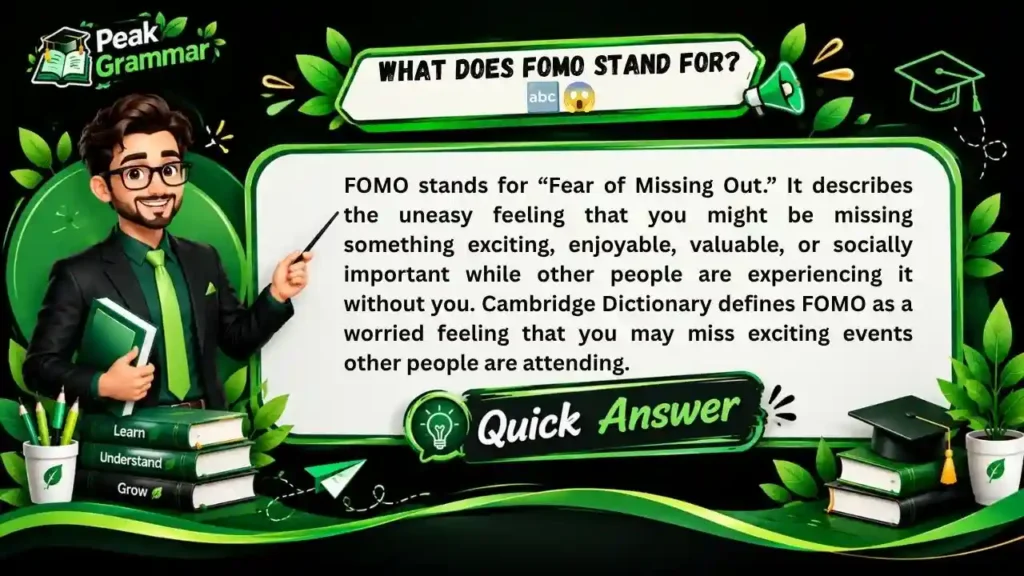
FOMO stands for “Fear of Missing Out.” It describes the uneasy feeling that you might be missing something exciting, enjoyable, valuable, or socially important while other people are experiencing it without you. Cambridge Dictionary defines FOMO as a worried feeling that you may miss exciting events other people are attending, particularly when social media triggers that feeling.
In casual internet language, however, FOMO meaning slang is not always extremely serious. Someone can say “I have FOMO” because their friends are at a party, because they skipped a concert, because everyone is watching a trending show, or even because a popular product might sell out. The context tells you how strong the feeling really is. 👀🔥
Quick Answer ⚡📌
FOMO means “Fear of Missing Out.” It describes the worry, anxiety, curiosity, regret, or uncomfortable feeling that you may be missing something good while other people are enjoying or experiencing it.
For example:
“Everyone is going to the concert tonight. I have serious FOMO 😭.”
This means:
“I wish I could go because I feel like I’m missing something exciting.”
In texting and social media, FOMO can refer to missing a party, event, trend, opportunity, conversation, trip, relationship moment, game, sale, or anything else that feels important or exciting.
It can also be used jokingly:
“I wasn’t even planning to buy these shoes, but now I have FOMO 😂.”
Here, the person is saying they feel pressure to buy the shoes because everyone else seems to have them.
TL;DR 📱🔥
- 😱 FOMO stands for Fear of Missing Out.
- 🧠 It means worrying that you are missing something others are enjoying or experiencing.
- 💬 FOMO meaning in text is usually the same basic meaning.
- 📱 Social media can make FOMO stronger by constantly showing what other people are doing.
- 🎉 FOMO can happen when you miss parties, trips, concerts, events, or gatherings.
- 👀 It can also involve trends, products, opportunities, games, shows, or online conversations.
- 😂 “I have FOMO” can be serious or completely playful.
- 😭 “Major FOMO” usually means a strong feeling of being left out or missing something.
- 🔥 “Don’t give me FOMO” means “Don’t make me wish I were there.”
- 💭 FOMO is not exactly the same as jealousy, although the feelings can overlap.
- 📸 Social media can trigger FOMO through constant exposure to other people’s experiences.
- 🧩 Context determines whether FOMO is being used seriously, casually, humorously, or sarcastically.
- 🌿 JOMO means “Joy of Missing Out” and is commonly described as the opposite of FOMO.
- ⚠️ FOMO is a common human feeling, but persistent or intense FOMO can become connected with problematic social-media use and reduced well-being
You Might Also Like That: FRFR Meaning
What Does FOMO Stand For? 🔤😱
FOMO stands for “Fear of Missing Out.”
The phrase describes a feeling that something interesting, rewarding, exciting, or socially important is happening somewhere else and you are not part of it.
Oxford describes FOMO as a feeling of worry that an interesting or exciting event is happening somewhere else.
For example:
“My friends are all going to the beach, and I’m stuck at home. Total FOMO.” 🌊😭
The person may not literally be afraid in the traditional sense. Fear here can mean an emotional concern that they are missing an experience they would rather be having.
That is why FOMO can involve several feelings at once:
- 😟 Worry
- 😭 Regret
- 👀 Curiosity
- 😬 Anxiety
- 💭 Envy
- 🎉 Excitement
- 🧠 Social pressure
- ❤️ Desire to belong
The exact emotion depends on the situation.
What Does FOMO Mean in Text? 💬📱
When someone uses FOMO in a text, they usually mean that they feel they are missing out on something other people are doing, enjoying, or experiencing.
For example:
Friend: “We’re all going out tonight!”
You: “Ugh, I have work. FOMO 😭”
Here, FOMO means:
“I wish I could join because I feel like I’m missing something fun.”
Another example:
“Seeing everyone’s vacation pictures is giving me FOMO.” ✈️📸
This means the pictures are making the person wish they were also on vacation.
Unlike some abbreviations, FOMO usually keeps the same basic meaning across texting platforms. Whether it appears in WhatsApp, Instagram DMs, Snapchat, Discord, Messenger, or a group chat, it generally refers to the fear or feeling of missing out. Current slang explainers also note that the context can range from social events to trends, shopping, opportunities, and online activities.
What Does FOMO Mean in Slang? 🔥🗣️
FOMO meaning slang is essentially the fear or uncomfortable feeling of being left out of something other people are experiencing.
The word has become casual enough that people often use it without describing serious anxiety.
For example:
“I bought the tickets because of FOMO 😂.”
This could simply mean:
“Everyone else was going, so I didn’t want to miss it.”
Another example:
“Don’t post pictures from the party. You’re giving me FOMO 😭.”
This does not necessarily mean the person is experiencing severe distress. It may simply be a humorous way of saying:
“I wish I were there too.”
So when you see FOMO meaning slang, remember that the word can describe anything from mild playful regret to a stronger emotional concern.
What Does “I Have FOMO” Mean? 👀💬
When someone says:
“I have FOMO.”
they usually mean:
“I feel like I’m missing out on something other people are enjoying.”
The missing experience could be almost anything.
Social Event FOMO 🎉
“Everyone went to the party without me. I have FOMO.”
Travel FOMO ✈️🌴
“My friends are traveling this weekend and I’m staying home. Major FOMO.”
Concert FOMO 🎵
“I couldn’t get concert tickets. I’m already getting FOMO.”
Food FOMO 🍕😂
“Everyone ordered the new burger, so now I have FOMO.”
Shopping FOMO 🛍️
“It’s almost sold out. I’m getting FOMO.”
Trend FOMO 📱🔥
“Everyone is watching this series. I don’t want to miss it.”
The key idea is always not wanting to miss something perceived as valuable, enjoyable, exciting, or socially important.
You Might Also Like That: Discreet vs Discrete
What Does “Major FOMO” Mean? 😭🔥
“Major FOMO” means a strong feeling of missing out.
For example:
“Everyone is at the festival right now. Major FOMO 😭.”
The person is emphasizing that they strongly wish they could be there.
Other common expressions include:
- Major FOMO 😭
- Serious FOMO 😩
- Getting FOMO 👀
- FOMO is real 😂
- FOMO kicking in 🔥
- Total FOMO 💀
- Don’t give me FOMO 😭
- I have bad FOMO 😩
These phrases do not create completely different definitions. They simply change the intensity or tone.
What Does “FOMO Is Real” Mean? 😂📱
When someone says:
“FOMO is real.”
they are usually acknowledging that they genuinely feel like they are missing something.
For example:
“Everyone posted pictures from the wedding. FOMO is real 😭.”
This means:
“Seeing all those pictures really makes me wish I had been there.”
Online, this phrase is often playful rather than deeply serious.
The surrounding emoji can provide an important clue:
“FOMO is real 😭” → emotional or dramatic
“FOMO is real 😂” → humorous
“FOMO is real 👀” → curious or tempted
“FOMO is real 🔥” → excited about the experience
What Does “Don’t Give Me FOMO” Mean? 😭👀
“Don’t give me FOMO” means:
“Don’t show or tell me things that will make me wish I had joined you.”
For example:
Friend: “We’re at the beach and the sunset is incredible 🌅.”
You: “Stop! Don’t give me FOMO 😭.”
The speaker probably wishes they were there.
This expression is common on social media because photos and videos can make people feel as though they are watching other people experience something they are missing.
FOMO on Social Media 📸📱
Social media is one of the most familiar places where FOMO appears.
You might see:
“Everyone is at the concert except me. FOMO 😭.”
Or:
“Seeing everyone’s vacation posts is giving me major FOMO.”
Platforms such as Instagram and TikTok make it easy to see carefully selected moments from other people’s lives. Research has linked FOMO with social-media engagement, while reviews describe the phenomenon as involving the perception that others are having rewarding experiences and the desire to remain connected to what they are doing.
This does not mean every person who uses Instagram or TikTok experiences harmful FOMO. Social media can also help people connect, share experiences, and maintain relationships.
The important point is that constant visibility can make comparison easier.
FOMO on TikTok 🎵📱
On TikTok, FOMO can appear in captions, comments, videos, and conversations.
Examples include:
“Everyone is doing this trend. I have FOMO 😭.”
“Don’t let TikTok give you FOMO.”
“Seeing everyone travel here gave me serious FOMO.”
TikTok can create a fast-moving environment where trends, challenges, events, products, sounds, and experiences appear and disappear quickly.
That can create the feeling:
“If I don’t do this now, I’ll miss it.” ⏳🔥
This is one reason FOMO meaning slang has expanded beyond parties and social events. Modern usage can involve almost anything that feels temporary, popular, exclusive, or socially valuable.
You Might Also Like That: EYP Meaning in Text
FOMO on Instagram 📸✨
On Instagram, FOMO often appears around:
- ✈️ Travel
- 🎉 Parties
- 💍 Weddings
- 🎵 Concerts
- 🍽️ Restaurants
- 🛍️ Shopping
- 👯 Friend groups
- 🌴 Vacations
- 📸 Events
- 💼 Career opportunities
For example:
“Everyone’s in Dubai this weekend and I’m getting serious FOMO.” ✈️😭
Or:
“These stories are giving me FOMO.”
The person is reacting to what they see other people doing.
FOMO in Group Chats 👥💬
Group chats can create a particularly obvious form of FOMO.
Imagine you open your phone and see:
“We’re going out at 8.”
Then:
“Who’s coming?”
Then:
“Everyone’s here 😂🔥.”
If you were not invited or cannot attend, you might reply:
“Wow, major FOMO 😭.”
Here, FOMO communicates more than simple sadness. It can suggest:
“I wish I were there.”
“I feel left out.”
“You guys are having fun without me.”
“I don’t want to miss this.”
The exact shade depends on the relationship between the people.
Is FOMO Always Negative? 🤔🧠
Not necessarily.
The word fear sounds strongly negative, but everyday FOMO can be very mild.
For example:
“I have FOMO because I can’t try the new restaurant tonight.” 🍔😂
This might simply mean:
“I wish I could go too.”
However, FOMO can become more emotionally significant when it repeatedly causes anxiety, compulsive checking, social comparison, or difficulty being satisfied with your own choices. Research has connected FOMO with social-media engagement and lower mood or life satisfaction, although the relationship is more complex than simply saying “social media causes FOMO.”
That distinction is important because internet slang and psychological concepts are not always identical in intensity.
FOMO vs Jealousy vs Envy 🧠🔍
These words can overlap, but they are not exact synonyms.
| Term | Basic idea | Example |
| 😱 FOMO | Fear of missing an experience | “I wish I were at the concert.” |
| 💚 Jealousy | Concern about losing something to someone else | “I’m worried they’ll replace me.” |
| 👀 Envy | Wanting something another person has | “I wish I had their lifestyle.” |
| 😭 Regret | Wishing you had made a different choice | “I wish I had gone.” |
| 🧠 Social comparison | Comparing your situation with others | “Everyone seems to be doing better.” |
Someone can experience FOMO and envy at the same time, but FOMO specifically centers on missing out.
FOMO vs Regret 💭⚡
FOMO and regret are also closely related.
FOMO often happens before or during an experience:
“Should I go? What if I miss something amazing?”
Regret often happens after a decision:
“I should have gone.”
For example:
Before the party: “I’m getting FOMO.”
After seeing the photos: “I regret not going.”
This distinction makes it easier to understand why someone might feel FOMO even when they ultimately decide not to participate.
FOMO vs JOMO 🌿✨
JOMO means “Joy of Missing Out.”
It describes feeling comfortable—or even happy—about skipping something and focusing on what you actually want to do. Cleveland Clinic describes JOMO as the ability to focus on what makes you happy rather than worrying about what others are doing.
Compare:
FOMO: “Everyone is going out. I should probably go too.” 😭
JOMO: “Everyone is going out, but I’m happy staying home tonight.” 😌📖
JOMO is not necessarily about avoiding people. It is more about choosing intentionally instead of feeling pressured to participate.
You Might Also Like That: EYP Meaning in Text
What Causes FOMO? 🧠👀
FOMO can come from several overlapping factors.
Social Comparison 👥
People naturally compare their experiences with others. Seeing someone else’s exciting trip, relationship, success, or social life can make your own situation feel less satisfying.
Desire to Belong ❤️
Humans generally want connection and social acceptance. Research on FOMO connects it with the need to belong and maintain social relationships.
Uncertainty ❓
Sometimes you do not even know what you are missing.
That uncertainty can make the feeling stronger:
“What if everyone is having an amazing time and I’m the only one missing it?”
Constant Updates 📲
Notifications, stories, posts, and group chats can make other people’s activities continuously visible.
Scarcity and Exclusivity 🔥
Limited tickets, sold-out products, temporary offers, and one-time events can create a stronger sense of urgency.
Can FOMO Affect Decisions? 🧠⚡
Yes. FOMO can influence everyday choices.
Someone might:
- 🎟️ Buy a ticket because everyone else is going.
- 🛍️ Purchase something because it may sell out.
- 📱 Keep checking social media so they do not miss updates.
- 🎮 Join a game because friends are already playing.
- 📺 Watch a trending show immediately.
- 💼 Chase an opportunity because they fear someone else will get it.
- 💬 Stay online because they do not want to miss a conversation.
The decision is not automatically bad. Sometimes FOMO encourages people to participate in genuinely valuable experiences.
The problem occurs when fear becomes the main reason for a decision.
FOMO and Social Media: What Is the Connection? 📱🧠
Social media does not create every instance of FOMO, but it can make the feeling easier to trigger.
A research review describes FOMO as involving the perception that other people are having rewarding experiences and a desire to stay connected with what they are doing.
A person may see:
“Everyone is traveling.” ✈️
Then think:
“Why am I not traveling?”
Then check more posts:
“What else am I missing?” 👀
That can create a cycle:
See → Compare → Feel left out → Check again → See more → Compare again. 🔄📱
Not everyone experiences this cycle, and social-media use itself should not automatically be labeled unhealthy.
Is FOMO a Mental Health Condition? 🧠⚠️
FOMO is not simply another name for a mental health disorder.
It is commonly used to describe a feeling or psychological phenomenon. Researchers have studied it in relation to social-media engagement, well-being, sleep, academic performance, and other areas.
That means you should not automatically interpret a casual statement like:
“I have FOMO 😂”
as a clinical problem.
In everyday slang, it may simply mean:
“I wish I could be there.”
The seriousness depends on frequency, intensity, distress, and impact on everyday life.
Where Did FOMO Come From? 🕰️📚
The history of the term is more interesting than many simple slang articles suggest.
Academic reviews describe FOMO as a concept that became prominent in the 2000s and later gained major attention alongside social networking.
There is also an earlier history around the phrase itself. Marketing researcher Dan Herman has said he developed the concept and began using the term in the late 1990s, while Patrick McGinnis famously used FOMO in a 2004 Harvard Business School student publication.
The academic study that helped formalize modern psychological research on FOMO was published by Andrew Przybylski and colleagues in 2013. Their work developed a self-report measure and found FOMO was associated with greater social-media engagement.
So FOMO was not invented by TikTok or Instagram. Social media helped make the concept widely visible and culturally recognizable.
FOMO in Shopping and Marketing 🛍️🔥
FOMO is not limited to friendships.
It can also appear when people see:
“Only 2 left!”
“Sale ends tonight!”
“Everyone is buying this.”
“Limited edition.”
The resulting feeling can be:
“If I don’t buy it now, I’ll miss my chance.”
This is often called FOMO marketing because urgency, scarcity, popularity, and exclusivity can encourage people to act quickly.
Importantly, feeling FOMO does not prove that a product is actually rare or that an opportunity will disappear. The emotional reaction and the factual situation are two different things. 🧠⚠️
FOMO in Gaming 🎮🔥
Gamers can experience FOMO when a game offers:
- ⏳ Limited-time events
- 🎁 Exclusive rewards
- 🏆 Seasonal content
- 👕 Limited cosmetics
- 🎟️ Battle passes
- 👥 Friend-group activities
- 🚀 Temporary challenges
For example:
“I need to log in tonight or I’ll miss the event.”
That is a classic FOMO-style situation.
Here, FOMO is about temporary access or social participation, rather than necessarily missing a party.
FOMO in Work and Career 💼🚀
FOMO can also appear professionally.
For example:
“Everyone is learning AI. I feel like I’m falling behind.”
Or:
“My coworkers are applying for this opportunity, so maybe I should too.”
This can sometimes motivate useful learning or action.
But it can also create unnecessary pressure if someone constantly compares their career with other people’s highlights.
A better question is:
“Is this opportunity actually right for me, or am I interested because I am afraid of being left behind?” 🧠✨
FOMO in Relationships and Friendships ❤️👥
FOMO can be especially emotional when friendships are involved.
For example:
“My friends went out without me. I have FOMO.”
Sometimes the person simply wishes they had joined.
Other times, the deeper feeling may involve:
- 😔 Feeling excluded
- 👀 Wondering why they were not invited
- 💭 Comparing relationships
- ❤️ Wanting more connection
- 😟 Worrying about being forgotten
This is why context matters. The word FOMO may be casual, but the emotion behind it can vary significantly.
Common FOMO Phrases and What They Mean 💬🔥
| Phrase | Simple meaning |
| “I have FOMO.” 😭 | I feel like I’m missing out. |
| “Major FOMO.” 🔥 | I strongly feel like I’m missing something. |
| “FOMO is real.” 😂 | I genuinely wish I could be part of this. |
| “Don’t give me FOMO.” 👀 | Don’t make me wish I were there. |
| “FOMO kicking in.” 😩 | I’m starting to feel left out or tempted. |
| “This is giving me FOMO.” 📱 | Seeing this makes me wish I were involved. |
| “I went because of FOMO.” 🎉 | I participated because I didn’t want to miss out. |
| “No FOMO here.” 😌 | I’m perfectly happy not participating. |
| “FOMO made me buy it.” 🛍️ | Fear of missing the opportunity influenced my purchase. |
| “Social media gives me FOMO.” 📱 | Seeing other people’s activities makes me feel left out. |
How to Respond When Someone Says “I Have FOMO” 💬😎
Your response depends on the situation.
Friendly Response 👯
“You should’ve come! We missed you 😭.”
Funny Response 😂
“FOMO is part of the experience 💀.”
Reassuring Response ❤️
“Don’t worry, we’ll do it again soon.”
Inviting Response 🎉
“Come with us next time!”
If They Are Seriously Upset 🧠
“I get why you’d feel left out. We can talk about it.”
The important thing is to recognize whether the person is joking or genuinely feeling excluded.
How to Use FOMO Naturally in a Sentence ✍️📱
FOMO is generally used as a noun in casual English.
Natural examples include:
“I have FOMO.”
“This is giving me FOMO.”
“I got major FOMO after seeing their pictures.”
“Don’t give me FOMO!”
“My FOMO made me buy the tickets.”
“I skipped the trip, but now I’m experiencing serious FOMO.”
You can also write it as fomo in informal digital communication. Capitalization is flexible online, although FOMO is the standard abbreviation style.
Is FOMO Slang or an Acronym? 🤔🔤
FOMO can reasonably be described as an acronym/abbreviation that is widely used as informal slang.
It is not just meaningless internet shorthand. The phrase “fear of missing out” has a clear meaning and has been studied in psychology and social-media research. Dictionaries also classify FOMO as informal or slang usage.
So if someone asks:
“Is FOMO slang?”
the best answer is:
Yes, FOMO is widely used as informal internet slang, but it is also an established term describing a recognizable psychological experience.
Common FOMO Mistakes to Avoid ⚠️🚫
Thinking FOMO Only Means Missing a Party 🎉
FOMO can involve almost anything:
events + trends + travel + products + opportunities + conversations + entertainment
Assuming FOMO Always Means Serious Anxiety 😟
In slang, FOMO can be playful.
“I have FOMO because everyone ordered pizza 😂.”
This does not necessarily describe serious psychological distress.
Confusing FOMO With Jealousy 💚
They can overlap, but FOMO specifically focuses on missing an experience or opportunity.
Assuming Social Media Is Always the Cause 📱
FOMO existed beyond social media and can happen in ordinary offline situations.
Assuming Everyone Who Says FOMO Wants to Join 🤔
Sometimes people say it jokingly, even when they are perfectly happy with their decision.
Thinking FOMO Always Leads to Bad Decisions ⚠️
Sometimes FOMO encourages people to attend meaningful events or pursue useful opportunities. The issue is whether the decision is intentional or mainly driven by fear.
How to Tell What FOMO Means From Context 🔎🧠
Use these simple clues:
“I have FOMO.”
➡️ Usually means “I feel like I’m missing out.”
“This gives me FOMO.”
➡️ Something you saw made you wish you were involved.
“Don’t give me FOMO.”
➡️ Stop showing me things that make me wish I were there.
“I went because of FOMO.”
➡️ Fear of missing the experience influenced the decision.
“Social media gives me FOMO.”
➡️ Seeing other people’s activities makes the person feel left out or behind.
“I don’t have FOMO.”
➡️ The person is comfortable with missing the experience.
This method makes FOMO meaning in text much easier to understand. 👀📱
How to Reduce FOMO in Everyday Life 🌿🧠
If FOMO is becoming distracting, a few simple habits can help.
Focus on Your Own Priorities 🎯
Ask:
“Do I actually want this, or do I just hate the idea of missing it?”
Limit Constant Checking 📵
Repeatedly checking stories, group chats, and notifications can keep your attention focused on what everyone else is doing.
Remember That Social Media Shows Selected Moments 📸
A post usually represents one moment, not someone’s entire life.
Practice JOMO 😌🌿
It is okay to intentionally skip something and enjoy what you chose instead. That is the basic idea behind Joy of Missing Out.
Make Decisions Before the Pressure Starts 🧠
If you already know your priorities, temporary excitement may have less influence over your choices.
Collective Data 📊📱
| FOMO Context | What FOMO Usually Means | Example | Typical Tone |
| 💬 Text message | Feeling left out | “I have FOMO 😭” | Casual |
| 👥 Group chat | Missing a social activity | “Everyone went without me. FOMO.” | Emotional/casual |
| Wishing you were part of an experience | “These vacation pics give me FOMO.” | Casual | |
| 🎵 TikTok | Missing a trend or experience | “Everyone’s doing this. FOMO!” | Playful |
| 🎉 Party | Worry about missing fun | “I can’t go tonight. Major FOMO.” | Social |
| ✈️ Travel | Wishing you were traveling | “Your trip is giving me FOMO.” | Envious/playful |
| 🛍️ Shopping | Fear of missing a deal/product | “It may sell out. FOMO!” | Urgent |
| 🎮 Gaming | Missing limited content | “I can’t miss the event.” | Motivational/urgent |
| 💼 Career | Fear of falling behind | “Everyone is learning this.” | Serious |
| ❤️ Friendship | Feeling excluded | “I have FOMO seeing you all together.” | Emotional |
| 🧠 Psychology | Concern about others having rewarding experiences | Persistent social comparison | Serious |
| 🌿 JOMO | Being happy to miss out | “I’m staying home and loving it.” | Positive |
FOMO vs Similar Internet Terms 🔥🧩
| Term | Meaning | Main idea |
| 😱 FOMO | Fear of Missing Out | “What if I miss something?” |
| 🌿 JOMO | Joy of Missing Out | “I’m happy with my choice to skip it.” |
| 🤔 FOBO | Fear of Better Options | “What if another option is better?” |
| 👀 Envy | Wanting what someone else has | “I wish I had that.” |
| 💚 Jealousy | Fear of losing something to another person | “I don’t want to lose this.” |
| 😭 Regret | Wishing you chose differently | “I should have done that.” |
JOMO is the most useful comparison for everyday FOMO because it captures the opposite emotional response: contentment rather than anxiety about missing an experience.
You Might Also Like That: OMP Meaning
FAQs ❓🔥
What does FOMO mean? 😱
FOMO means “Fear of Missing Out.” It describes the feeling that you may be missing something exciting, valuable, enjoyable, or socially important while other people are experiencing it.
What does FOMO mean in text? 💬
FOMO meaning in text is usually Fear of Missing Out. Someone may use it when they wish they could join an event, activity, conversation, trip, trend, or experience.
What does FOMO mean in slang? 📱
FOMO meaning slang refers to the casual use of “Fear of Missing Out” to describe feeling left out, tempted, curious, or regretful because you might miss something.
What does “I have FOMO” mean? 👀
It usually means “I feel like I’m missing out.” The person thinks others are experiencing something they would also like to experience.
What does “major FOMO” mean? 😭
Major FOMO means a strong or noticeable feeling of missing out.
What does “FOMO is real” mean? 😂
It means the person genuinely feels like they are missing something, although the phrase is often used humorously or dramatically online.
What does “Don’t give me FOMO” mean? 📱
It means “Don’t show or tell me things that will make me wish I were there.”
Is FOMO a bad thing? ⚠️
Not always. Mild FOMO is a common feeling. However, persistent or intense FOMO can become connected with excessive checking, social comparison, and problematic social-media engagement.
Is FOMO a mental illness? 🧠
No. FOMO is not simply another name for a mental illness. It is a feeling and psychological concept that researchers study in connection with social behavior, social media, and well-being.
Is FOMO only caused by social media? 📱
No. People can experience FOMO offline too. Social media can make other people’s activities more visible and therefore may intensify the feeling for some people.
Is FOMO the same as jealousy? 💚
No. They can overlap, but FOMO specifically involves fear or concern about missing an experience or opportunity. Jealousy more often involves fear of losing something to another person.
What is the opposite of FOMO? 🌿
The commonly used opposite is JOMO, meaning “Joy of Missing Out.” It describes being content with choosing not to participate.
What does FOMO mean on TikTok? 🎵
On TikTok, FOMO generally has the same meaning: Fear of Missing Out. It can refer to missing trends, experiences, events, products, challenges, or social activities.
What does FOMO mean on Instagram? 📸
On Instagram, FOMO usually describes the feeling of missing something after seeing other people’s posts, Stories, Reels, trips, parties, events, or experiences.
Can FOMO be used jokingly? 😂
Yes. Very often. Someone might say “I have FOMO because everyone ordered dessert” even though they are not seriously anxious.
Conclusion 🎯✨
The simplest FOMO meaning is “Fear of Missing Out.” In everyday language, it describes the feeling that you may be missing something exciting, valuable, enjoyable, or socially important while other people are experiencing it.
When people use FOMO meaning slang in texts, comments, TikTok captions, Instagram Stories, group chats, or casual conversations, the emotion is often lighter than the word fear might suggest. “I have FOMO 😭” can simply mean “I wish I were there,” while “Don’t give me FOMO!” usually means “Don’t make me wish I had joined.” 📱😂