Choosing between unaccessible and inaccessible can feel confusing because both words seem to express the idea of something that cannot be accessed. English often uses the prefix “un-” to create opposites, so it may seem natural to write unaccessible. However, inaccessible remains the standard and preferred form in modern English. The difference matters when you want your writing to sound clear, natural, and correct, especially in academic, professional, or formal writing.
In this guide, we’ll explain unaccessible vs. inaccessible, answer whether unaccessible is a real word, and show you how to use inaccessible correctly. You’ll also learn the meaning, examples, synonyms, and differences between related words such as unavailable and unreachable, so you can confidently choose the right word for every situation.
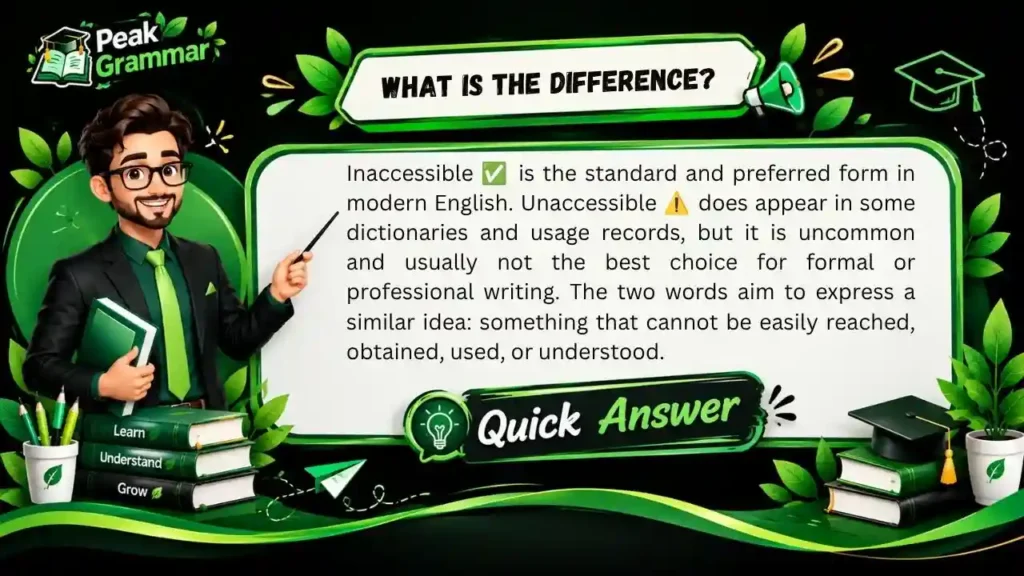
Quick Answer:
Inaccessible ✅ is the standard and preferred form in modern English. Unaccessible ⚠️ does appear in some dictionaries and usage records, but it is uncommon and usually not the best choice for formal or professional writing. The two words aim to express a similar idea: something that cannot be easily reached, obtained, used, or understood.
If you want your writing to sound natural, clear, and standard, choose inaccessible. This applies to academic work, business writing, websites, emails, and everyday communication. The simple rule is: use “inaccessible” unless you have a specific reason to discuss the rare variant “unaccessible.” ✍️
⚡ TL;DR
Inaccessible ✅ is the standard and preferred word in modern English, while unaccessible ⚠️ is a rare variant found in some dictionaries. Although both can express the idea of something being difficult or impossible to access, inaccessible is the better choice for everyday, academic, and professional writing. The word can describe places, websites, information, buildings, ideas, and more. When choosing between unaccessible vs inaccessible, remember this simple rule: use “inaccessible” for clear, natural, and standard English.
You Might Also Like That: Correct vs Correctly
Unaccessible vs. Inaccessible: What Is the Difference?
The main difference is usage and frequency, not the basic idea behind the words. Inaccessible is the established form that English speakers commonly use. It can describe a place that is difficult to reach, information that is hard to obtain, or language that is difficult to understand.
Unaccessible may appear in dictionaries or older and uncommon usage, but it does not have the same level of acceptance in everyday modern English.For most readers, inaccessible will sound more natural and professional. So, if you are unsure which word to choose, inaccessible is the safer answer.
| Feature | Inaccessible ✅ | Unaccessible ⚠️ |
| Standard usage | Yes | Rare |
| Meaning | Not accessible | Similar meaning |
| Common today | Very common | Uncommon |
| Formal writing | Recommended | Usually avoid |
| Best choice | Yes | No |
Is “Unaccessible” a Real Word?
Yes, but there is an important detail. Unaccessible is not simply a meaningless spelling mistake. The word appears in some dictionaries and usage records, and a discussion on English Stack Exchange describes it as an uncommon variant of inaccessible.
However, being found in a dictionary does not mean that a word is equally common or equally suitable in every situation. Inaccessible has become the normal choice in modern standard English. Therefore, you may encounter unaccessible, but you should generally choose inaccessible when writing for a broad audience. This approach keeps your writing natural and easy to understand. 📝
Why Is “Inaccessible” the Standard Form?
The reason comes partly from the way English developed its negative prefixes. English uses several prefixes to create opposite meanings, including un- and in-. While un- works naturally in words such as unhappy and unclear, English does not always allow writers to choose either prefix freely.
The word inaccessible became the established form through the history of English and its Latin-derived vocabulary. The Stack Exchange discussion also points to the competition between un- and in- when forming negative words.So, even though unaccessible may seem logical, inaccessible is the form readers expect.
Why Does “Unaccessible” Sound Correct?
The spelling unaccessible feels natural because English speakers often use un- to create negative adjectives. Think about words such as unfair, unclear, unknown, and unavailable. When people see accessible, they may naturally think that adding un- should create its opposite.
However, English does not always follow one simple pattern. Some words use in-, while others use un- or another negative form. That means you cannot always create a correct word simply by adding un-. In this case, inaccessible is the established choice. 🔤
What Does “Inaccessible” Mean?
Inaccessible means something is difficult or impossible to reach, obtain, use, enter, or understand. The exact meaning depends on the situation. For example, an inaccessible road may be difficult to travel on, while inaccessible information may be difficult to obtain.
The word can also describe ideas or language that people find difficult to understand. Cambridge gives meanings connected with being hard to reach, hard to get, and hard to understand.This makes inaccessible a useful word in everyday, academic, technical, and professional writing.
Accessible vs. Inaccessible
Accessible and inaccessible are opposites. Something accessible can be reached, entered, obtained, used, or understood with reasonable ease. Something inaccessible presents a barrier that makes access difficult or impossible. Cambridge also uses accessible for places, technology, information, and ideas
For example, you could say, “The website is accessible to all users.” If users cannot reach or use it, you could say, “The website is inaccessible.” The same contrast works for buildings, roads, information, education, and complex ideas. ✅
You Might Also Like That: OMP Meaning
How to Use “Inaccessible” in a Sentence
The best way to understand inaccessible is to see it in natural sentences. You can use it for physical places, information, technology, or things that people struggle to understand.
- 🏔️ The mountain village became inaccessible after heavy snowfall.
- 💻 The website was inaccessible during the update.
- 📚 Some important information remained inaccessible to students.
- 🧠 The article used language that was inaccessible to beginners.
- 🚗 The narrow road is inaccessible to large vehicles.
These examples show that inaccessible has several practical uses beyond simply describing a place.
Inaccessible in Different Contexts
Inaccessible works in many different situations. You can use it when talking about a building, road, website, document, service, person, or idea. Cambridge also recognizes uses involving access, obtaining something, understanding something, and even describing a person who is difficult to approach.
For example, an inaccessible building may be difficult to enter, while inaccessible information may be difficult to obtain. An inaccessible idea may be too difficult for a reader to understand. This flexibility makes the word useful across everyday conversation, education, business, technology, and formal writing. 🌐
What Does “Inaccessible” Mean in Technology and Accessibility?
In technology, inaccessible often means that users cannot properly reach, use, or interact with digital content. A website may become inaccessible because of technical problems, restricted access, or poor accessibility features. Cambridge also uses inaccessible for sites and digital information that users cannot easily access or use.
The word also appears in digital accessibility, where designers try to make websites, apps, and documents usable by people with different needs. For example, a website that does not work properly with assistive technology may create an accessibility barrier. 💻
You Might Also Like That: EYP Meaning in Text
Inaccessible vs. Unavailable
Inaccessible and unavailable can overlap, but they do not always mean exactly the same thing. Inaccessible focuses on the difficulty of getting to, entering, using, or understanding something. Unavailable usually focuses on something not being ready, present, free, or obtainable at a particular time.
For example, a website can be available but still have a private section that is inaccessible because you need permission. This distinction helps you choose the more precise word. So, use inaccessible when access is the main problem and unavailable when something simply cannot be used or obtained at that time. 🔐
Inaccessible vs. Unreachable
Inaccessible and unreachable can both describe something that you cannot get to, but they have slightly different uses. Inaccessible often focuses on access or entry, while unreachable commonly focuses on the inability to reach, contact, or achieve something.
For example, a remote village may be inaccessible because there is no usable road. A person may be unreachable because nobody can contact them. A goal can also be unreachable when you cannot achieve it. Choosing the right word makes your sentence more specific and natural. 🎯
Inaccessible vs. Unattainable vs. Unobtainable
These words may look similar, but they serve different purposes. Inaccessible usually means difficult to reach, enter, use, or understand. Unattainable describes something that cannot be achieved, while unobtainable describes something that cannot be obtained or acquired.
For example, “The building is inaccessible” focuses on entering it. “The goal is unattainable” focuses on achieving it. “The rare book is unobtainable” focuses on getting it. Using the most precise word helps your writing sound clearer and more natural instead of relying on one general adjective. ✨
Inaccessible Synonyms and Antonyms
The best inaccessible synonyms depend on your sentence. Words such as unreachable, unavailable, unattainable, unobtainable, impassable, restricted, and unapproachable can work in certain contexts, but they are not always exact replacements.
Some useful antonyms include accessible, reachable, available, obtainable, attainable, and approachable. Remember that context matters. For example, reachable works well for a place, while attainable works better for a goal. Choosing synonyms by meaning rather than simply replacing words can make your writing more precise. 📖
Common Mistakes With “Inaccessible”
One common mistake is writing unaccessible when you mean the standard word inaccessible. Although unaccessible has some recorded usage, inaccessible remains the better choice for modern standard writing.
Another mistake involves using inaccessible when a more precise word would work better. For example, use unavailable when something is not currently available and unreachable when someone cannot be contacted. Avoid treating all these words as exact synonyms. A small word-choice change can make your sentence much clearer. ✍️
What Are the Different Forms of “Inaccessible”?
The word inaccessible belongs to a useful word family. The base adjective is accessible, while its negative form is inaccessible. The noun inaccessibility describes the condition or quality of being difficult to reach, understand, or obtain.
You may also see the adverb inaccessibly, which describes something done in a way that makes access, understanding, or obtaining difficult.Learning these forms can help you avoid repeating the same adjective and make your writing more flexible. 🔤
| Word | Part of Speech | Example |
| Accessible | Adjective | The building is accessible. |
| Inaccessible | Adjective | The road is inaccessible. |
| Inaccessibility | Noun | Its inaccessibility caused problems. |
| Inaccessibly | Adverb | The material was written inaccessibly. |
How Do You Pronounce “Inaccessible”?
Inaccessible is commonly pronounced like in-ak-SES-uh-bul. The main stress falls on the “ses” sound. Cambridge lists the pronunciation as /ˌɪn.əkˈses.ə.bəl/ in both British and American English.
When saying the word, break it into smaller parts instead of trying to pronounce it all at once: in + ac + cess + i + ble. Practicing the stressed “SES” sound can make the pronunciation easier. 🗣️ This is especially useful if you plan to use the word in academic, business, or professional conversations.
Is “Inaccessible” Formal or Informal?
Inaccessible works well in both everyday and formal English. You can use it in casual conversations when describing a place or website, but it also fits naturally in academic, business, technical, and professional writing.
For example, a report might say that “the data remains inaccessible to unauthorized users.” A student might write that “the article contains inaccessible language.” The word does not sound overly formal, so you can use it confidently when you need to explain that something is difficult or impossible to access. 📘
You Might Also Like That: What Does WYF Mean
Frequently Asked Questions
Is it unaccessible or inaccessible?
Inaccessible is the standard and preferred form. Unaccessible appears in some dictionaries and usage records, but it is uncommon.
Is unaccessible a real word?
Yes, unaccessible has recorded usage, but it is rare. For modern standard English, inaccessible is the safer choice.
Is unaccessible grammatically correct?
It can appear as a variant, but most formal writing should use inaccessible because it is the established form.
Why is inaccessible preferred?
English has established inaccessible through its history and word formation. The fact that un- works with many words does not mean it works with every adjective.
Can I use unaccessible in formal writing?
It is better to avoid it. Choose inaccessible for academic, professional, and formal writing.
What does inaccessible mean?
It means difficult or impossible to reach, obtain, use, enter, or understand.
What is the opposite of inaccessible?
The most direct opposite is accessible. Depending on context, reachable, available, or obtainable may also work.
What is another word for inaccessible?
Possible alternatives include unreachable, unavailable, unobtainable, unattainable, and impassable, depending on the context.
What is the difference between inaccessible and unreachable?
Inaccessible focuses on access, while unreachable often focuses on reaching, contacting, or achieving something.
What is the difference between inaccessible and unavailable?
Inaccessible means access is difficult or blocked, while unavailable usually means something is not ready, present, or available to use.
Conclusion
When you are deciding between unaccessible vs. inaccessible, choose inaccessible. It is the standard, common, and widely understood form in modern English. While unaccessible does appear in some dictionaries and usage records, it remains uncommon and can make your writing sound less natural.
The easiest rule to remember is simple: Use “inaccessible” when you mean difficult or impossible to access, reach, obtain, use, or understand. Whether you are writing an article, email, essay, report, or website copy, inaccessible is the clear choice. ✅