Are you confused about correct vs correctly? 🤔 These two words come from the same root, but they do different jobs in a sentence. Choosing the wrong one can make an otherwise good English sentence sound grammatically incorrect.
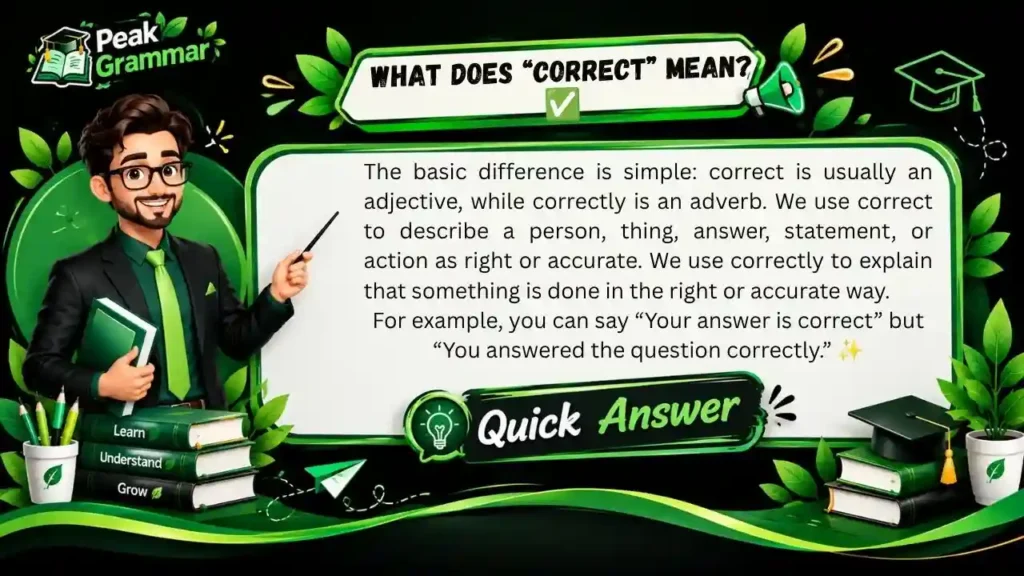
The basic difference is simple: correct is usually an adjective, while correctly is an adverb. We use correct to describe a person, thing, answer, statement, or action as right or accurate. We use correctly to explain that something is done in the right or accurate way.
For example, you can say “Your answer is correct” but “You answered the question correctly.” In this guide, you’ll learn exactly when to use correct or correctly, with simple examples and easy grammar rules. 📚✨
Quick Answer ⚡
Correct and correctly have similar meanings, but they have different grammatical roles.
✅ Correct = right, accurate, or free from mistakes
✅ Correctly = in a right, accurate, or proper way
Compare:
- 📝 Your answer is correct.
- ✍️ You answered correctly.
👉 Easy rule:
Correct describes something.
Correctly describes how something is done.
So, if you are describing an answer, sentence, spelling, statement, or result, you will often need correct.
If you are describing how someone performs an action, you will often need correctly.
TL;DR ⚡
The main difference between correct vs correctly is their part of speech.
🔹 Correct is mainly an adjective. It describes a noun or tells us that something is right or accurate.
That is the correct answer.
🔹 Correctly is an adverb. It describes a verb and tells us that an action was performed in the right way.
She answered the question correctly.
🧠 Remember:
Correct = what is right ✅
Correctly = how something is done ✅
You Might Also Like That: Unaccessible vs Inaccessible
Correct vs Correctly at a Glance 📊
| Word | Part of Speech | Meaning | Example |
| ✅ Correct | Adjective | Right or accurate | Your answer is correct. |
| ✍️ Correctly | Adverb | In the right way | You answered correctly. |
The two words are closely related, but they cannot always replace each other.
Compare These Sentences
✅ Your pronunciation is correct.
Here, correct describes the noun pronunciation.
✅ You pronounced the word correctly.
Here, correctly describes the verb pronounced.
This is the key difference you need to remember.
What Does “Correct” Mean? ✅
Correct means right, accurate, true, or free from mistakes. It is most commonly used as an adjective.
You can use correct to describe answers, information, spelling, grammar, pronunciation, decisions, statements, calculations, and many other things.
For example:
- 📝 Your answer is correct.
- 📚 That is the correct spelling.
- 🔤 This is the correct pronunciation.
- ➗ The calculation is correct.
- 💡 Your information is correct.
- ✅ She made the correct decision.
- 📖 This is the correct way to write the sentence.
In each example, correct describes a noun.
Correct as an Adjective 📚
An adjective describes a noun or pronoun. Since correct is commonly an adjective, it can appear before a noun or after a linking verb.
Before a Noun
You can put correct directly before the noun it describes:
- the correct answer
- the correct spelling
- the correct method
- the correct information
- the correct pronunciation
Example:
Please choose the correct answer.
After a Linking Verb
You can also use correct after verbs such as be, seem, look, appear, and become.
- Your answer is correct.
- That statement seems correct.
- The information appears correct.
- Your calculation looks correct.
Here, correct describes the subject rather than directly modifying a noun.
What Does “Correctly” Mean? ✍️
Correctly means in a correct, accurate, or proper way. It is an adverb formed from the adjective correct.
We generally use correctly to describe an action or verb.
For example:
- ✍️ She spelled the word correctly.
- 🗣️ He pronounced my name correctly.
- 📝 You answered the question correctly.
- 💻 The computer is working correctly.
- 📚 He used the grammar rule correctly.
- 🔢 She calculated the total correctly.
In these examples, correctly explains how the action happened.
That is why we use correctly rather than correct.
Correct vs Correctly Grammar 📖
The easiest way to understand the grammar is to identify what the word describes.
Correct → Describes a Noun or Subject
Your answer is correct.
Here, correct describes answer.
Correctly → Describes an Action
You answered correctly.
Here, correctly describes answered.
Think about the question each word answers:
Correct: Which one? What kind? Is it right?
Correctly: How was the action performed?
You Might Also Like That: Effect vs Affect
A Simple Comparison
| Sentence | Why? |
| Your answer is correct. | Correct describes answer. |
| You answered correctly. | Correctly describes answered. |
| That is the correct spelling. | Correct describes spelling. |
| You spelled it correctly. | Correctly describes spelled. |
| His pronunciation is correct. | Correct describes pronunciation. |
| He pronounced it correctly. | Correctly describes pronounced. |
This pattern works in many everyday sentences. 🧠
When Should You Use Correct? 🤔
Use correct when you want to describe something as right, accurate, or free from mistakes.
Common combinations include:
- ✅ correct answer
- ✏️ correct spelling
- 📚 correct grammar
- 🗣️ correct pronunciation
- 🔢 correct calculation
- 📖 correct information
- 💡 correct explanation
- 🎯 correct decision
- 📝 correct sentence
- 🔤 correct word
For example:
Is this the correct answer?
Your spelling is correct.
She gave me the correct information.
In these sentences, correct describes a person, thing, answer, or piece of information.
When Should You Use Correctly? ✍️
Use correctly when you want to explain that an action was performed in the right way.
It commonly appears with action verbs such as:
- answer
- spell
- pronounce
- write
- use
- calculate
- understand
- explain
- follow
- complete
Examples:
- ✍️ She spelled the word correctly.
- 🗣️ He pronounced the name correctly.
- 📚 You used the word correctly.
- ➗ They calculated the answer correctly.
- 📝 He wrote the sentence correctly.
- 💡 She explained the rule correctly.
Here, correctly tells us how the action was performed.
Correct or Correctly: Which One Is Right? 🔍
Sometimes both words can appear in sentences about the same subject, but they have different structures.
Compare:
Example 1
✅ Your answer is correct.
❌ Your answer is correctly.
Why? Because answer is a noun, and we need an adjective to describe it.
Example 2
❌ You answered the question correct.
✅ You answered the question correctly.
Why? Because answered is an action, so we need an adverb to describe how the person answered.
Example 3
✅ That is the correct spelling.
❌ That is the correctly spelling.
Here, spelling is a noun, so correct is required.
Example 4
✅ You spelled the word correctly.
❌ You spelled the word correct.
Here, correctly describes the action spelled.
🧠 Quick test: If the word describes a thing, choose correct. If it describes how an action is performed, choose correctly.
Correct vs Correctly Sentence Examples 📝
Here are some simple examples to make the difference clearer.
Examples With “Correct” ✅
- This is the correct answer.
- Your grammar is correct.
- That is the correct spelling.
- She gave the correct information.
- Is this the correct address?
- His pronunciation is correct.
- We chose the correct option.
- Your calculation is correct.
Examples With “Correctly” ✍️
- You answered the question correctly.
- She spelled my name correctly.
- He pronounced the word correctly.
- They completed the task correctly.
- You used the expression correctly.
- She calculated the total correctly.
- He followed the instructions correctly.
- The machine is working correctly.
Notice the pattern:
Correct → describes something
Correctly → describes an action
You Might Also Like That: IYKYK Meaning
Common Mistakes With Correct and Correctly ⚠️
Learners often use correct where an adverb is needed or correctly where an adjective is required.
Mistake 1
❌ You answered the question correct.
✅ You answered the question correctly.
The word correctly describes the action answered.
Mistake 2
❌ Your answer is correctly.
✅ Your answer is correct.
The word correct describes the noun answer.
Mistake 3
❌ She spelled my name correct.
✅ She spelled my name correctly.
The adverb correctly explains how she spelled the name.
Mistake 4
❌ This is the correctly answer.
✅ This is the correct answer.
Because answer is a noun, it needs the adjective correct.
Mistake 5
❌ His pronunciation is correctly.
✅ His pronunciation is correct.
The linking verb is connects the subject to the adjective correct.
Correct vs Correctly With “Be” Verbs 💡
One common source of confusion is using correctly after forms of the verb be.
Usually, when you are describing a subject after is, am, are, was, or were, you need the adjective correct.
✅ Your answer is correct.
✅ The information was correct.
✅ Her pronunciation is correct.
Not:
❌ Your answer is correctly.
However, correctly can appear elsewhere in a sentence when it modifies an action:
✅ You answered the question correctly.
So, don’t automatically choose correctly just because you are talking about something being done properly. Look at the grammar of the sentence.
Correctly vs Rightly 🤔
Correctly and rightly can sometimes have similar meanings, but they are not always interchangeable.
Correctly usually means in an accurate or proper way.
She answered the question correctly.
Rightly can mean in a morally or reasonably justified way, depending on the context.
He was rightly concerned about the problem.
For grammar, spelling, calculations, pronunciation, and factual accuracy, correctly is often the clearer choice.
Correct vs Accurate 📚
Correct and accurate are also closely related.
Correct generally means right or free from error.
Your answer is correct.
Accurate emphasizes precision or exactness.
The measurement is accurate.
Both can be appropriate in certain situations, but they are not always identical.
For everyday grammar questions, correct is often the more natural choice when you simply mean right.
Correct Word Forms 🔄
Learning the related forms of correct can make your English stronger.
Correct
Correct can function mainly as an adjective and can also be used as a verb.
As an adjective:
That answer is correct.
As a verb:
Please correct my sentence.
Correctly
Correctly is the adverb:
Please use the word correctly.
Correction
Correction is a noun referring to the act or result of correcting something.
The teacher made a correction to my sentence.
Correctness
Correctness refers to the quality of being correct.
The correctness of the information was checked.
Incorrect
Incorrect means not correct or wrong.
That answer is incorrect.
Understanding these related forms can help you recognize how correct changes according to its role in a sentence.
How to Remember Correct vs Correctly 🧠
Here’s the easiest memory trick:
Correct = Thing ✅
If you are describing what something is, use correct.
The answer is correct.
Correctly = Action ✍️
If you are describing how something is done, use correctly.
You answered correctly.
Think:
Correct = WHAT is right?
Correctly = HOW was it done?
Another Easy Trick
Look at the word immediately before it.
If you have a noun that needs description:
correct answer
If you have an action verb that needs description:
answered correctly
This simple pattern can solve many correct vs correctly questions.
You Might Also Like That: There vs Their vs They’re
Frequently Asiked Questions ❓
Is it correct or correctly?
Both correct and correctly are correct words, but the right choice depends on the sentence.
Use correct as an adjective:
Your answer is correct.
Use correctly as an adverb:
You answered correctly.
Is “You are correct” or “You are correctly” correct?
✅ You are correct is correct.
Here, correct is an adjective describing you.
❌ You are correctly is not normally correct when used alone in this structure.
Is it “answer correctly” or “answer correct”?
The standard form is:
✅ Answer correctly.
Because correctly describes the verb answer.
For example:
Please answer the question correctly.
Is “spell it correct” or “spell it correctly” correct?
The standard form is:
✅ Spell it correctly.
The word correctly describes how the action of spelling should be performed.
Is “the correct answer” correct?
Yes. ✅
Correct is an adjective describing the noun answer.
Choose the correct answer.
Can correct be a verb?
Yes. Correct can also function as a verb meaning to fix an error or mistake.
For example:
The teacher corrected my sentence.
Please correct this mistake.
Can correctly be used with every verb?
Not necessarily. Correctly is an adverb, so it is used when you want to describe an action as being performed accurately or properly.
For example:
She completed the task correctly.
The exact sentence structure still determines whether correctly is appropriate.
What is the difference between correct and correctly?
Correct is mainly an adjective meaning right or accurate.
Correctly is an adverb meaning in a right or accurate way.
Compare:
The answer is correct. ✅
She answered correctly. ✅
Which is correct: “You did it correct” or “You did it correctly”?
In standard formal English, use:
✅ You did it correctly.
Correctly modifies the verb did and explains how the action was performed.
In some informal varieties of English, you may hear “You did it correct,” but “You did it correctly” is the standard form expected in careful writing.
Conclusion 🎯
The difference between correct vs correctly mainly comes down to grammar.
Correct is primarily an adjective used to describe something as right, accurate, or free from mistakes. Correctly is an adverb used to describe an action performed in the right or accurate way.
Compare these two sentences:
✅ Your answer is correct.
✍️ You answered correctly.
In the first sentence, correct describes the answer. In the second, correctly describes the action of answering.
🧠 Remember this simple rule:
Correct = describes a thing or person as right ✅
Correctly = describes how an action is performed ✍️
With this rule and a little practice, you can confidently choose between correct and correctly in everyday English, academic writing, and professional communication. 🌟