Thanks a lot” is a simple phrase, but many English learners wonder whether it is correct, natural, or appropriate to use. The confusion often comes from comparing it with phrases such as “thank you a lot,” “thanks so much,” and “thank you very much.” Knowing the small differences can help you sound more natural in everyday English.
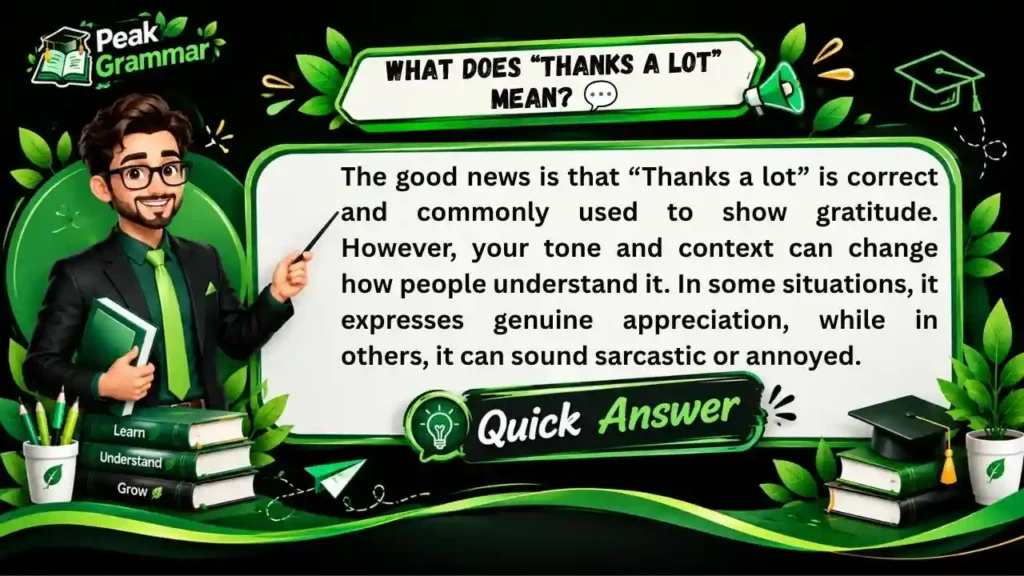
The good news is that “Thanks a lot” is correct and commonly used to show gratitude. However, your tone and context can change how people understand it. In some situations, it expresses genuine appreciation, while in others, it can sound sarcastic or annoyed.
Great — I’ll continue from the introduction and keep the article simple, natural, active-voice, SEO-focused, and human-friendly. I’ll use icons only with important words, not after every single word, so the article stays readable.
Quick Answer ✅
Yes, “Thanks a lot” is a correct and natural English expression. People commonly use it when they want to show strong gratitude for someone’s help, kindness, or support. It usually carries the same basic meaning as “Thank you very much.” 😊
However, your tone and context matter. You can use “Thanks a lot” sincerely when someone does something helpful, but the same phrase can sound sarcastic 😒 when you say it after something unpleasant happens. So, the phrase itself isn’t rude; the situation determines how people understand it.
TL;DR 📝
- ✅ “Thanks a lot” is correct and natural English for expressing gratitude.
- 🙏 It usually means “Thank you very much” and adds emphasis to your thanks.
- 💬 “Thanks a lot” works best in casual conversations, texts, and friendly situations.
- ❌ “Thank you a lot” sounds unnatural; use “Thanks a lot,” “Thank you very much,” or “Thank you so much.”
- 😊 “Thanks a lot” can show genuine appreciation when you use it sincerely.
- 😒 It can also sound sarcastic when you use it after something annoying or unpleasant.
- 🎯 Context and tone determine whether “Thanks a lot” sounds friendly, neutral, or sarcastic.
- 👔 For formal or professional situations, consider “Thank you very much” or “I really appreciate your help.”
- 💛 “Thanks so much” is another warm and natural alternative.
- ✉️ “Many thanks” can work well in written or professional communication.
- 💬 If someone says “Thanks a lot,” you can reply with “You’re welcome,” “My pleasure,” “No problem,” or “Happy to help.”
- 🌟 The key takeaway: “Thanks a lot” is perfectly fine—just make sure your tone and context match your intended meaning.
You Might Also Like That: FOMO Meaning
What Does “Thanks a Lot” Mean? 💬
“Thanks a lot” means “thank you very much” or “I really appreciate what you did.” People use it to add emphasis to a simple “thanks.” For example, you might say, “Thanks a lot for helping me with my homework.” Here, the speaker clearly shows genuine appreciation. 🙏
The phrase works well in everyday English, especially in conversations with friends, family, classmates, and coworkers. It can also appear in texts and casual messages. However, you should consider the situation before using it because “thanks a lot” can also carry sarcasm in certain contexts.
Is “Thanks a Lot” Grammatically Correct? ✍️
Yes, “Thanks a lot” is grammatically correct and sounds natural to English speakers. The phrase works as a common expression of gratitude. You can use it when you want to thank someone for something they have done. ✅
One common mistake occurs when learners write “Thank you a lot.” Although people may understand what you mean, native speakers generally do not use this structure. Instead, choose “Thanks a lot,” “Thank you very much,” or “Thank you so much.” This small difference can make your English sound much more natural.
“Thanks a Lot” vs “Thank You a Lot” 🔎
- Thanks a lot ✅ — Natural and common
- Thank you a lot ❌ — Generally unnatural
- Thank you very much ✅ — Natural and polite
- Thank you so much ✅ — Natural and warm
Is “Thanks a Lot” Formal or Informal? 👔
“Thanks a lot” usually has a casual or informal tone. People commonly use it during everyday conversations and friendly messages. For example, “Thanks a lot for picking me up!” sounds perfectly natural when speaking to a friend. 😊
You can sometimes use it at work, especially when talking casually with a coworker. However, a more formal situation may call for “Thank you very much” or “I really appreciate your help.” Choosing the right phrase depends on your relationship with the person and the level of formality you need.
Where Can You Use It? 📍
You can naturally use “Thanks a lot” in:
- 👥 Casual conversations
- 📱 Text messages
- 🏠 Conversations with family
- 🤝 Friendly workplace conversations
- 💬 Everyday social situations
For formal letters or important business communication, choose a more professional expression.
You Might Also Like That: HU Meaning in Text
Can “Thanks a Lot” Sound Sarcastic? 😒
Yes, “Thanks a lot” can sound sarcastic, but it does not always have a sarcastic meaning. When someone says it after an unwanted event, listeners may understand it as irritation rather than genuine gratitude. Context usually gives the phrase its intended meaning.
For example, “Thanks a lot for helping me!” clearly shows appreciation. But if someone says, “You deleted my presentation? Thanks a lot!”, the speaker probably feels annoyed. 😒 The words remain the same, but the situation changes the meaning. This is why you should consider the context and tone before interpreting the phrase.
Genuine vs Sarcastic Examples 😊😒
Genuine:
“Thanks a lot for helping me finish the project!” 🙏
Sarcastic:
“You broke my phone? Thanks a lot!” 😒
The first sentence shows real gratitude, while the second expresses frustration through irony.
Is “Thanks a Lot” Rude? 🤔
No, “Thanks a lot” is not automatically rude. In many situations, it is simply a friendly way to thank someone. If a friend helps you carry your bags, saying “Thanks a lot!” sounds warm and appreciative. 😊
The problem comes from tone and context. If you use the phrase after someone causes a problem, the listener may hear sarcasm. Written messages can create even more confusion because the reader cannot hear your voice. If you want to avoid misunderstanding, use “Thank you so much” or “I really appreciate it” when genuine gratitude matters.
When Should You Say “Thanks a Lot”? 👍
You should say “Thanks a lot” when you want to give someone a clear and friendly thank-you in an informal situation. It works especially well when someone provides help, gives you something useful, or does something kind for you. 🙏
For example, you can say, “Thanks a lot for your advice,” or “Thanks a lot for helping me today.” These sentences sound natural and positive. You can also use the phrase in casual texts, conversations, and friendly workplace interactions when the relationship allows an informal tone.
Can You Use “Thanks a Lot” in a Professional Email? 💼
You can use “Thanks a lot” in some professional emails, but it may sound more casual than you want. If you communicate with a close coworker about a simple favor, the phrase may feel perfectly natural. However, formal business communication often benefits from a more polished expression. 👔
Instead, you can write “Thank you very much,” “Thank you so much,” or “I really appreciate your help.” These options communicate gratitude clearly without creating confusion about your tone. For an important client, manager, or formal request, “Thank you very much” often provides a safer choice.
Better Professional Examples 💼
Instead of:
“Thanks a lot for your assistance.”
You could write:
“Thank you very much for your assistance.” 🙏
Or:
“I really appreciate your help with this matter.” ✅
These expressions sound more professional while still showing genuine gratitude.
You Might Also Like That: FRFR Meaning
Thanks a Lot vs Thank You Very Much 🔄
Both “Thanks a lot” and “Thank you very much” express strong gratitude, but they can create slightly different impressions. “Thanks a lot” usually feels more conversational and relaxed, while “Thank you very much” often sounds more polite and formal. 👔
For example, you might tell your friend, “Thanks a lot for the ride!” But when writing to a customer or business contact, “Thank you very much for your assistance” may sound more appropriate. Neither phrase is wrong. Your choice should depend on the relationship, setting, and tone.
| Expression | Tone | Best Use |
| Thanks a lot 😊 | Casual | Everyday conversation |
| Thank you very much 🙏 | Polite/Formal | Professional situations |
| Thanks so much 💛 | Warm | Friends and casual work |
| Many thanks ✉️ | Polite | Written communication |
Thanks a Lot vs Thanks So Much 💛
“Thanks a lot” and “Thanks so much” both express strong appreciation, and both sound natural in everyday English. The main difference comes from tone rather than meaning. “Thanks so much” often sounds warmer and more personal, while “Thanks a lot” can sound slightly more direct. 😊
For example, “Thanks so much for remembering my birthday!” sounds warm and friendly. “Thanks a lot for helping me move!” sounds natural and appreciative. Both work well in casual conversations, texts, and friendly messages.
Thanks a Lot vs Thank You a Lot ❌
“Thanks a lot” is the natural expression, while “thank you a lot” generally sounds unnatural in standard English. English learners often make this mistake because both phrases contain the words “thank” and “you.” However, English uses these expressions differently.
Use “Thanks a lot” when you want a casual, emphatic thank-you. Use “Thank you very much” or “Thank you so much” when you want to keep the full “thank you” structure. Remember this simple rule: say “Thanks a lot,” not “Thank you a lot.” ✅
Better Alternatives to “Thanks a Lot” 🌟
You have many alternatives when you want to express gratitude. Your best choice depends on the situation and the level of warmth or formality you want.
- 😊 Thanks — Simple and casual
- 💛 Thanks so much — Warm and friendly
- 🙏 Thank you very much — Polite and formal
- 🌟 Thank you so much — Warm and appreciative
- ✉️ Many thanks — Useful in writing
- 🤝 I really appreciate it — Natural and sincere
- 💼 Much appreciated — Short and professional
Choose the expression that matches your relationship and situation instead of using one phrase everywhere.
How to Reply When Someone Says “Thanks a Lot”? 💬
When someone says “Thanks a lot” to show genuine gratitude, you can respond with a simple and friendly phrase. Your answer can depend on how formal or casual the conversation feels. 😊
Common responses include:
- You’re welcome. 🙏
- No problem. 👍
- My pleasure. 😊
- Anytime. 🤝
- Happy to help. 🌟
- Of course! 💬
For example, if your coworker says, “Thanks a lot for helping me,” you can reply, “You’re welcome! Happy to help.” This keeps the conversation friendly and natural.
Common Examples of “Thanks a Lot” 💬
The phrase works in many everyday situations. The following examples show how naturally you can use it:
- 👥 Friend: “Thanks a lot for picking me up.”
- 📚 School: “Thanks a lot for explaining this lesson.”
- 💼 Work: “Thanks a lot for sending the report.”
- 📱 Text: “Thanks a lot! I really needed this.”
- 🏠 Family: “Thanks a lot for helping me clean the house.”
- 😊 Genuine: “Thanks a lot for your support.”
- 😒 Sarcastic: “You forgot my appointment? Thanks a lot.”
The context and tone tell readers whether the speaker feels grateful or annoyed.
You Might Also Like That: FRFR Meaning
Frequently Asked Questions ❓
Is “Thanks a Lot” Correct English? ✅
Yes. “Thanks a lot” is correct and natural English. People commonly use it to express strong gratitude, especially in casual conversations.
Is “Thanks a Lot” Polite? 😊
Yes, it can sound polite and friendly when you use it sincerely. However, context can make it sound sarcastic.
Is “Thanks a Lot” Sarcastic? 😒
Not always. It normally expresses gratitude, but people can use it sarcastically after something annoying or unpleasant happens.
Is “Thanks a Lot” Formal? 👔
It is generally informal or conversational. Use “Thank you very much” or another professional phrase when you need a more formal tone.
Can I Use “Thanks a Lot” in an Email? ✉️
Yes, especially in a casual or friendly email. For formal business emails, “Thank you very much” or “I really appreciate your help” may work better.
Is “Thank You a Lot” Correct? ❌
It is generally considered unnatural in standard English. Use “Thanks a lot,” “Thank you very much,” or “Thank you so much” instead.
What Is Another Way to Say “Thanks a Lot”? 🌟
You can say “Thanks so much,” “Thank you very much,” “Many thanks,” or “I really appreciate it.” Choose one based on the tone and situation.
Conclusion 🎯
“Thanks a lot” is correct, natural, and widely used to express gratitude. It usually means “thank you very much” and works especially well in casual conversations, texts, and friendly situations. 😊
However, always consider tone and context. A sincere “Thanks a lot!” shows appreciation, while the same words can sound sarcastic after something frustrating happens. For formal situations, choose “Thank you very much” or “I really appreciate your help.” Most importantly, remember that “Thanks a lot” is natural, while “Thank you a lot” is generally not.