“No cap” is a popular slang expression that usually means “no lie,” “for real,” or “I’m being honest.” People often use it in text messages, chats, TikTok comments, social media posts, and casual conversations to show that they are telling the truth or are not exaggerating. For example, if someone says, “No cap, this is the best pizza I’ve ever had,” they mean they are being completely serious about their opinion.
Understanding the no cap meaning also becomes easier when you know the related slang words “cap” and “capping.” While “cap” can mean a lie or exaggeration, “no cap” tells someone that a statement is genuine. In this guide, we’ll explain what no cap means in text and slang, how people use it, and what it means in different everyday contexts.
Quick Answer: What Does No Cap Mean? 🔎
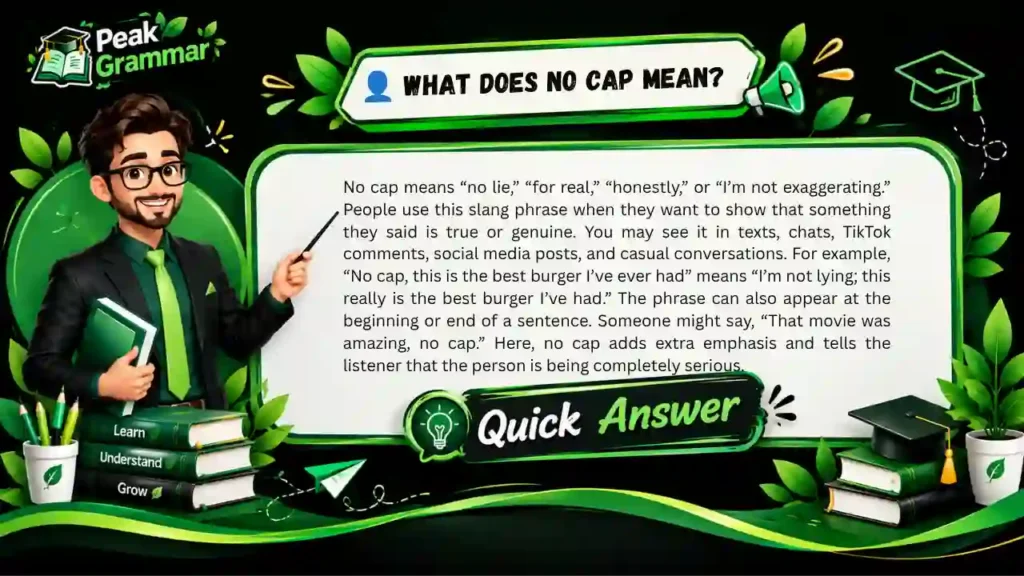
No cap means “no lie,” “for real,” “honestly,” or “I’m not exaggerating.” People use this slang phrase when they want to show that something they said is true or genuine. You may see it in texts, chats, TikTok comments, social media posts, and casual conversations. For example, “No cap, this is the best burger I’ve ever had” means “I’m not lying; this really is the best burger I’ve had.”
The phrase can also appear at the beginning or end of a sentence. Someone might say, “That movie was amazing, no cap.” Here, no cap adds extra emphasis and tells the listener that the person is being completely serious.
TL;DR: No Cap Meaning in Simple Words 📌
- 🧢 No cap means no lie or for real.
- 💬 It is common in texting, chats, and social media.
- ✅ People use it to show they are telling the truth.
- 🚫 Cap can mean a lie or exaggeration.
- 🗣️ Capping means lying or exaggerating.
- 📱 You may see “no cap” on TikTok, Instagram, and other platforms.
- 👕 It is informal slang, so avoid it in formal writing.
- 🔍 In some contexts, no cap can literally mean no limit.
- 🧢 The cap emoji can also represent a lie or exaggeration.
You Might Also Like That: Who vs Whom
What Does No Cap Mean in Text and Texting? 📱
The no cap meaning in text is usually “I’m telling the truth” or “I’m not lying.” People add it to text messages when they want to make their statement sound serious or honest. For example, a friend might text, “No cap, you need to try this restaurant.” The person is saying they genuinely recommend it. This makes no cap in texting a simple way to add emphasis without writing a long explanation.
You can place no cap at different points in a casual message. Someone might write, “No cap, that was hilarious,” or “That was hilarious, no cap.” Both sentences tell the reader that the speaker is being serious and honest.
What Does Cap Mean in Slang? 🧢
To understand no cap slang, you also need to understand cap. In casual language, cap can mean a lie, false claim, or exaggeration. If someone says, “That’s cap,” they usually mean, “That’s not true.” If someone says, “You’re capping,” they mean that the other person is lying or exaggerating. This gives “cap” and “no cap” opposite meanings in many conversations.
The word capping can describe the act of making a claim that is not true or making something sound bigger than it really is. These expressions are especially common in online conversations, texting, memes, and casual speech.
Cap vs No Cap: What’s the Difference? ⚖️
The easiest way to understand cap vs no cap is to remember that they often express opposite ideas. Cap suggests a lie or exaggeration, while no cap shows that the speaker is being honest. Learning this difference also makes related slang such as “you’re capping” easier to understand.
| Expression 🗣️ | Meaning 💡 | Example ✍️ |
| Cap 🧢 | Lie or exaggeration | “That’s cap.” |
| Capping 🚫 | Lying or exaggerating | “You’re capping.” |
| No cap ✅ | Truth or no exaggeration | “No cap, that was amazing.” |
How to Use “No Cap” in a Sentence ✍️
You can use no cap in a sentence when you want to stress that your statement is true, honest, or not exaggerated. It often sounds natural when you are sharing an opinion, complimenting someone, or describing an experience. For example, “No cap, your new haircut looks great” means the speaker genuinely likes the haircut.
You can also put the phrase after the main statement. For example, “This is the best game I’ve played, no cap.” In both positions, the phrase adds emphasis. Because it is slang, keep it for casual conversations rather than formal situations.
No Cap in Everyday Conversations 💬
In everyday speech, no cap can make a statement sound more direct and convincing. Friends may use it when sharing strong opinions, telling stories, giving compliments, or reacting to something surprising. For example, “No cap, I was nervous before the test” simply means, “I’m honestly telling you that I was nervous.” The phrase does not change the main message; it adds a sense of honesty and emphasis. Your choice of words should still match the people and situation around you.
No Cap Meaning on TikTok and Social Media 📲
The no cap meaning on TikTok and social media is usually the same as its general slang meaning: “I’m being honest” or “I’m not exaggerating.” Users may place it in captions, comments, messages, memes, or video descriptions. For example, someone might comment, “No cap, this is the funniest video today.” The writer uses the phrase to show that the comment is a genuine opinion.
You can also see no cap meaning on Instagram and other social platforms. The expression has become part of wider internet slang, but its meaning still depends on context. People may use it seriously, casually, or simply for extra emphasis.
What Does 🧢 Mean in Texting? 🧢
The 🧢 emoji can have a special slang meaning in texting and online conversations. Because “cap” can mean a lie or exaggeration, people sometimes use the baseball-cap emoji to express that idea. For example, someone might reply with 🧢 when they think another person is not telling the truth. In this context, the emoji does not simply refer to a hat.
You may also see combinations such as 🚫🧢, which can suggest “no lie” or “no exaggeration.” However, emoji meanings can change with context, so always look at the full message before deciding what someone means.
Is “No Cap” Formal or Informal? 📝
No cap is informal slang, so it works best in relaxed situations. You can use it naturally when chatting with friends, sending text messages, commenting online, or talking casually. However, it usually does not belong in academic writing, professional reports, formal emails, or business documents. In those situations, standard words sound clearer and more appropriate.
Instead of “no cap,” you can use words such as honestly, truly, genuinely, or without exaggeration. Understanding the difference between casual slang and formal English can help you communicate more clearly without sounding out of place.
Where Did “No Cap” Come From? 📚
The history of no cap slang goes beyond modern social media. The slang use of cap has roots in African American English and Black slang, and the expression later became strongly connected with hip-hop culture. Over time, “no cap” spread into wider popular culture and online communication.
Social media helped make the phrase more visible to a much larger audience, including younger internet users. However, it is not accurate to say that TikTok or Gen Z invented no cap. Its history goes back further. Today, people commonly recognize the expression as part of modern internet and casual slang.
What Does “No Cap” Mean Literally? 🚫
Although no cap meaning in slang usually refers to honesty, the phrase can have another meaning in a different context. Here, cap can mean a limit, maximum, or upper amount. Therefore, “no cap” can literally mean “no limit.” This meaning has nothing to do with lying or slang.
For example, “There is no cap on the number of entries” means there is no maximum number of entries. Context helps you identify the correct meaning. If someone says, “No cap, that was incredible,” they probably mean “no lie.” If they discuss prices, limits, or numbers, “no cap” may mean “no maximum limit.”
When Should You Use “No Cap”? 👍
Use no cap when you are having a casual conversation and want to emphasize that you are being honest. It can work well in text messages, social media comments, group chats, and conversations with friends. For example, “No cap, you did a great job” sounds natural in a relaxed setting.
However, avoid using slang just because it is popular. Not everyone uses the same expressions, and some readers may not understand them. If you are writing for a professional or academic audience, choose standard English instead. Context, audience, and tone should guide your choice.
How Do You Respond When Someone Says “No Cap”? 💬
Your response to no cap depends on what the other person says. If they share something surprising, you might respond with “For real?” or “Seriously?” If you agree with them, you could say “Facts!” or “I know, right?” In a casual conversation, you can even reply with “No cap!” to show strong agreement.
For example, if a friend says, “No cap, this is the best pizza in town,” you could answer, “For real? I need to try it.” There is no single correct response. The best reply depends on the conversation and relationship.
No Cap vs Similar Slang Expressions 🔄
Several casual expressions have a meaning close to no cap, but they do not always sound exactly the same. For real, no lie, seriously, and straight up can all emphasize honesty. Facts often shows strong agreement, while “no cap” specifically stresses that the speaker is not lying or exaggerating.
- No cap 🧢 — I’m telling the truth.
- For real ✅ — Seriously or genuinely.
- No lie 🚫 — I’m not lying.
- Facts 💯 — I strongly agree.
- Seriously 🗣️ — I really mean it.
- Straight up 👍 — Honestly or directly.
FAQs About No Cap ❓
What does no cap mean?
No cap means “no lie,” “for real,” or “I’m being honest.” People use it to show that they are not exaggerating.
What does no cap mean in text?
In a text message, no cap usually means the writer is telling the truth or wants to emphasize that a statement is genuine.
Is no cap slang?
Yes. No cap is informal slang commonly used in texting, social media, online chats, and casual conversations.
What does cap mean in slang?
Cap can mean a lie or exaggeration, while capping means lying or exaggerating.
Is no cap formal?
No. It is informal language, so use words such as “honestly” or “truly” in formal writing.
What does 🧢 mean in texting?
The 🧢 emoji can represent cap, which may mean a lie or exaggeration in slang.
What is the opposite of no cap?
In slang, cap is generally the opposite idea of no cap. “Cap” suggests a lie or exaggeration.
What does no cap mean on TikTok?
On TikTok, no cap usually means “I’m serious,” “no lie,” or “I’m not exaggerating.”
Final Thought 💭
The main no cap meaning is simple: “no lie,” “for real,” or “I’m telling the truth.” You will often see this slang in texts, chats, TikTok comments, social media posts, and casual conversations. Understanding cap and capping makes the phrase even easier because these terms often describe lying or exaggerating.
Remember the simple rule: no cap = truth ✅, while cap = lie or exaggeration 🧢. Also, pay attention to context because “no cap” can sometimes literally mean “no limit.” Once you understand these differences, you can easily recognize and understand the phrase in everyday online and casual English.