

Past tense helps us talk about actions, events, or situations that happened in the past. For example, “I walked to school yesterday” uses the simple past tense because the action already happened. English commonly teaches four past-tense forms: simple past, past continuous, past perfect, and past perfect continuous. Each form helps us describe past events in a different way.
Understanding what is past tense makes English grammar easier. In this guide, you’ll learn past tense rules, verb forms, sentence structures, and everyday examples. You’ll also discover how to use past tense correctly, avoid common mistakes, and choose the right form when speaking or writing.
⚡ Quick Answer: What Is Past Tense?
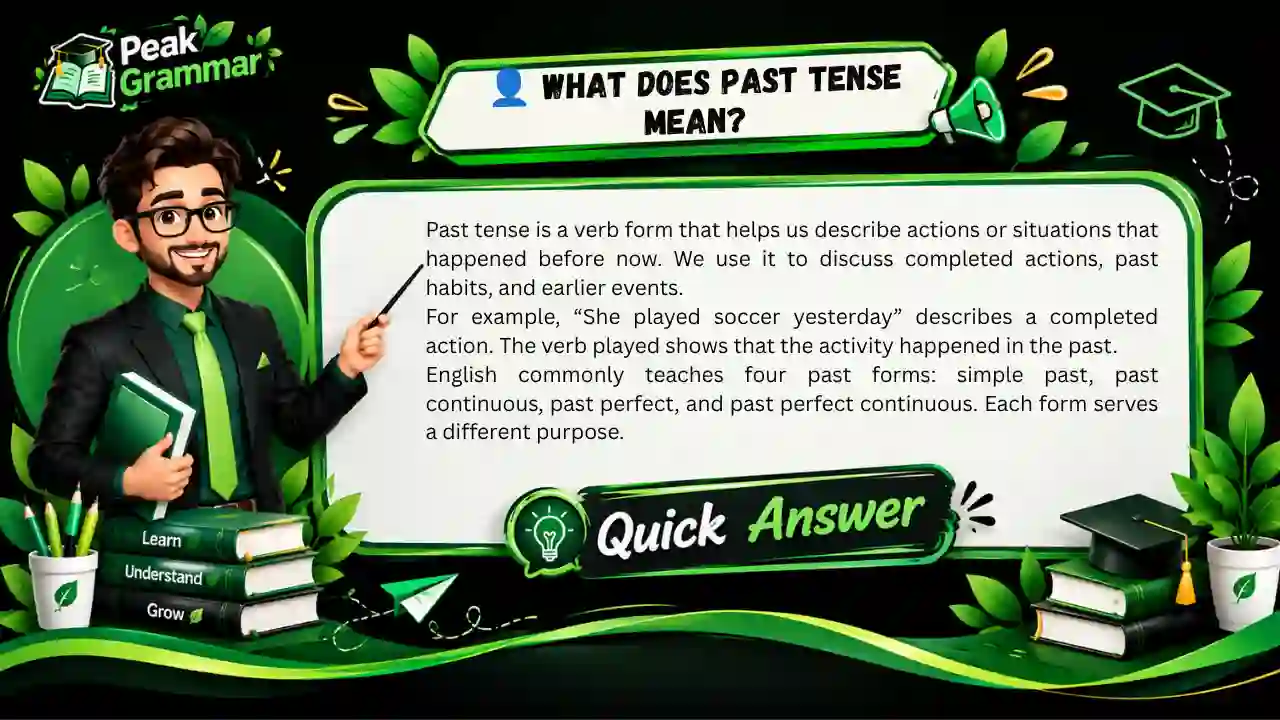
Past tense is a verb form that helps us describe actions or situations that happened before now. We use it to discuss completed actions, past habits, and earlier events.
For example, “She played soccer yesterday” describes a completed action. The verb played shows that the activity happened in the past.
English commonly teaches four past forms: simple past, past continuous, past perfect, and past perfect continuous. Each form serves a different purpose.
📌 TL;DR: Past Tense at a Glance
- 📖 Meaning: Describes past actions, events, or situations.
- ⏰ Simple past: I walked home.
- 🔄 Past continuous: I was walking home.
- ✅ Past perfect: I had walked home.
- ⏳ Past perfect continuous: I had been walking for an hour.
- ✍️ Regular verbs: Often add -ed, such as walk → walked.
- ⭐ Irregular verbs: Change differently, such as go → went.
- 💡 Important rule: Use the base verb after did or didn’t.
You Might Also Like That: ICL Meaning
📖 What Is Past Tense? Meaning and Definition
The past tense meaning is simple: it shows that something happened before the present moment. We use past-tense verbs when sharing memories, telling stories, or explaining earlier activities.
For example, “They visited their grandparents last weekend” describes a completed event. The verb visited tells us when the action happened.
✨ Simple Examples of Past Tense
- I finished my homework.
- She bought a new phone.
- We watched a movie.
- He wrote a letter.
These past tense examples show how verbs help readers understand earlier events.
⏰ Why Do We Use Past Tense in English?
We use past tense in English grammar to describe things that happened earlier. It helps us share experiences, explain past routines, and tell people what happened.
For example, “I lived in Chicago in 2020” describes a past situation. We can also describe repeated habits, such as “She walked to school every morning.”
🎯 Completed Actions, Past Habits, and States
Past tense commonly describes:
- ✅ Completed actions: He cleaned his room.
- 🔄 Past habits: We played outside every evening.
- 🏠 Past states: She owned a small house.
These uses make everyday communication clearer.
📚 What Are the Four Types of Past Tense?
English learners commonly study four types of past tense. Each form helps explain when an action happened, whether it continued, or how it relates to another past event.
| Past form | Formula | Example |
| Simple past | Subject + V2 | She cooked. |
| Past continuous | Was/were + verb-ing | She was cooking. |
| Past perfect | Had + V3 | She had cooked. |
| Past perfect continuous | Had been + verb-ing | She had been cooking. |
💡 How to Choose the Correct Form
Use simple past for completed events, past continuous for actions in progress, past perfect for earlier completed events, and past perfect continuous to emphasize duration before a past point.
✍️ Simple Past Tense: Rules and Formula
The simple past tense describes completed actions or past situations. Regular verbs often take -ed, while irregular verbs follow different patterns.
The basic past tense formula for positive sentences is:
Subject + past-tense verb + rest of sentence
For example, “She cleaned the kitchen yesterday.”
✅ Positive, Negative, and Question Sentences
| Sentence type | Example |
| Positive | He played tennis. |
| Negative | He didn’t play tennis. |
| Question | Did he play tennis? |
💡 Remember: After did or didn’t, use the base verb, not the past form.
🔄 Past Continuous Tense With Examples
The past continuous tense describes an action that was happening at a particular time in the past. It often provides background information or describes an action that another event interrupted.
Formula: Subject + was/were + verb-ing
For example, “I was studying when my friend called.”
⏳ Was/Were and Interrupted Actions
Use was with I, he, she, and it. Use were with you, we, and they.
- She was reading a book.
- They were playing outside.
- We were eating when the lights went out.
✅ Past Perfect Tense With Examples
The past perfect tense describes an action that happened before another past event. It helps readers understand the order of events.
Formula: Subject + had + past participle (V3)
For example, “She had finished dinner before her guests arrived.”
🕒 Earlier Past Events
The past perfect often appears with before, after, already, and by the time.
- I had left before the rain started.
- They had completed the project.
- He had eaten before the meeting.
💡 Use past perfect when you need to make an earlier past action clear.
⌛ Past Perfect Continuous Tense
The past perfect continuous tense emphasizes how long an action continued before another past event or time.
Formula: Subject + had been + verb-ing
For example, “She had been studying for two hours before dinner.”
This form often appears with for and since.
🔍 Duration Before Another Past Event
- He had been working all morning.
- They had been waiting for an hour.
- We had been traveling since sunrise.
Memory trick: Use had been + verb-ing when you want to emphasize the duration of an earlier ongoing action.
📝 Regular and Irregular Past Tense Verbs
Past tense verbs help us describe earlier actions. Regular verbs usually follow predictable spelling patterns, while irregular verbs change in different ways.
For example, walk → walked follows a regular pattern, but go → went does not.
📘 Regular Verb Spelling Rules
- Add -ed: walk → walked.
- Add -d: love → loved.
- Change consonant + y to -ied: study → studied.
- Sometimes double the final consonant: stop → stopped.
⭐ Common Irregular Verb Chart
| Base verb (V1) | Past (V2) | Past participle (V3) |
| Go | Went | Gone |
| Eat | Ate | Eaten |
| Write | Wrote | Written |
| See | Saw | Seen |
| Take | Took | Taken |
| Buy | Bought | Bought |
| Come | Came | Come |
| Speak | Spoke | Spoken |
🎯 How to Use Was, Were, and Did Correctly
Was, were, and did commonly appear in past-tense sentences, but they serve different purposes.
Use was and were as past forms of be or as helping verbs in continuous sentences. Use did to form most simple-past questions and negatives with other verbs.
💬 Was vs. Were and Did vs. Didn’t
- She was happy.
- They were tired.
- Did you finish?
- I didn’t understand.
❌ Did you went home?
✅ Did you go home?
Remember that did already carries the past-tense meaning.
🌟 50 Past Tense Examples in English
These past tense sentences show how English speakers describe completed actions, ongoing activities, earlier events, and past experiences.
🏠 Everyday Conversations
- I woke up early.
- She made breakfast.
- He washed his car.
- We cleaned the kitchen.
- They visited their friends.
- I bought groceries.
- She called her mother.
- He lost his keys.
- We watched television.
- They walked home.
- I drank coffee.
- She opened the door.
- He fixed his bike.
- We cooked dinner.
- They went shopping.
- I was sleeping.
- She was singing.
- They were laughing.
- He had already left.
- We had finished eating.
🎓 School and Workplace Examples
- I completed my assignment.
- She studied English.
- He passed the exam.
- We attended class.
- They learned new words.
- I wrote an email.
- She answered the question.
- He joined the meeting.
- We discussed the project.
- They finished their work.
- I was taking notes.
- She was preparing slides.
- They were practicing grammar.
- He had submitted the report.
- We had completed the lesson.
✈️ Travel and Past Experiences
- I traveled to New York.
- She visited California.
- He booked a hotel.
- We explored the city.
- They enjoyed the trip.
- I took photographs.
- She met new people.
- He missed the train.
- We arrived late.
- They returned home.
- I was driving downtown.
- She was waiting outside.
- They had booked tickets.
- He had been traveling all day.
- We had been walking for hours.
⚖️ Past Tense vs. Past Simple
Many learners ask about the difference between past tense and past simple. The two terms relate closely, but they do not always mean exactly the same thing.
Past tense can refer broadly to grammatical forms that describe past situations. Simple past refers to one specific form, such as walked, ate, or went.
📊 Meaning and Comparison
| Past form | Example |
| Simple past | I walked home. |
| Past continuous | I was walking home. |
| Past perfect | I had walked home. |
💡 Key point: The simple past belongs to the broader group of past-tense forms.
🔁 Past Tense vs. Present and Present Perfect
The present tense describes current situations, habits, or general facts. The simple past describes earlier events, while the present perfect connects past actions with the present.
For example, “I visited Boston last year” identifies a finished past event.
📊 Choosing the Correct Tense
| Tense | Example |
| Present simple | I work here. |
| Simple past | I worked here in 2022. |
| Present perfect | I have worked here since 2022. |
| Past perfect | I had worked there before I moved. |
Tip: Use the present perfect when the past has a meaningful connection to now.
🕒 Time Expressions Used With Past Tense
Past tense time expressions help readers understand when something happened. Common examples include yesterday, last night, last week, ago, before, and in 2020.
These expressions often appear with the simple past, but the tense still depends on the meaning of the sentence.
📅 Yesterday, Ago, Since, and For
- Yesterday: I called yesterday.
- Last week: We traveled last week.
- Ago: She left two hours ago.
- Since: He had been waiting since noon.
- For: They had been studying for three hours.
Remember that since marks a starting point, while for describes a length of time.
📖 Past Tense in Storytelling and Writing
Writers use past tense in storytelling to explain events in a clear order. The simple past moves the story forward, while the past continuous describes background activities.
For example, “I was walking home when I saw a lost dog.”
✍️ Keeping Tense Consistent
Use the same main tense when events belong to the same time frame. Change tense when the meaning requires it.
- ❌ She opened the door and sees a cat.
- ✅ She opened the door and saw a cat.
A clear timeline helps readers follow the story without confusion.
❌ Common Past Tense Mistakes to Avoid
Many past tense grammar mistakes happen when learners use the wrong verb form or forget how helping verbs work.
The easiest way to improve is to compare incorrect sentences with their correct versions.
🚫 Incorrect vs. Correct Sentences
| Incorrect | Correct |
| Did you went? | Did you go? |
| She didn’t ate. | She didn’t eat. |
| I goed home. | I went home. |
| They was happy. | They were happy. |
| He have finished yesterday. | He finished yesterday. |
Memory trick: After did or didn’t, return the main verb to its base form.
🧠 Past Tense Exercises With Answers
Practice helps you remember past tense rules and use the correct verb forms naturally. Complete these six questions before checking the answers.
📝 Multiple-Choice Practice
- She ___ to school yesterday. (go / went)
- They ___ watching television. (was / were)
- Did you ___ breakfast? (eat / ate)
- He had ___ before noon. (leave / left)
- We ___ football last Sunday. (play / played)
- She had been ___ for hours. (study / studying)
✅ Answer Key With Explanations
- Went — irregular simple past.
- Were — agrees with they.
- Eat — base verb after did.
- Left — past participle after had.
- Played — regular simple past.
- Studying — verb-ing after had been.
❓ Frequently Asked Questions About Past Tense
What is past tense in simple words?
Past tense helps us describe something that happened before now. For example, “I played basketball yesterday.”
What are the four types of past tense?
The four commonly taught forms are simple past, past continuous, past perfect, and past perfect continuous.
What are five examples of past tense?
Five examples are walked, ate, wrote, visited, and saw.
How do you change a verb into past tense?
Add -ed to many regular verbs. For irregular verbs, learn the correct past form, such as go → went.
What is the past tense of be?
The past forms of be are was and were.
Is past tense the same as simple past?
Not always. Simple past is one form within the broader group of past-tense constructions.
Can past tense describe imaginary situations?
Yes. English sometimes uses past forms for unreal or imagined situations, such as “If I had more time, I would travel.”
How can I learn past tense quickly?
Practice common verbs, read short stories, write daily sentences, and review past tense exercises with answers.
🎯 Final Thoughts
Learning past tense becomes easier when you understand its basic meaning, four common forms, and sentence rules. Start with simple past tense, then practice continuous and perfect forms as your confidence grows.
Focus on regular and irregular verbs, use clear time expressions, and remember that did takes the base verb. Practice writing short sentences about yesterday, last week, or a memorable trip.
With regular practice, you’ll use past tense in English grammar more naturally and describe past experiences with greater confidence.