Have you ever wondered whether to say “proud for you” or “proud of you”? These phrases may look similar, but they do not always express the same idea. In everyday English, “proud of you” is the standard and natural expression when you want to show admiration for someone’s achievement, effort, progress, or actions. On the other hand, “proud for you” sounds less common and can sometimes confuse English learners.
In this guide, we’ll explain the difference between proud for you and proud of you, what “proud of you” means, and when to use each phrase. You’ll also see simple examples that make the grammar and meaning easy to understand, so you can choose the right expression with confidence.
Quick Answer 🎯
The short answer is simple: “proud of you” is the standard and natural expression in everyday English. ❤️ We use it when we feel admiration, respect, or happiness because of something a person has done. For example, “I’m proud of you for finishing your degree.” 🎓
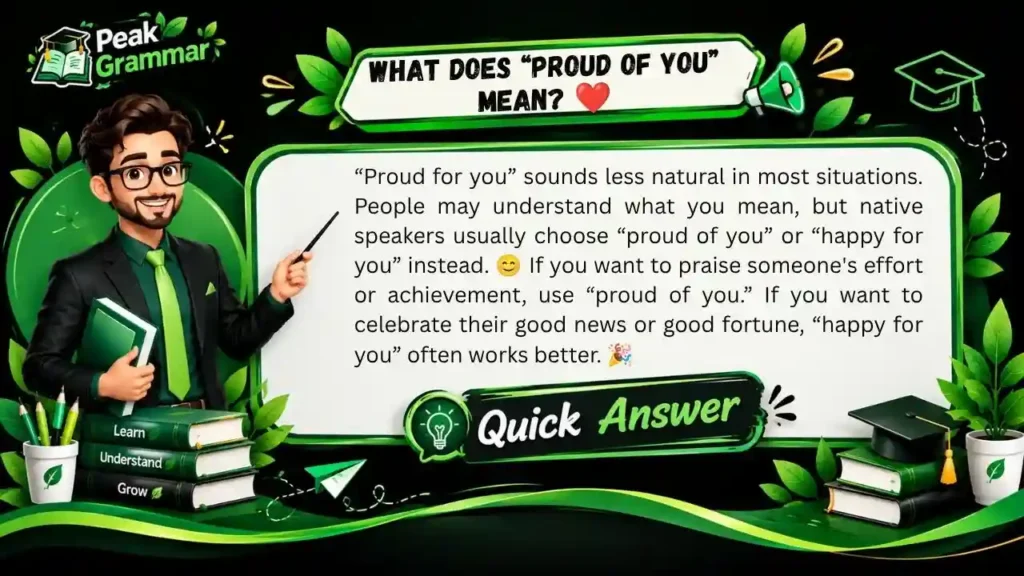
“Proud for you” sounds less natural in most situations. People may understand what you mean, but native speakers usually choose “proud of you” or “happy for you” instead. 😊 If you want to praise someone’s effort or achievement, use “proud of you.” If you want to celebrate their good news or good fortune, “happy for you” often works better. 🎉
TL;DR ⚡
- ❤️ “Proud of you” is the standard and natural expression for showing admiration, pride, or appreciation for someone’s effort, achievement, character, or progress.
- ⚠️ “Proud for you” is uncommon and often sounds awkward to native speakers.
- 🎉 If you mean that you feel happy because something good happened to someone, “happy for you” is usually the better phrase.
- 📚 The normal grammar pattern is proud + of + person/thing: “I’m proud of you,” “She’s proud of her son,” and “We’re proud of our team.”
- 🏆 Use “proud of you” for achievements, hard work, personal growth, courage, and positive changes.
- 😊 Use “happy for you” for good news, success, opportunities, relationships, promotions, or other positive events.
- 💬 “Proud of you” also works naturally in texting and everyday conversations, such as “So proud of you!”
- ❤️ In relationships, the phrase can communicate support, affection, admiration, and encouragement.
- 🧠 The easiest rule to remember is: proud of = admiration; happy for = happiness on someone’s behalf.
- ✍️ For standard English writing, avoid using “proud for you” as a direct replacement for “proud of you.” Current grammar resources consistently recommend “proud of you” as the safer natural choice.
You Might Also Like That: BSF Meaning
What Does “Proud of You” Mean? ❤️
The phrase “proud of you” means that someone feels pleased, impressed, or proud because of your actions, qualities, progress, or achievements. It often shows strong emotional support. 💕 For example, a parent might say, “I’m proud of you for working so hard.” A friend might say, “I’m proud of you for reaching your goal.” 🏆
The phrase does not always require a major achievement. You can feel proud of someone because they kept trying, showed courage, helped others, or made positive progress. 🌱 That makes “I’m proud of you” a warm and meaningful phrase in everyday conversations, relationships, families, and friendships. 🤝
What Does “Proud for You” Mean? 🤔
“Proud for you” can suggest that someone feels pride or happiness on another person’s behalf. However, English speakers do not normally use it as a direct replacement for “proud of you.” 🗣️ For example, if your friend gets a new job, saying “I’m happy for you” sounds much more natural than “I’m proud for you.” 🎉
Some speakers may still use “proud for you” in casual speech, especially when they want to express strong happiness about another person’s success. 😊 However, English learners should usually choose “proud of you” when they admire the person and “happy for you” when they celebrate the person’s good news. ✅
Proud For You vs Proud of You: What’s the Difference? 🔍
The main difference comes from the focus of the feeling. ❤️ When you say “I’m proud of you,” you focus on the person and what they have done. You admire their effort, achievement, character, or progress. For example, “I’m proud of you for passing your exam.” 📚
When someone says “I’m proud for you,” they may try to express happiness or pride on your behalf. However, this wording sounds uncommon or awkward to many English speakers. Therefore, “proud of you” remains the safer and more natural choice. If your main idea is happiness about someone’s good fortune, choose “happy for you.” 🎉
| Phrase | Main Meaning | Naturalness | Example |
| ❤️ Proud of you | Admiration or personal pride | ✅ Very natural | “I’m proud of you.” |
| 😊 Proud for you | Pride or happiness on someone’s behalf | ⚠️ Uncommon | “I’m proud for you.” |
| 🎉 Happy for you | Happiness about someone’s good news | ✅ Very natural | “I’m happy for you.” |
Why Do We Say “Proud of You” Instead of “Proud for You”? 📚
English uses certain adjective + preposition combinations naturally. The adjective “proud” normally takes “of” when we identify the person or thing that causes our pride. 🧠 That gives us familiar expressions such as “proud of you,” “proud of my son,” and “proud of my achievement.” 🏆
You cannot always replace an English preposition with another word simply because the meaning seems logical. English learners often need to learn these combinations as common patterns. ✍️ For example, we say “afraid of,” “fond of,” “ashamed of,” and “proud of.” Therefore, “proud of you” sounds natural because English speakers commonly use this established structure. ✅
Is “Proud for You” Grammatically Correct? ⚠️
The answer needs some context. In ordinary English, “I’m proud of you” is the standard expression when you want to praise someone’s achievement, effort, or progress. ❤️ Most learners should use this form because it sounds natural and clear. Saying “I’m proud for you” may sound unusual or awkward to many listeners.
That does not mean people can never produce or understand “proud for you.” 🗣️ Some speakers may use it to express pride or happiness on another person’s behalf. However, “happy for you” usually communicates that idea more naturally. 🎉 So, when in doubt, remember this simple rule: use “proud of you” for admiration and “happy for you” for happiness about someone’s good news.
Proud of You vs Happy for You 😊
Although “proud of you” and “happy for you” can appear in similar conversations, they focus on different feelings. 💭 “Proud of you” shows admiration for the person, their effort, their choices, or their achievement. For example, “I’m proud of you for studying every day.” 📚
“Happy for you” focuses more on the good thing that happened to the person. 🎉 For example, if your friend gets their dream job, you can say, “I’m so happy for you!” Both phrases can sometimes work together: “I’m proud of you, and I’m so happy for you.” ❤️ This combination shows both admiration and happiness.
When Should You Say “I’m Proud of You”? 🏆
You can say “I’m proud of you” whenever someone’s actions, effort, growth, or achievement makes you feel genuine pride. ❤️ The phrase works well in both serious and everyday situations. You do not need to wait for a huge accomplishment.
You can use it when someone:
- 🎓 Graduates or passes an important exam
- 💪 Overcomes a difficult challenge
- 🌱 Makes positive personal progress
- 🏆 Reaches an important goal
- ❤️ Shows courage or kindness
- 🔥 Keeps working despite difficulties
- 👏 Makes a positive change in life
For example, “I’m proud of you for not giving up” can feel just as meaningful as praise for a major achievement.
You Might Also Like That: OMP Meaning
“Proud of You” in Different Situations 💬
The meaning of “proud of you” can become slightly different depending on the relationship between the speakers. ❤️ A parent may use it to celebrate a child’s growth, while a friend may use it to support someone during a difficult time. A partner may use it to show love and admiration. 💕
Parents and Children 👨👩👧
Parents often say “I’m proud of you” when their child achieves something or shows positive growth. 🎓 They may also use it after a child handles a difficult situation with courage. The phrase can show love, support, and approval at the same time. ❤️
Friends 🤝
Friends can use “proud of you” to celebrate achievements or personal progress. For example, “You finally finished your project—I’m so proud of you!” 🎉 The phrase can make a friend feel supported and appreciated.
Romantic Partners ❤️
Partners may say “I’m proud of you” when they admire each other’s effort, courage, career progress, or personal growth. 💕 It can sound especially meaningful after someone works through a difficult situation.
Teachers and Students 🎓
Teachers and mentors can use the phrase to encourage students after hard work, improvement, or achievement. 📚 For example, “You worked really hard this semester, and I’m proud of you.”
Workplace and Professional Situations 💼
In professional settings, “I’m proud of you” can work in friendly or supportive relationships, although the exact tone depends on the workplace. 👍 Managers, mentors, or teammates may use it after a major achievement, successful presentation, or difficult project.
Common Mistakes With “Proud of” and “Proud for” ❌
English learners sometimes choose the wrong preposition after “proud.” The most common and natural structure is “proud of.” ✅ For example, say “I’m proud of you,” “She is proud of her son,” or “They are proud of their achievement.” 🏆
Avoid changing “of” to another preposition without a reason. Here are some useful examples:
- ❌ I’m proud for you.
- ✅ I’m proud of you.
- ❌ I’m proud for my achievement.
- ✅ I’m proud of my achievement.
- ❌ She is proud on her daughter.
- ✅ She is proud of her daughter.
Remember: proud + of is the normal pattern when you identify the source of your pride. 📚
You Might Also Like That: EYP Meaning in Text
Can You Say “I’m Proud for You” in Casual English? 🗣️
Yes, you may hear “I’m proud for you” occasionally, especially in informal or emotional conversations. However, hearing a phrase does not always mean that it represents the most natural standard English. 🧠 Many speakers would choose “I’m proud of you” or “I’m happy for you” depending on what they want to express.
If someone achieved something through hard work, say “I’m proud of you.” 🏆 If something wonderful happened to them and you simply want to celebrate their happiness, say “I’m happy for you.” 🎉 This simple distinction will help you sound more natural and avoid confusion in everyday English.
How to Respond When Someone Says “I’m Proud of You” ❤️
When someone says “I’m proud of you,” they usually want to show support, admiration, or affection. 😊 You do not need a complicated response. A simple “Thank you” often works perfectly. If the person means a lot to you, you can give a warmer answer.
Here are some natural responses:
- ❤️ “Thank you, that means a lot.”
- 😊 “I really appreciate that.”
- 🥹 “That means so much to me.”
- 🤝 “Thank you for supporting me.”
- 🌟 “I’m glad you think so.”
Choose your response based on the relationship and the situation.
Alternatives to “I’m Proud of You” 🌟
Sometimes you may want to express the same positive feeling without repeating “I’m proud of you.” You can choose another phrase based on the exact emotion you want to communicate. ❤️
Some useful alternatives include:
- 🎉 “I’m so happy for you.”
- 👏 “You did an amazing job.”
- 💪 “I’m impressed by your effort.”
- 🌟 “You should be proud of yourself.”
- ❤️ “I admire what you’ve done.”
- 🔥 “You’ve come so far.”
- 🏆 “You worked really hard for this.”
- 😊 “I’m really happy to see you succeed.”
These expressions help you sound natural and genuine while matching the situation more closely.
Proud For You vs Proud of You — Examples ✍️
Examples make the difference much easier to remember. 📚 Use “proud of you” when you want to praise someone’s action, effort, character, or achievement.
Natural examples:
- ❤️ “I’m proud of you for finishing your degree.”
- 🏆 “We’re proud of you for winning the competition.”
- 💪 “I’m proud of you for staying strong.”
- 🌱 “She is proud of you for making progress.”
- 🎓 “Your parents are proud of you.”
For happiness about another person’s good news, use “happy for you.” 🎉 For example, “I’m so happy for you—you finally got your dream job!” This sounds more natural than using “proud for you” in the same situation.
Proud For You vs Proud of You — Comparison Table 📊
| Point | ❤️ Proud of You | 😊 Proud for You |
| Meaning | Shows personal pride or admiration | Can express pride on someone’s behalf |
| Commonness | ✅ Very common | ⚠️ Uncommon |
| Natural English | ✅ Natural | ⚠️ Often sounds awkward |
| Best for | Achievements, effort, growth, character | Rare/context-dependent situations |
| Better alternative | — | 🎉 “Happy for you” |
| Example | “I’m proud of you.” | “I’m happy for you.” |
The easiest rule is to remember “proud of you” for admiration and “happy for you” for celebrating someone’s good fortune. 🧠 This distinction will help you choose the expression that sounds natural in most conversations.
You Might Also Like That: What Does WYF Mean
Frequently Asked Questions ❓
Is “proud of you” grammatically correct? ✅
Yes. “Proud of you” is the standard and natural expression used to show admiration or pride in someone’s actions, qualities, effort, or achievements. ❤️
Is “proud for you” grammatically correct? 🤔
“Proud for you” is uncommon and may sound awkward in ordinary English. Most speakers would choose “proud of you” or “happy for you” depending on the intended meaning.
What does “proud of you” mean? ❤️
It means that someone feels admiration, satisfaction, or pride because of what you have done or the person you have become.
What does “proud for you” mean? 💭
It can suggest feeling pride or happiness on someone else’s behalf, but English speakers do not normally use it as a direct replacement for “proud of you.”
Should I say “proud of you” or “happy for you”? 🎉
Use “proud of you” when you admire someone’s effort or achievement. Use “happy for you” when you feel happy about something good happening to them.
Can native speakers say “proud for you”? 🗣️
Some speakers may use it in casual conversation, but it is not the usual choice. For clear, natural English, choose “proud of you” or “happy for you.”
Why do we use “of” after proud? 📚
English commonly uses the adjective-preposition combination “proud of.” This established pattern makes “proud of you” sound natural.
Can I say “I’m proud of myself”? 🌟
Yes. “I’m proud of myself” is completely natural when you feel good about your own effort, achievement, progress, or actions.
What is another way to say “I’m proud of you”? ❤️
You can say “You did a great job,” “I’m impressed by you,” “You should be proud of yourself,” or “I admire your effort.” Choose the phrase that best matches your situation.
Conclusion 🏁
When comparing “proud for you vs proud of you,” the safest and most natural choice is “proud of you.” ❤️ Use it when you want to show admiration, pride, support, or appreciation for someone’s effort, achievement, character, or progress. For example, “I’m proud of you for not giving up” sounds natural and heartfelt. 🌟
“Proud for you” can appear in casual or less common usage, but it does not normally replace “proud of you.” If you simply want to celebrate someone’s good news or success, “happy for you” is usually a better choice. 🎉 Remember the simple rule: proud of you = admiration ❤️, while happy for you = happiness about someone’s good fortune 😊.