When choosing the right words in English, ask vs pose can create confusion, especially when you talk about questions. We often say “ask a question”, but English also allows us to say “pose a question.” Both phrases are correct, yet they can create a slightly different meaning and tone. Ask usually sounds more natural when you directly seek information or an answer from someone, while pose often presents a question for discussion, thought, or consideration.
Understanding the difference between ask a question vs pose a question can help you write and speak more naturally. In this guide, we’ll explain when to use ask or pose, compare their meanings with clear examples, and show how they work in everyday and formal English. Whether you are writing a message, having a conversation, or working on academic writing, you’ll learn which word fits each situation best.
Quick Answer
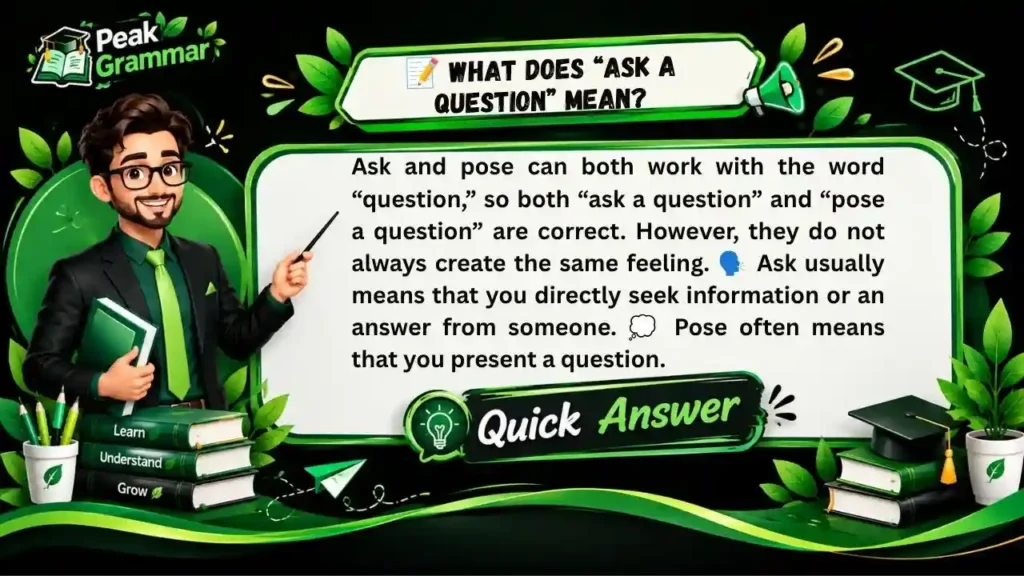
Ask and pose can both work with the word “question,” so both “ask a question” and “pose a question” are correct. However, they do not always create the same feeling. 🗣️ Ask usually means that you directly seek information or an answer from someone. 💭 Pose often means that you present a question for thought, discussion, or consideration. For example, you might ask your teacher a question, but a research paper may pose an important question about a topic.
The easiest rule is this: 👉 use ask when you want a direct response, and use pose when you want to present a question or idea for people to consider. Context still matters, so you should not treat this rule as absolute. ✨
TL;DR
- Ask means to directly seek information or an answer from someone.
- Pose means to present a question for thought, discussion, or consideration.
- Both “ask a question” and “pose a question” are grammatically correct.Ask sounds more natural in everyday English and conversation.
- Pose often works well in academic, professional, analytical, and formal contexts.
- Use ask when a specific person or group is expected to respond.
- Use pose when you present a question, issue, or problem without focusing on an immediate response.
You Might Also Like That: FOMO Meaning
What Does “Ask a Question” Mean?
The verb ask means to request information, an answer, help, or clarification. When you ask a question, you normally direct that question toward a person or group. 🗣️ The other person usually expects to respond. This makes ask a question the most natural phrase in everyday English. You can use it with friends, teachers, coworkers, customers, interviewers, and many other people. For example: “I asked my teacher a question about the homework.” Here, the speaker directly wants information from the teacher.
Examples of “Ask” in Everyday English
You can use ask in many common situations. For example: “Can I ask you a question?” or “I asked my manager about the deadline.” 📚 Students can ask questions in class, while customers can ask for information from a company. You can also ask for help, ask for permission, or ask someone to do something. These patterns make ask a very flexible verb. ⭐ When you directly communicate with another person and expect an answer or response, ask will usually sound natural and clear.
What Does “Pose a Question” Mean?
Pose a question means to present, raise, or put a question forward for consideration. Unlike ask, the phrase does not always focus on getting an immediate answer from a particular person. 💡 Writers often use pose a question when they discuss research, ideas, problems, debates, or larger issues. For example: “The study poses an important question about online education.” The study does not literally speak to someone and wait for an answer. Instead, it presents an issue that readers can think about or discuss.
Common Collocations With “Pose”
The word pose works with more than just questions. It commonly appears with words such as pose a question, pose a problem, pose a challenge, and pose a threat. ⚠️ For example, “The new system poses a serious problem” means the system creates or presents a problem. Similarly, “The speaker posed a difficult question” means the speaker presented a question that required thought. These common combinations show why pose often sounds more formal, analytical, or thoughtful than ask, especially in written English. ✍️
Ask vs Pose — Key Differences
The main difference between ask vs pose involves the purpose and context of the question. 🗣️ Ask usually creates a direct interaction between the person asking and the person answering. 💭 Pose often presents a question as an idea, issue, or problem that deserves attention. However, both words can overlap, and pose does not always mean “formal.” Your choice should depend on what you want the sentence to communicate.
| 📝 Ask | 💭 Pose |
| Usually direct | Often more detached |
| Often expects a response | May invite consideration |
| Very common in conversation | Common in formal writing |
| Natural and neutral | Often sounds analytical |
| Usually involves a person | Can present a general issue |
| “I asked her a question” | “The study posed a question” |
Ask a Question vs Pose a Question
Ask a question vs pose a question often creates confusion because both phrases can describe the same basic action. For example, “The speaker asked a question” and “The speaker posed a question” can both be grammatically correct. The difference comes from the focus. 🗣️ Asked often highlights the act of seeking an answer, while 💭 posed can highlight the act of presenting the question itself.
You can sometimes use them interchangeably, but the sentence may sound different. Ask normally feels more natural and conversational, while pose can give the sentence a more formal or reflective tone. ✨
You Might Also Like That: SMH Meaning
When Should You Use “Ask”?
Use ask when you directly want information, clarification, permission, or a response. 🗣️ It works especially well when you know who should answer your question. You can ask a friend, ask a teacher, ask a manager, or ask a customer something. It also works naturally in emails, interviews, meetings, and everyday conversations. For example, “I asked my manager about the new schedule.” Here, the speaker directly seeks information from the manager.
Examples of “Ask”
- 🗣️ I asked my friend a question.
- 📚 She asked the teacher about the lesson.
- 💬 Can I ask you something?
- 🧑💼 The employee asked about the new policy.
- ❓ He asked for clarification.
- 🎤 The reporter asked the actor about the movie.
These examples show why ask remains the safest choice for most everyday situations.
When Should You Use “Pose”?
Use pose when you want to present a question, problem, or challenge for thought or discussion. 💭 This use appears often in academic writing, research, journalism, presentations, debates, and analytical discussions. For example, “The research poses an important question about climate change.” The writer presents an issue for readers to consider rather than directly asking one person for information.
That does not mean pose only belongs in formal writing. ✨ You can use it in speech too, especially when you intentionally want a more thoughtful or formal tone. Still, ask usually sounds more natural in casual conversation.
Examples of “Pose”
- 📚 The study posed an important question.
- 🎤 The speaker posed a difficult question to the audience.
- 🔬 The research poses several questions about the results.
- 💭 The article poses an interesting question.
- ⚠️ The new policy poses a serious challenge.
- 🧠 The problem poses a challenge for researchers.
Ask vs Pose in Academic Writing
In academic writing, both ask and pose can be correct. The better choice depends on what the writer describes. If researchers directly question participants, ask works naturally: “The researchers asked participants whether they agreed.” 👥 If a study presents a question for readers or researchers to consider, pose often sounds better: “The study poses an important question about the results.”
This distinction gives academic writers more control over tone and meaning. ✍️ Do not assume that pose always sounds more intelligent or that ask sounds too simple for academic writing. Choose the word that accurately describes the action.
You Might Also Like That: HU Meaning in Text
Ask vs Pose in Everyday English
In everyday English, ask is usually the better choice because it sounds natural, direct, and friendly. 🗣️ You would normally say, “Can I ask you a question?” rather than “Can I pose you a question?” The first version sounds simple and normal in conversation. You can use pose in everyday speech, but it may sound more formal or deliberate.
For example, during a serious discussion, someone might say, “Let me pose a question.” 💭 That sentence sounds natural because the speaker wants to introduce a thoughtful idea. However, for ordinary communication, ask remains the easiest choice.
Ask vs Pose vs Raise a Question
The words ask, pose, and raise can all connect with questions, but they place attention on different actions. 🗣️ Ask a question usually means directly seeking an answer. 💭 Pose a question means presenting a question for thought or discussion. 🔎 Raise a question means bringing an issue or doubt into attention.
For example:
- 🗣️ I asked my teacher a question.
- 💭 The study posed an important question.
- 🔎 The results raised several questions.
These three verbs can sometimes overlap, but they do not always sound equally natural. Understanding this difference helps you choose stronger words.
Common Mistakes With Ask and Pose
Learners sometimes make a few common mistakes when choosing between ask and pose. ❌ One mistake involves using pose simply because it sounds more sophisticated. Another mistake involves believing that pose always belongs in academic writing. It does not. 📝 Writers should choose words based on meaning, not appearance.
Also, do not confuse pose a question with pose as. 💡 Pose a question means present a question, while pose as someone means pretend to be someone. Finally, remember that ask and pose can overlap, but they do not always create the same tone or focus.
You Might Also Like That: FRFR Meaning
How to Choose Between Ask and Pose
Choosing between these verbs becomes easier when you think about your purpose. 🎯 Ask yourself what you are doing with the question.
- 🗣️ Want a direct answer from someone? → Use ASK
- 💭 Presenting a question for thought or discussion? → Use POSE
- 🔎 Introducing an issue or doubt? → Consider RAISE
- 📚 Writing about direct questions to participants? → ASK often works best
- ✍️ Presenting a research question? → POSE often works well
Remember that these are helpful guidelines, not strict grammar laws. Context always matters. When in doubt in everyday English, ask usually sounds more natural and straightforward.
Ask vs Pose Examples in Real Sentences
Seeing both words in real situations makes the difference easier to understand. 👇
| 📌 Situation | 📝 Natural Sentence |
| 🏠 Conversation | I asked her a question. |
| 📚 Classroom | The student asked the teacher about the lesson. |
| 🧑💼 Workplace | I asked my manager for clarification. |
| 🎤 Interview | The reporter asked him about the decision. |
| 🔬 Research | The study posed an important question. |
| 🗣️ Debate | The speaker posed a challenging question. |
| 📊 Research findings | The results raised several questions. |
The examples show that context, not just formality, should guide your choice. ✨
You Might Also Like That: IDK Meaning
Frequently Asked Questions
Is it correct to say “pose a question”?
Yes. “Pose a question” is completely correct English. It often means to present a question for thought, discussion, or consideration.
Is it better to ask or pose a question?
Use ask for direct, everyday questions. Use pose when you want to present a question in a more formal, analytical, or thoughtful context.
Is pose more formal than ask?
Pose often sounds more formal, but formality is not the only difference. Meaning and context also affect the choice.
Can I use pose in everyday conversation?
Yes, but ask usually sounds more natural in casual conversation.
Should I use ask or pose in academic writing?
You can use both. Use ask for direct questions and pose when a paper or study presents a question for consideration.
Can ask and pose be used interchangeably?
ometimes, but replacing one with the other can change the tone and focus of the sentence.
What is the difference between a question asked and a question posed?
A question asked usually focuses on direct inquiry, while 💭 a question posed often focuses on presenting an issue for thought or discussion.
What is the difference between pose and propose?
Pose can mean present a question or problem. Propose means suggest an idea, plan, or action. They have different meanings.
What does “pose a question” mean?
It means to present or raise a question for someone to think about, discuss, or consider.
Conclusion
Understanding ask vs pose becomes simple when you focus on the purpose of the question. 🗣️ Use ask when you directly seek information, clarification, or a response from someone. 💭 Use pose when you present a question for thought, discussion, or consideration. Both “ask a question” and “pose a question” are correct, so neither word is automatically better.
For everyday English, ask will usually sound more natural. For academic, analytical, or formal contexts, pose can work especially well. 🎯 The best approach is to consider your audience, purpose, and context before choosing the word. Once you understand this simple difference, you can use both verbs with greater confidence.