
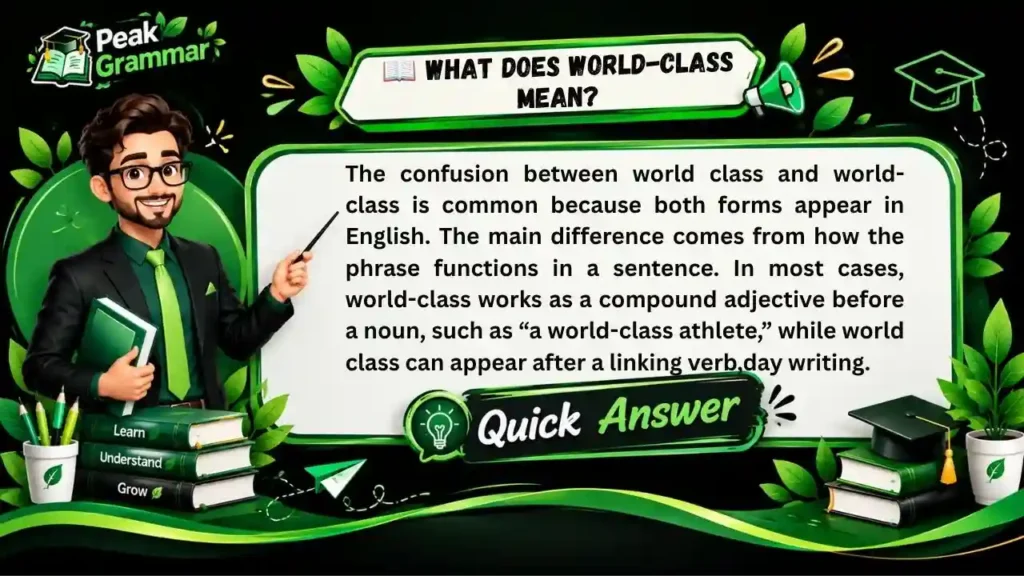
The confusion between world class and world-class is common because both forms appear in English. The main difference comes from how the phrase functions in a sentence. In most cases, world-class works as a compound adjective before a noun, such as “a world-class athlete,” while world class can appear after a linking verb, as in “The athlete is world class.” Understanding this simple grammar rule can help you choose the correct form in formal, professional, and everyday writing.
If you are unsure whether world class or world-class is correct, look at the word that follows it. When the phrase directly describes a noun, the hyphenated form is usually the right choice. Once you understand this pattern, you can use world-class naturally in sentences without second-guessing your grammar.
⚡Quick Answer
World-class is usually the correct form when the phrase comes directly before a noun as a compound adjective. For example, you can say, “She is a world-class athlete” or “They offer world-class service.” The hyphen joins the two words so they work together to describe the noun. 🌎
World class can also be correct when the phrase comes after a linking verb and describes a subject, such as, “Her performance is world class.” 📝 So, the easiest rule is: before a noun → world-class; after a linking verb → world class in common usage.
📌 TL;DR
- 🌎 World-class is usually used before a noun: world-class athlete, world-class service, or world-class education.
- ✍️ World class can be used after a linking verb: “The athlete is world class.”
- 🔗 The hyphen connects “world” and “class” when they work together as a compound adjective.
- 🏆 World-class means among the best in the world or having an exceptionally high standard.
- ❌ Don’t assume world class is always incorrect; context determines the correct form.
- 💼 Use world-class naturally in business, professional, academic, and everyday writing.
- 💡 Easy rule: Before a noun → world-class | After a linking verb → world class.
- ⭐ Similar alternatives include outstanding, exceptional, first-rate, top-quality, and world-leading.
You Might Also Like That: FRFR Meaning
📖 What Does World-Class Mean?
World-class means among the best in the world or having an extremely high level of quality, skill, or performance. 🌟 We use this adjective to describe people, places, services, products, organizations, and achievements that meet a very high standard. For example, “He is a world-class player” means he performs at a level considered among the best internationally.
You may see world-class used in many situations, including world-class education, world-class healthcare, world-class facilities, and world-class customer service. 🏆 The expression does not always mean something is literally ranked number one. It usually suggests an exceptional or internationally respected standard.
✍️ When to Use World-Class
Use world-class when it directly modifies a noun. In this position, world-class acts as a compound adjective, so the hyphen helps show that “world” and “class” belong together as one description. ✅ For example, write a world-class university, a world-class chef, or a world-class performance.
This pattern works in both everyday and professional writing. 💼 You might write, “The company provides world-class training,” or “She received world-class coaching.” The same rule applies to phrases such as world-class athlete, world-class restaurant, world-class service, and world-class technology. When the phrase comes immediately before the noun it describes, the hyphenated form is the safest standard choice.
📝 When to Use World Class
World class can appear without a hyphen when it follows a linking verb and describes the subject rather than directly modifying a noun. For example, “The restaurant is world class” and “Their customer service was world class.” 👍 Here, the phrase describes the restaurant or service after the linking verb.
You will commonly see this structure with verbs such as is, are, was, were, seems, and became. 🔎 For example, “Her performance was world class.” This is why world class should not automatically be treated as incorrect. The grammatical position matters, although individual style guides and publications may prefer consistent hyphenation in some contexts.
📊 World-Class vs World Class Examples
The easiest way to understand the difference is to compare the phrases in real sentences. 👇
| Usage | Form | Example |
| Before a noun | world-class 🌟 | She is a world-class athlete. |
| Before a noun | world-class 🏫 | They built a world-class university. |
| Before a noun | world-class 🍽️ | We visited a world-class restaurant. |
| After a linking verb | world class 🏆 | The athlete is world class. |
| After a linking verb | world class ⭐ | Their service is world class. |
| After a linking verb | world class 🎭 | Her performance was world class. |
💡 Quick rule: If the phrase sits directly before the noun, use world-class. If it describes the subject after a linking verb, world class is commonly used.
You Might Also Like That: FOMO Meaning
🔗 Why Is World-Class Hyphenated?
The hyphen in world-class connects the two words so readers understand that they work together as one adjective. 🧩 Without the hyphen, the relationship between the words can become less clear when they appear before a noun. This is a common feature of compound adjectives in English.
For example, we normally write world-class athlete, just as we write high-quality service, full-time employee, and award-winning author. ✨ The hyphen does not change the basic meaning of world-class. Instead, it makes the grammatical relationship clearer. This is especially useful in formal and professional writing, where clear sentence structure matters.
🚫 Common World-Class and World Class Mistakes
One common mistake occurs when writers leave out the hyphen before a noun. ❌ For example, “She is a world class athlete” is generally better written as “She is a world-class athlete.” The hyphen makes the compound adjective clear.
Another mistake involves assuming that world class is always wrong. ❌ That is too simple. A sentence such as “The athlete is world class” can be acceptable in common usage. ✅ Writers should look at the grammatical position before choosing the form. Also avoid randomly changing between world-class and world class in the same document. Consistent usage makes your writing look more polished. ✨
💼 World-Class in Different Types of Writing
You can use world-class in many types of writing, including business, academic, professional, and everyday English. For example, a company might advertise world-class customer service, while a university might describe its world-class research facilities. 🏢 In academic writing, however, writers should avoid using promotional language unless they can support the claim.
Marketing content often uses world-class to highlight quality, expertise, or customer experience. 📈 In professional writing, use the term when it genuinely adds meaning rather than as empty praise. On a resume, for example, saying you have world-class skills can sound exaggerated unless your achievements support that claim. Good writing uses strong words carefully and keeps the meaning believable.
❓ Is World-Class One Word, Two Words, or Hyphenated?
World-class is two words connected by a hyphen, not one single word. ✍️ The phrase contains the words world and class, with a hyphen joining them when they work together as a compound adjective. So, “worldclass” written as one word is generally not the standard form.
The choice between world-class and world class depends on how the expression functions in the sentence. 🔎 For example, “a world-class hospital” uses the hyphenated adjective before the noun, while “The hospital is world class” uses the open form after the linking verb. This distinction helps you choose the correct form naturally.
You Might Also Like That: FOMO Meaning
⚖️ Is World Class Always Incorrect?
No, world class is not always incorrect. 🚫 This is one of the most important points to remember. Writers often use the open form after a linking verb when the phrase describes the subject. For example, “The team’s performance is world class” is a common construction.
However, when the phrase directly modifies a noun, the hyphenated form is usually the better choice. ✅ Compare “They hired a world-class coach” with “The coach is world class.” The first phrase directly describes the noun coach, while the second describes the coach after the linking verb is. Understanding this difference is more useful than simply memorizing that one spelling is right and the other is wrong.
🧠 World Class vs World-Class: Easy Rule to Remember
Here is a simple way to remember the world-class grammar rule. 📝 When world + class comes directly before a noun and describes it, use the hyphen: world-class athlete, world-class service, or world-class education. This makes the two words work together as one compound adjective.
When the phrase comes after a linking verb and describes the subject, you can commonly use world class: “The athlete is world class.” 🌎 If you are unsure, ask yourself one question: “Is world-class directly describing the noun that comes after it?” If the answer is yes, the hyphenated form is usually the right choice.
🌟 World-Class vs Similar Expressions
Several expressions have meanings close to world-class, but they are not always interchangeable. 🔎 Best-in-class usually means one of the best within a particular category or industry. World-leading emphasizes leadership or excellence on an international level, while top-notch is a more casual way to describe something excellent.
You can also use first-rate, outstanding, exceptional, or highest-standard depending on the sentence. 💡 For example, “a world-class university” emphasizes international excellence, while “a top-notch university” sounds more informal. Choosing the right expression helps you match the tone and purpose of your writing.
🔤 World-Class Synonyms and Alternatives
If you use world-class too often, you can replace it with other words that communicate excellence. ✨ Useful synonyms and alternatives include outstanding, exceptional, first-rate, top-quality, leading, and internationally recognized. The best choice depends on the exact meaning you want to express.
For example, instead of saying “They provide world-class service,” you could write “They provide exceptional service” or “They provide top-quality service.” 👍 In professional and academic writing, these alternatives can sometimes sound more precise because they explain the quality without making a broad claim. Always choose a word that accurately matches the evidence and context.
💡 How to Remember the Difference
The easiest memory trick is “before the noun, join the words.” 🔗 When world-class comes before a noun, the hyphen joins the words into one clear description: world-class athlete, world-class hotel, or world-class technology.
When the phrase comes after a linking verb, the open form world class commonly works: “The hotel is world class.” 🌎 Keep this simple pattern in mind whenever you write the phrase. It will help you avoid one of the most common world class vs world-class grammar mistakes without needing to remember complicated grammar terms.
You Might Also Like That: IDK Meaning
❓ Frequently Asked Questions
Is world-class hyphenated?
Yes. ✅ Use world-class when the phrase works as a compound adjective before a noun, such as a world-class athlete.
Is world class grammatically correct?
Yes, in the right context. 👍 For example, “The athlete is world class” commonly uses the open form after a linking verb.
Which is correct, world class or world-class?
Both forms can be correct. 🔎 The choice depends mainly on how you use the phrase in the sentence.
Is world-class an adjective?
Yes. World-class commonly functions as a compound adjective that describes a noun, such as in “world-class education.” 📚
Can I say “the service is world class”?
Yes. ✅ “The service is world class” is a common construction in which the phrase describes the subject after the linking verb.
What does world-class mean?
World-class means among the best in the world or having an exceptionally high standard of quality, skill, or performance. 🌟
How do you use world-class in a sentence?
Use world-class before a noun: “They offer world-class healthcare.” 🏥
🏁 Conclusion
The difference between world class and world-class mainly depends on how you use the phrase in a sentence. 📝 When it directly modifies a noun, the hyphenated form world-class is usually the best choice: “She is a world-class singer.” When it follows a linking verb and describes the subject, the open form world class can be appropriate: “Her singing is world class.”
The key is to focus on grammar and sentence structure, not simply memorize one spelling. 🌎 Once you understand this pattern, you can confidently use world-class in professional, academic, business, and everyday writing while keeping your sentences clear and natural.