Many English learners confuse “that’s mean” and “that means” because the phrases look and sound similar. However, they have different meanings and grammatical roles. “That’s mean” usually means “that is mean” and describes something unkind, rude, or hurtful. On the other hand, “that means” explains what something indicates, represents, or leads to. Understanding this small difference can help you avoid common English grammar mistakes and choose the right phrase with confidence.
In this guide, we’ll explain that’s mean vs that means in simple terms, show how each phrase works, and provide clear examples from everyday English. You’ll also learn when to use “that’s mean” or “that means,” why “that’s means” is incorrect, and an easy way to remember the difference.
🎯 Quick Answer
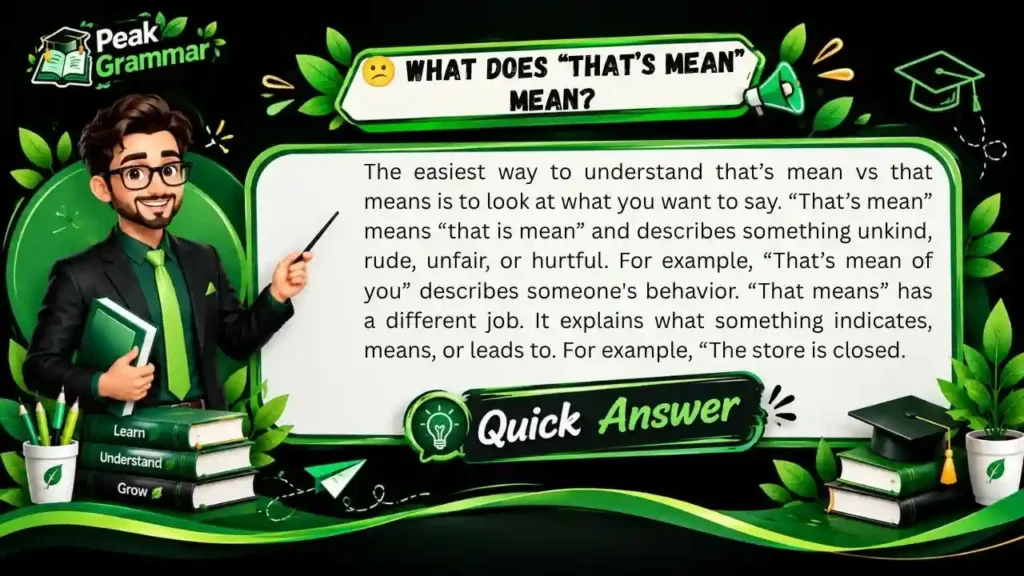
The easiest way to understand that’s mean vs that means is to look at what you want to say. “That’s mean” means “that is mean” and describes something unkind, rude, unfair, or hurtful. For example, “That’s mean of you” describes someone’s behavior. “That means” has a different job. It explains what something indicates, means, or leads to. For example, “The store is closed. That means we need to come back tomorrow.”
| Expression | Meaning | Example |
| That’s mean 😕 | That is unkind | “That’s mean of you.” |
| That means 💡 | That indicates something | “That means we should leave.” |
Remember: emotion or judgment → “that’s mean” 💭, while explanation or result → “that means” 🔎.
⚡ TL;DR
- That’s mean 😕 = “That is mean” and describes something unkind, rude, cruel, or hurtful.
- That means 💡 = explains what something indicates, represents, or leads to.
- That’s is a contraction of “that is.” 🔤
- In “that’s mean,” mean is an adjective describing behavior or an action.
- In “that means,” means is a verb explaining meaning or a result.
- ❌ “That’s means” is incorrect when you mean “that indicates.”
- ✅ Use “that’s mean” for judgment or emotion.
- ✅ Use “that means” for explanation, meaning, or results.
👉 Easy memory trick: That’s mean = unkind 😕 | That means = indicates 💡
You Might Also Like That: Quieter vs More Quiet
😕 What Does “That’s Mean” Mean?
“That’s mean” is a short form of “that is mean.” Here, “that’s” works as a contraction of “that is,” while “mean” works as an adjective. We use it to describe an action, comment, or behavior that seems unkind, rude, cruel, unfair, or hurtful. For example, if someone laughs at another person’s mistake, you can say, “That’s mean.” You can also say, “That’s mean of you.” In both cases, you are making an emotional judgment about someone’s behavior.
💬 Examples of “That’s Mean”
- “You ignored her message? That’s mean.” 😕
- “That’s mean of you to say that.” 💬
- “Making fun of him was mean.” 🙁
- “That’s a mean thing to do.” 🚫
So, if you are talking about unkind behavior, “that’s mean” is the natural choice. You can replace “that’s” with “that is” to check it: “That is mean.” ✅
💡 What Does “That Means” Mean?
“That means” has a different grammatical role. Here, “that” acts as the subject, and “means” acts as a verb. We use the phrase when something shows, indicates, explains, or leads to another idea. For example, “The road is closed. That means we need another route.” The second sentence explains the result or meaning of the first sentence. You will often see “that means” in everyday English, explanations, instructions, conversations, and written communication.
📝 Examples of “That Means”
- “She is late. That means she missed the bus.” 🚌
- “The light is red. That means we should stop.” 🚦
- “He passed the test. That means he can move to the next level.” 🎓
- “The shop is closed. That means we must return tomorrow.” 🏪
A simple way to remember it is: “that means” gives information or explains a result. 🔎
🧩 The Grammar Behind “That’s Mean” and “That Means”
The main difference comes from grammar, not just spelling. In “that’s mean,” the word “that’s” means “that is.” The word “mean” then describes something. So the structure is that + is + adjective. In “that means,” “that” works as the subject and “means” works as the verb. The structure is subject + verb. This small difference changes the meaning of the whole phrase.
| Phrase | Grammar | Function |
| That’s mean 😕 | That + is + adjective | Describes something |
| That means 💡 | That + verb | Explains something |
This explains why “that’s means” does not work in standard English. ❌
📊 That’s Mean vs That Means: Side-by-Side Comparison
A side-by-side comparison makes the difference easier to remember. “That’s mean” focuses on a person’s behavior or an action that seems unkind. “That means” focuses on information, meaning, or a result. Both expressions are grammatically correct, but you cannot freely replace one with the other. The correct choice depends on what you want your sentence to communicate.
| Feature | That’s Mean 😕 | That Means 💡 |
| Basic meaning | That is unkind | That indicates |
| Main function | Describes behavior | Explains information |
| Grammar | Adjective | Verb |
| Common use | Judgment | Meaning/result |
| Example | “That’s mean.” | “That means we’re late.” |
👉 Quick rule: If you are judging something as unkind, choose “that’s mean.” If you are explaining what something indicates, choose “that means.”
You Might Also Like That: IYKYK Meaning
🌍 How Context Changes the Meaning
Context helps you choose the correct phrase. Imagine your friend makes a rude joke about someone. You might say, “That’s mean.” You are expressing your reaction or judgment. Now imagine your friend tells you that the office closes at five. You might say, “That means we need to leave early.” Here, you are explaining a result. The words may look similar, but the purpose changes.
Ask yourself one simple question: Am I judging behavior, or am I explaining information? 😎 If you are judging behavior, use “that’s mean.” If you are explaining information or a consequence, use “that means.”
😏 When “That’s Mean” Can Sound Playful or Sarcastic
Sometimes people use “that’s mean” in a playful way. Friends may say it when someone makes a harmless joke or teases them. For example, a friend might hide your favorite snack and you could laugh and say, “That’s mean!” 😄 You may not truly feel angry or hurt. Your tone and context show that you are joking. People also use the phrase sarcastically when they want to make a light complaint.
However, the basic meaning stays connected to unkindness or unfair behavior. The situation simply changes how strongly the listener understands the phrase. 🎭
🔗 How “That Means” Connects Ideas
“That means” often connects one idea to another. The first statement provides information, while the second statement explains its meaning, result, or consequence. For example, “The weather is getting worse. That means our flight may be delayed.” ✈️ The second sentence helps the listener understand what the first situation could lead to.
You can use “that means” to express several ideas:
- Meaning: “That means he agrees.” 👍
- Result: “That means we need more time.” ⏰
- Consequence: “That means you cannot enter.” 🚫
- Interpretation: “That means she understood the message.” 💬
❌ Common Mistakes With That’s Mean and That Means
English learners often confuse these expressions because “that’s” and “that means” sound similar in quick speech. However, replacing one with the other can change the sentence completely. One common mistake is writing “that’s means.” ❌ Another mistake involves leaving out the apostrophe in “thats.” Correct punctuation also matters when you write the contraction.
Here are some common mistakes:
- ❌ Thats mean → ✅ That’s mean
- ❌ That’s means we should go → ✅ That means we should go
- ❌ That mean we are late → ✅ That means we are late
- ❌ That means of you → ✅ That’s mean of you
Learning the structure makes these mistakes much easier to avoid. 🧠
🚫 Is “That’s Means” Correct?
“That’s means” is generally incorrect when you want to say that something indicates or leads to something. The problem comes from the grammar. “That’s” already means “that is,” so adding “means” creates an incorrect structure for this meaning. Instead, simply use “that means.”
Compare these sentences:
- ❌ “That’s means we are late.”
- ✅ “That means we are late.”
- ✅ “That’s mean of you.”
Notice how the final sentence works because “that’s” means “that is.” 👍 This is one of the most important differences to understand when learning that’s mean vs that means grammar.
You Might Also Like That: Effect vs Affect
🧠 A Simple Test to Choose the Right Phrase
You can use a quick test whenever you are unsure whether to write “that’s mean or that means.” First, try replacing “that’s” with “that is.” If the sentence still makes sense and describes something unkind, choose “that’s mean.” For example, “That’s mean” becomes “That is mean.” ✅
If you are explaining a meaning, result, or consequence, choose “that means.” 💡 For example, “The door is locked. That means we cannot enter.” The easiest memory trick is:
That’s mean = That is unkind 😕
That means = That indicates something 💡
💬 That’s Mean vs That Means in Real Conversations
People use both expressions naturally in everyday English, especially during conversations, text messages, and casual discussions. You might hear “That’s mean” after someone makes a rude comment, while “That means” often follows new information.
For example:
Friend 1: “I told everyone about your mistake.” 😬
Friend 2: “Wow, that’s mean!”
Now consider another conversation:
Friend 1: “The meeting starts at eight.” ⏰
Friend 2: “Oh, that means we need to leave early.”
These examples show how context determines the correct expression. One expresses judgment, while the other provides an explanation.
🔤 What’s the Difference Between “Mean” and “Means”?
The words “mean” and “means” can serve different grammatical roles. In “that’s mean,” “mean” works as an adjective. It describes someone or something as unkind. In “that means,” “means” works as a verb. It tells us what something indicates or represents.
This difference also explains why the phrases behave differently:
- Mean → adjective in “That’s mean.” 😕
- Means → verb in “That means something.” 💡
- That’s → contraction of “that is”
- That means → “that” + present-tense verb “means”
Understanding these basic parts of speech helps you use both phrases correctly instead of simply memorizing them. 📚
🔄 Related Expressions You May Also Confuse
Once you understand “that’s mean vs that means,” you can apply the same idea to similar expressions. For example, “it’s mean” means “it is mean,” while “it means” explains what something indicates. The same pattern appears with “this means” and “that means.”
Compare these:
- It’s mean → It is unkind. 😕
- It means → It indicates something. 💡
- This means → This indicates something. 🔎
- That means → That indicates something. 🔎
- That’s rude → That is rude. 😬
These examples show why understanding contractions and verb forms helps you avoid many common English grammar mistakes.
You Might Also Like That: Then vs Than
❓ Frequently Asked Questions
Is “that’s mean” grammatically correct? ✅
Yes. “That’s mean” is correct when it means “that is mean.” You use it to describe something unkind, rude, or hurtful.
Is “that means” grammatically correct? ✅
Yes. “That means” is correct when you use it to explain what something indicates, represents, or leads to.
Is “that’s means” correct? ❌
No, not for the standard meaning of “that means.” Use “that means” when you want to explain a result or meaning.
What does “that’s mean” mean? 💭
It usually means “that is unkind.” You can use it when someone behaves rudely or says something hurtful.
What does “that means” mean? 🔎
It means “that indicates,” “that signifies,” or “that leads to this result.”
Can “that’s mean” be sarcastic? 😏
Yes. Friends sometimes use “that’s mean” playfully or sarcastically, depending on their tone and situation.
🏁 Conclusion
The difference between “that’s mean” and “that means” becomes simple once you understand their grammar. “That’s mean” means “that is mean” and describes something unkind, rude, or hurtful. “That means” uses “means” as a verb and explains what something indicates, represents, or leads to. Both expressions are correct, but they serve different purposes. 🎯
Keep this simple rule in mind: “That’s mean” = that is unkind 😕, while “that means” = that indicates something 💡. When you focus on the meaning and sentence structure, you can confidently choose the right phrase in both spoken and written English.