

If you’ve seen FYI in an email, text, or workplace message and wondered, “What does FYI mean?”, the answer is simple. FYI stands for “For Your Information.” People use this common abbreviation when they want to share information, give someone an update, or make them aware of something without always asking them to take action. You may see FYI in professional emails, casual texts, online chats, and everyday conversations.
Understanding the FYI meaning can also help you communicate more clearly. While the phrase usually has a neutral tone, its meaning can change slightly depending on the situation and the way someone uses it. In this guide, you’ll learn the FYI full form, how to use FYI correctly, what it means in email and texting, whether FYI sounds formal or rude, and which alternatives you can use in different situations.
⚡ Quick Answer: What Does FYI Mean?
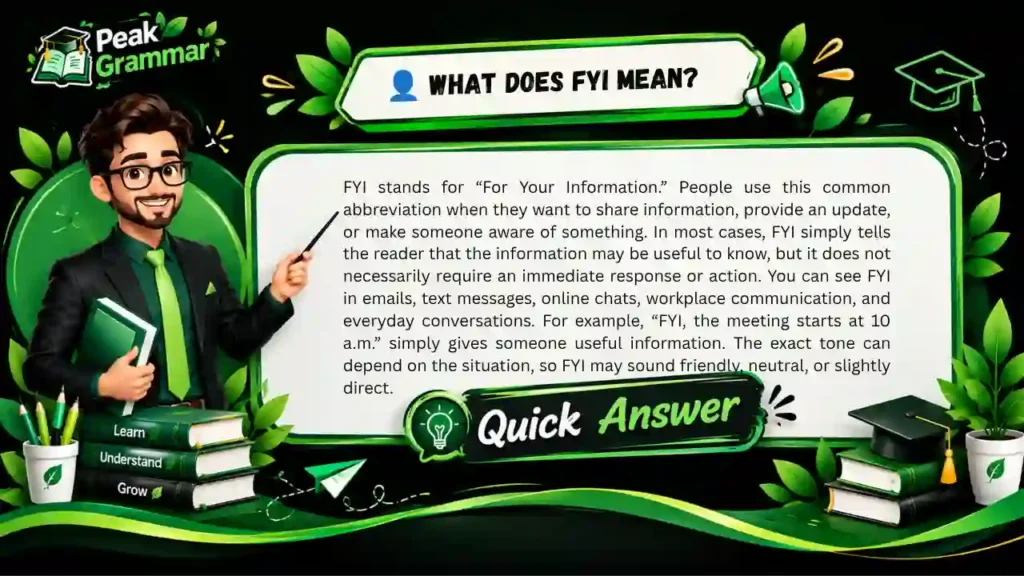
FYI stands for “For Your Information.” People use this common abbreviation when they want to share information, provide an update, or make someone aware of something. In most cases, FYI simply tells the reader that the information may be useful to know, but it does not necessarily require an immediate response or action.
You can see FYI in emails, text messages, online chats, workplace communication, and everyday conversations. For example, “FYI, the meeting starts at 10 a.m.” simply gives someone useful information. The exact tone can depend on the situation, so FYI may sound friendly, neutral, or slightly direct.
📌 TL;DR: FYI Meaning in Simple Words
- FYI full form: For Your Information
- 💬 FYI meaning: Used to share information with someone
- 📧 Common use: Emails and workplace messages
- 📱 Casual use: Texting and online chat
- 🏢 Professional use: Sharing updates or useful details
- ✍️ Standard form: FYI
- 🙂 Tone: Usually neutral, but context can change the tone
- ⚠️ Important: FYI does not always mean the reader must take action
You Might Also Like That: Instagram Slang Meaning
🔎 What Does FYI Mean?
FYI meaning is simple: “For Your Information.” People use it when they want another person to know about something. For example, if a coworker says, “FYI, the client moved the meeting to Friday,” they are simply sharing an update. The message does not automatically ask you to reply or do something.
The term can work in both formal and informal communication. You may find it in a business email, a message from a coworker, or a casual text from a friend. Its purpose stays similar: to provide information or bring something to someone’s attention.
📝 What Is the Full Form of FYI?
The FYI full form is “For Your Information.” Each word has a simple purpose. “For” introduces the reason, “your” shows that the information is intended for the reader, and “information” explains what the sender wants to share.
FYI works as a common written abbreviation for the phrase. Some language sources also describe it as an initialism because people normally say the individual letters. You may also see FYI used as a noun, such as “I sent you an FYI,” especially in workplace communication.
💡 How Is FYI Used?
People use FYI when they want to pass along information without making a direct request. You can place it at the beginning of a sentence, followed by a comma, or use it in an email subject when the message mainly provides an update.
Common examples include:
- FYI, the office will close early today.
- FYI, I attached the updated document.
- FYI: The deadline has changed.
- I’m sending this FYI so you have the latest information.
The key idea is simple: share information clearly without creating confusion about whether action is required.
📧 FYI Meaning in Email
In an email, FYI usually means that the sender wants you to know something. It often appears when someone forwards a message, shares an update, or provides a document for reference. For example, “FYI, I’ve attached the new schedule” tells the recipient that the schedule is available for them to review.
You can also use FYI in an email subject line, such as “FYI: Updated Meeting Schedule.” This quickly tells the recipient that the email mainly provides information. In professional communication, FYI can save time because it clearly separates an information-only message from a direct request.
📩 FYI Email Examples
A professional email might say, “FYI, the project deadline has moved to Monday.” Another example is, “FYI, I’ve attached the report from yesterday’s meeting.” Both messages provide useful information without directly asking the recipient to complete a task.
When you use FYI in email, make the purpose clear. If you need the person to take action, state that request directly instead of relying only on FYI. This makes your professional email easier to understand and avoids misunderstandings.
📱 FYI Meaning in Texting and Chat
In texting, FYI has the same basic meaning: “For Your Information.” People often use it to share quick updates, helpful details, or something they think another person should know. For example, “FYI, your package arrived” simply gives the recipient an update.
In casual chat and text messages, people may use lowercase “fyi” instead of uppercase FYI. This does not usually change the meaning. The style simply feels more relaxed. Whether someone writes FYI or fyi, the surrounding message and relationship between the people can affect how the phrase feels.
🏢 Is FYI Formal or Informal?
FYI can work in both formal and informal communication. In the workplace, people commonly use it in emails, project updates, meeting notices, and messages between coworkers. It can sound professional when the sender uses it clearly and appropriately.
In casual conversations, FYI can sound more relaxed. However, the phrase may sometimes feel too direct depending on the situation. If you are writing a highly formal document, you may want to use “for your information,” “please note,” or “for your reference” instead.
😐 Is FYI Rude or Passive-Aggressive?
FYI is not automatically rude. Most of the time, it simply provides information. However, the tone can change depending on the wording around it. A short message such as “FYI” followed by criticism may feel cold or passive-aggressive, especially in a workplace conversation.
You can make your message friendlier by adding a little context. Instead of writing only “FYI,” try something like, “Just an FYI, the schedule has changed.” A polite explanation helps the reader understand your intention and reduces the chance that your message will sound blunt.
🔠 Should FYI Be Capitalized?
The standard written form is FYI, with all three letters capitalized. This style works especially well in professional emails, business communication, and formal writing. For example, “FYI, the meeting room has changed” follows the common style.
In casual texting and online chat, you may also see fyi in lowercase. People often use lowercase forms because they type quickly and follow an informal style. Both forms communicate the same basic idea, but FYI remains the safest choice when you want your writing to look clear and professional.
🗣️ FYI Examples in Different Situations
The best way to understand FYI usage is to see it in real situations. You can use it when sharing a workplace update, sending information to a friend, or pointing someone toward useful details.
- 🏢 Work: “FYI, the client approved the proposal.”
- 📧 Email: “FYI, I attached the final report.”
- 📱 Text: “FYI, your order arrived.”
- 💬 Chat: “FYI, Sarah is joining us later.”
- 📅 Meeting: “FYI, tomorrow’s meeting starts at 9 a.m.”
These examples show that FYI can fit many types of everyday communication.
💼 What Does FYI Mean at Work?
At work, FYI often helps people share updates without asking for immediate action. A manager may send an FYI about a schedule change, while a coworker may use it when forwarding a useful document. It can also help teams keep each other informed without filling every message with unnecessary explanation.
For example, “FYI, the client meeting has moved to Thursday” gives coworkers an important update. However, if you need someone to complete a task, make that request clear. For example, “Please update the calendar by Thursday” communicates an actual action instead of simply providing information.
⚠️ When Should You Not Use FYI?
Although FYI works in many situations, it does not fit every type of writing. Avoid relying on it when you need the reader to understand a specific request, deadline, or responsibility. A direct sentence often works better when you expect action.
You should also use caution in academic writing and highly formal documents. These settings often prefer complete phrases and precise language. Instead of writing “FYI,” you might write “for your information,” “please note,” or “for your reference.” Choosing the right expression helps your writing match the audience and situation.
🔄 What Can You Say Instead of FYI?
You have several alternatives when FYI does not match the tone you want. Your choice should depend on whether you want to sound casual, professional, polite, or more formal.
- 📌 Please note — clear and professional
- 📚 For your reference — useful when sharing a resource
- 💬 Just so you know — casual and friendly
- 👋 Just a heads-up — relaxed and conversational
- 📢 Please be advised — more formal
- 📄 For your information — the complete form of FYI
These alternatives let you communicate the same general idea while adjusting the tone.
⚖️ FYI vs. Similar Abbreviations
Several abbreviations may look similar to FYI, but they do not always serve the same purpose.
| Term | Full Form | Common Purpose |
| FYI | For Your Information | Share information |
| FYR | For Your Reference | Provide something for later reference |
| FYA | For Your Awareness | Draw attention to information |
| PSA | Public Service Announcement | Share information with a wider audience |
Understanding these differences helps you choose the right expression. FYI generally focuses on making one person aware of information, while terms such as PSA usually serve a broader audience.
🔤 Is FYI a Noun or an Abbreviation?
FYI is commonly described as an abbreviation or initialism for “For Your Information.” However, it can also function as a noun in everyday English. For example, someone might say, “Here’s an FYI about the new schedule.”
You may also see the plural form FYIs when someone refers to several informational messages. This usage appears more often in workplace communication. The important point is that FYI can work as both a shortened expression and a noun, depending on how you place it in a sentence.
🕰️ Where Did FYI Come From?
The expression “for your information” has a long history in English, while the short form FYI became common in modern communication. Merriam-Webster records the noun use of FYI from the 1980s, showing how the abbreviation became established in everyday English.
Over time, FYI became especially common in business communication, email, texting, and digital messaging. Its short form makes it convenient when people want to share information quickly. Today, most readers recognize FYI immediately, which explains why it remains common across both professional and casual communication.
❓ Frequently Asked Questions About FYI
What does FYI mean?
FYI means “For Your Information.” People use it to share information, provide an update, or make someone aware of something.
What is the full form of FYI?
The FYI full form is For Your Information. It is a common abbreviation used in written communication.
What does FYI mean in texting?
In texting, FYI still means For Your Information. People use it to share quick updates or useful information.
What does FYI mean in an email?
In an email, FYI usually tells the recipient that the sender is providing information. It does not necessarily mean that the recipient needs to take action.
Is FYI formal or informal?
FYI can be both formal and informal. It commonly appears in professional emails but also works in casual texts and chats.
Is FYI professional?
Yes. FYI is widely used in professional communication, especially when coworkers share updates or information.
Is FYI rude?
FYI is not inherently rude. However, the wording and context can make it sound blunt or passive-aggressive.
Should FYI be capitalized?
FYI is the standard form, especially in professional writing. Lowercase fyi often appears in casual texting and chat.
What can I use instead of FYI?
You can use “please note,” “for your reference,” “just so you know,” “just a heads-up,” or the full phrase “for your information.”
Can FYI be used in academic writing?
You can understand FYI in academic writing, but highly formal academic work usually benefits from writing the complete phrase or using more precise wording.
✅ Final Thoughts
The meaning of FYI is simple: “For Your Information.” People use this abbreviation to share information, give updates, or make someone aware of something. You can find it in emails, texts, chats, workplace messages, and everyday conversations.
The most important thing is to consider context and tone. FYI usually sounds neutral, but a poorly worded message can feel blunt. Use FYI when you want to provide information, and choose alternatives such as “please note” or “for your reference” when you need a more formal or specific tone.