


Have you ever paused while writing because you were unsure whether to use quiet or quite? These two words look and sound similar, but they have completely different meanings and uses. Quiet usually describes little or no noise, a calm place, or someone who does not talk much. Quite, on the other hand, works as an adverb and usually shows degree or extent, with meanings such as “fairly,” “rather,” “very,” or “completely,” depending on the context.
Learning the difference between quiet and quite becomes much easier when you look at their meanings, pronunciation, grammar, and sentence examples together. In this guide, you’ll learn when to use quiet or quite, how to pronounce each word, common mistakes to avoid, and simple ways to remember quiet vs quite in everyday English.
Quick Answer: Quiet vs Quite 🔍
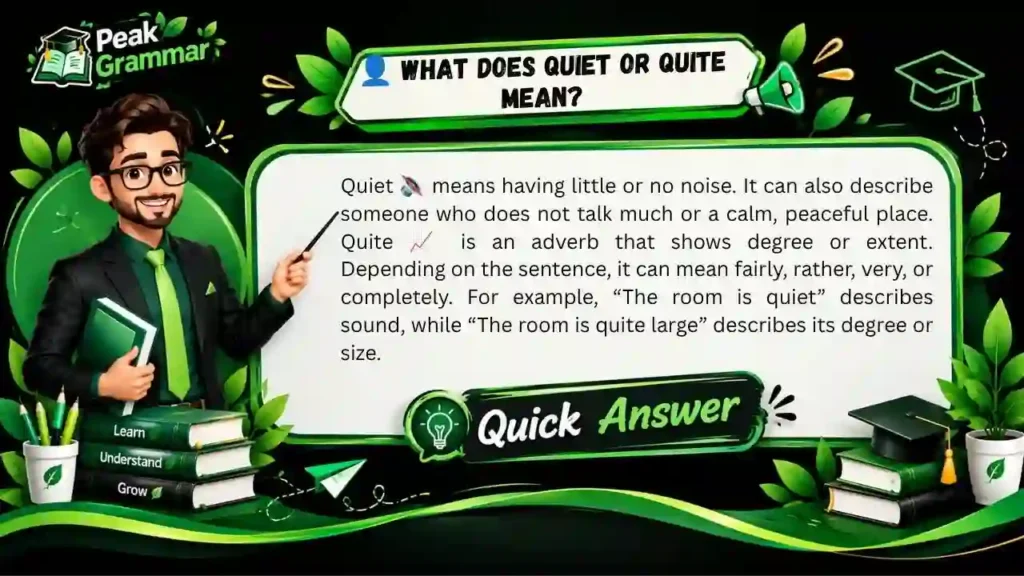
Quiet 🔇 means having little or no noise. It can also describe someone who does not talk much or a calm, peaceful place. Quite 📈 is an adverb that shows degree or extent. Depending on the sentence, it can mean fairly, rather, very, or completely. For example, “The room is quiet” describes sound, while “The room is quite large” describes its degree or size.
TL;DR 📌
- Quiet 🔇 = little or no noise or a calm state.
- Quite 📈 = shows degree or extent.
- Quiet can work as an adjective, noun, or verb.
- Quite mainly works as an adverb.
- Quiet has two syllables: qui-et.
- Quite has one syllable and sounds like kwite.
- Use quiet when talking about sound or calmness.
- Use quite when modifying another word.
You Might Also Like That: Cooked Meaning
What Does Quiet Mean? 🔇
Quiet describes something with little or no sound. You can use it for a room, street, person, place, or situation. For example, “The library is quiet” means the library has very little noise. You can also describe a person as quiet when they do not speak much. In this sense, quiet can suggest a calm or reserved nature. The word can also describe a peaceful moment, such as “We had a quiet evening at home.”
Quiet as an Adjective, Noun, or Verb 📝
Quiet can work in several ways. As an adjective, it describes something with little noise: “The house is quiet.” As a noun, it can describe peace or silence: “I enjoy the quiet.” As a verb, it means to make something less noisy: “The teacher tried to quiet the class.” You may also hear quiet down when someone asks another person to become less noisy. These uses make quiet more flexible than many learners expect.
What Does Quite Mean? 📈
Quite works mainly as an adverb. It changes the strength or degree of another word. Depending on context, quite can mean fairly, rather, very, or completely. For example, “The movie was quite interesting” can mean that the movie was fairly or very interesting. The exact strength can depend on the sentence, the adjective that follows it, and sometimes the variety of English being used. This is why learning quite meaning requires a little more attention to context.
Quite Meaning “Fairly” or “Rather” 📊
When quite means fairly or rather, it shows a moderate degree. For example, “The test was quite difficult” can mean the test was fairly difficult. You might also say, “The restaurant is quite busy” or “She is quite good at tennis.” The word does not simply describe something; it adds a level of degree. Always look at the surrounding words to understand exactly how strong the meaning is in that sentence.
Quite Meaning “Very” or “Completely” 💡
In some sentences, quite can express a stronger meaning, such as very or completely. For example, “I’m quite certain” can mean completely certain, while “That was quite amazing” can express strong emphasis. The meaning can change with the word that follows quite and with the context. British and American English can also use quite with slightly different force. So, instead of memorizing one fixed meaning, learn how quite works with different words.
Quiet vs Quite: Key Differences 🔎
The easiest way to understand the difference between quiet and quite is to focus on their jobs. Quiet usually relates to sound, silence, or calmness. Quite usually relates to degree or extent. They also have different grammatical roles and pronunciation. This quick comparison makes the distinction easier to remember and helps you choose the correct word when writing or speaking.
| Feature | Quiet 🔇 | Quite 📈 |
| Main meaning | Little/no noise | Degree or extent |
| Common role | Adjective | Adverb |
| Other uses | Noun, verb | Mainly adverb |
| Syllables | 2 | 1 |
| Pronunciation | /ˈkwaɪət/ | /kwaɪt/ |
| Example | “The room is quiet.” | “The room is quite large.” |
Quiet vs Quite Pronunciation 🗣️
Quiet and quite sound similar, which causes many spelling mistakes. However, they are not pronounced exactly the same. Quiet usually has two syllables and sounds like “kwy-uht.” Quite has one syllable and sounds like “kwite.” You can hear the difference when you say the words slowly. Learning this pronunciation difference can help you remember the spelling and avoid confusing quiet vs quite when writing.
Why Their Pronunciation Causes Confusion 🤔
Both words begin with a similar “kw” sound, and their spellings look almost identical. The main difference is that quiet contains an extra vowel sound, while quite has one clear syllable. Try saying them aloud: quiet → “kwy-uht,” quite → “kwite.” This small pronunciation difference can help you identify the correct word when you are speaking or writing.
Quiet vs Quite Examples in Sentences ✍️
Examples make the quiet and quite difference much easier to understand. Look at how each word works in a normal sentence. When you see quiet, think about noise or calmness. When you see quite, think about degree or emphasis. Reading several examples also helps English learners recognize the correct word naturally instead of trying to remember a complicated grammar rule every time.
Examples With Quiet 🔇
- “The library is quiet.” 📚
- “We found a quiet place to relax.” 🌿
- “Please keep quiet during the movie.” 🤫
- “He is a very quiet person.” 🙂
- “I enjoy the quiet of the countryside.” 🌳
In each example, quiet connects to sound, silence, calmness, or a person’s behavior.
Examples With Quite 📈
- “The movie was quite interesting.” 🎬
- “The test was quite difficult.” 📝
- “She is quite tired today.” 😴
- “That restaurant is quite popular.” 🍽️
- “I’m quite sure about my answer.” ✅
Here, quite changes the degree of the word that follows it.
Side-by-Side Examples 🔄
| Quiet 🔇 | Quite 📈 |
| “The room is quiet.” | “The room is quite large.” |
| “She is quiet.” | “She is quite friendly.” |
| “Keep quiet, please.” | “The movie was quite good.” |
| “It is a quiet street.” | “It is quite a busy street.” |
Common Mistakes With Quiet and Quite ⚠️
People often confuse these words because their spelling looks similar. The easiest solution is to ask yourself what you are describing. If you mean sound or silence, choose quiet. If you want to show the degree of an adjective or another word, choose quite. Checking the word that comes after it can also help you identify the correct choice.
- ❌ “Please be quite.”
✅ “Please be quiet.” 🔇 - ❌ “The movie was quiet interesting.”
✅ “The movie was quite interesting.” 📈 - ❌ “The room is quite.”
✅ “The room is quiet.” 🤫
When Should You Use Quiet or Quite? 🎯
Use quiet when your sentence talks about noise, silence, peace, calmness, or someone who does not talk much. For example, “The classroom is quiet” describes the sound level. You can also use it as a noun or verb in certain situations, such as “I enjoy the quiet” or “Please quiet the crowd.”
Use quite when you want to add degree or emphasis. It normally modifies another word, such as an adjective or adverb. For example, “The book is quite interesting” means the book is interesting to a certain degree.
A Simple Decision Rule ✅
Ask yourself one simple question: Am I talking about noise or degree? 🔍 If the answer is noise or calmness, use quiet. If the answer is degree, strength, or extent, use quite. This quick rule will solve most everyday quiet or quite questions. For example, “Please stay quiet” talks about noise, while “The lesson was quite easy” talks about degree.
How to Remember the Difference Between Quiet and Quite 🧠
A simple memory trick can make this confusing pair easier to remember. Think of quiet 🔇 as a word connected to sound. When something has little or no noise, it is quiet. Think of quite 📈 as a word connected to degree. It tells you how much or how strongly something is true. You do not need to memorize a long grammar rule. Just remember these two simple ideas when you write.
QUIET = sound or calmness 🔇
QUITE = degree or extent 📈
Special Uses of Quite You Should Know 💡
The word quite appears in several common expressions. Learning these phrases can help you understand natural English more easily. You may see quite a few, quite a lot, quite a bit, quite a, and quite some in everyday writing and conversation. The exact meaning can depend on the phrase and context. These expressions also explain why translating quite with one fixed word does not always work.
Quite a Few, Quite a Lot, and Quite a Bit 🔢
Quite a few means a fairly large number, while quite a lot and quite a bit usually describe a fairly large amount. For example, “I have quite a few books” means I have many books. “She has quite a lot of work” means she has a large amount of work. These phrases are common, so understanding them can improve your everyday English.
Not Quite ❌
Not quite usually means not completely or not exactly. For example, “I’m not quite ready” means I am not completely ready yet. You can also say, “That answer is not quite correct,” meaning it is close but not fully correct. This phrase appears often in everyday English and gives quite another useful meaning that learners should recognize.
Quite a and Quite Some 🔎
You may also see quite a before a singular noun phrase, as in “It was quite a surprise.” Quite some can emphasize a notable amount or degree, although its use varies by context and style. These expressions show that quite can work in several patterns. You do not need to memorize every pattern at once; focus first on the common ones you see in everyday English.
Does Quite Mean the Same Thing in British and American English? 🇬🇧🇺🇸
The meaning and strength of quite can vary between British English and American English, especially when it appears with adjectives such as “good,” “interesting,” or “difficult.” In some contexts, British English may use quite with a moderate meaning, while American English may use it more strongly. Context still matters, so avoid treating one interpretation as a strict rule for every speaker.
For English learners, the safest approach is to understand the surrounding sentence and the type of adjective that follows quite. 📚
Good Information: Quiet vs Quite at a Glance 📌
Here is the most useful information to keep in mind:
- Quiet 🔇 relates to sound, silence, or calmness.
- Quite 📈 relates to degree or extent.
- Quiet can act as an adjective, noun, or verb.
- Quite mainly acts as an adverb.
- Quiet has two syllables.
- Quite has one syllable.
- Quiet can describe a person or place.
- Quite can modify an adjective or adverb.
- Not quite means not completely or not exactly.
- Quite a few means a fairly large number.
Collective Data: Quiet vs Quite 📊
| Question | Answer |
| What does quiet mean? | Little/no noise or calmness 🔇 |
| What does quite mean? | Degree or extent 📈 |
| Is quiet an adjective? | Yes ✅ |
| Can quiet be a noun? | Yes ✅ |
| Can quiet be a verb? | Yes ✅ |
| Is quite an adverb? | Yes ✅ |
| Do they sound the same? | No ❌ |
| How many syllables does quiet have? | Usually two |
| How many syllables does quite have? | One |
| What does not quite mean? | Not completely/not exactly |
| What does quite a few mean? | A fairly large number |
Frequently Asked Questions ❓
What is the difference between quiet and quite?
Quiet 🔇 describes little or no noise, calmness, or a person who speaks little. Quite 📈 is an adverb that shows degree or extent. The correct word depends on what you want to say.
Is quiet an adjective or a verb?
Quiet can be both. As an adjective, “The room is quiet.” As a verb, “Please quiet the class.” It can also work as a noun in phrases such as “enjoy the quiet.”
Is quite an adverb?
Yes. Quite is mainly an adverb. It modifies another word and shows degree, as in “quite difficult,” “quite interesting,” or “quite slowly.”
Does quite mean very?
Sometimes. Quite can express a strong degree similar to very, but its exact force depends on context, the word it modifies, and sometimes the variety of English.
What does “not quite” mean?
Not quite usually means not completely or not exactly. For example, “The answer is not quite right” means the answer is close but not fully correct.
What does “quite a few” mean?
Quite a few means a fairly large number. For example, “She has quite a few friends” means she has many friends.
Conclusion 🎯
The difference between quiet 🔇 and quite 📈 becomes simple when you focus on their main jobs. Quiet describes little or no noise, calmness, or silence, while quite usually expresses degree or extent. Remember the easy rule: quiet = sound, and quite = degree. Also remember that quiet has two syllables, while quite has one. With a little practice and the sentence examples above, you can choose the correct word more confidently in everyday English writing and conversation.