Choosing between “quieter” and “more quiet” can be confusing, especially when both forms appear in English. If you are wondering which is correct, the good news is that the answer is simpler than it may seem. “Quieter” is the usual comparative form of “quiet,” but “more quiet” can also appear in certain contexts. Understanding the difference will help you choose the most natural form.
In this guide, we’ll explain quieter vs more quiet in simple terms, show you when to use each form, and provide clear examples. You’ll also learn the comparative form of quiet, common mistakes to avoid, and which option sounds more natural in everyday English.
Quick Answer:⚡
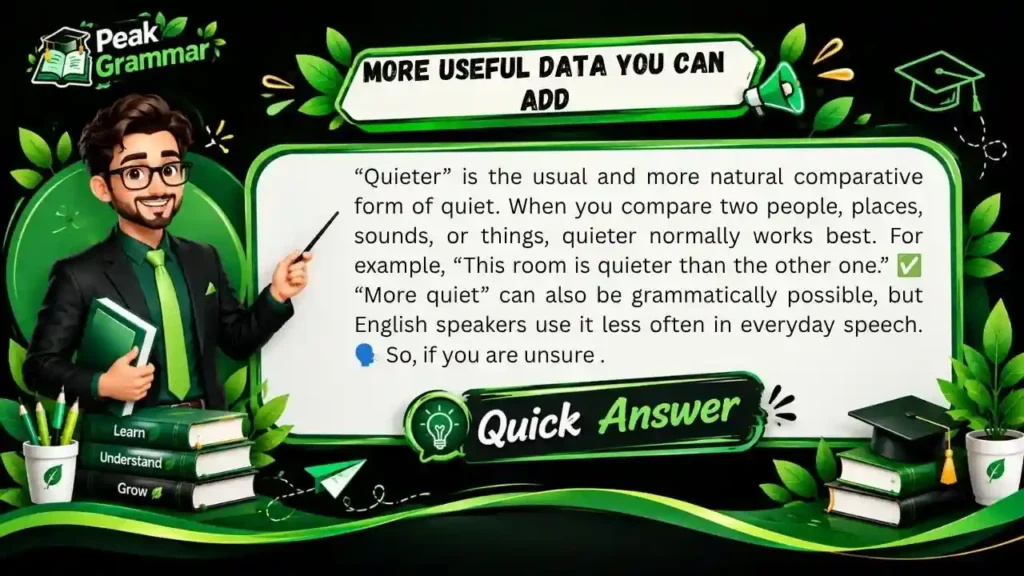
“Quieter” is the usual and more natural comparative form of quiet. When you compare two people, places, sounds, or things, quieter normally works best. For example, “This room is quieter than the other one.” ✅ “More quiet” can also be grammatically possible, but English speakers use it less often in everyday speech. 🗣️ So, if you are unsure which form to choose, use “quieter” in most situations.
| Form | Use | Example |
| quieter 🔇 | Common comparative | This room is quieter. |
| more quiet 🤫 | Possible in some contexts | The place became more quiet. |
⚡ TL;DR:
- 🔇 Quieter is the usual and more natural comparative form of quiet.
- 🤫 More quiet is also grammatically possible, but it appears less often in ordinary English.
- 📚 The basic forms are quiet → quieter → quietest.
- ❌ Avoid “more quieter” because it combines two comparative markers.
- 🗣️ Use quieter for most everyday conversations, schoolwork, professional writing, and direct comparisons.
- ✨ Use more quiet when you want special emphasis, contrast, rhythm, or a particular writing style.
- 🔊 Quieter can describe less noise, but it can also describe less activity or a calmer atmosphere.
- 🎯 When you are unsure, choose “quieter.” It is concise and generally sounds more natural. Current grammar sources support this distinction while noting that both forms can occur.
You Might Also Like That: HMMM Meaning
📌 Quick Comparison
| Form | Meaning | Best Use |
| Quieter 🔇 | Having less noise or activity | Most situations ⭐ |
| More quiet 🤫 | Having less noise or activity | Emphasis, contrast, or style |
| Quietest 🏆 | Having the least noise/activity in a group | Superlative |
| More quieter ❌ | Incorrect double comparative | Avoid |
💡 More Useful Data You Can Add
1. Quieter vs More Quiet: Grammar vs Natural Usage
This would make a strong addition because grammatically possible and most natural are not always the same thing. Both quieter and more quiet can function as comparative forms, but quieter generally wins in normal usage.
Example:
- ✅ The library is quieter than the cafeteria.
- ⚠️ The library is more quiet than the cafeteria.
The first sentence sounds more natural for most readers.
2. Why Can English Use Both Forms? 🤔
The word quiet sits in a flexible area of English comparative grammar. Some two-syllable adjectives can take either -er or more, so speakers may produce both quieter and more quiet.
This means you should avoid teaching readers an overly strict rule such as “more quiet is always wrong.” A better explanation is:
Both forms can occur, but “quieter” is usually the preferred choice.
That gives readers a more accurate understanding of English.
3. Quieter vs More Quiet in Formal Writing ✍️
For essays, exams, workplace writing, emails, and professional content, quieter usually provides the cleaner choice. It is shorter and more familiar to readers. ⭐
Examples:
- ✅ We need a quieter workspace.
- ✅ The new equipment operates quieter than the old model.
If more quiet adds a specific contrast or stylistic effect, it can still work, but you should not use it simply because you think quieter is incorrect.
4. Quieter vs More Quiet in Spoken English 🗣️
In everyday conversation, quieter usually feels smoother and easier to say. For example:
“Can you find somewhere quieter?”
This sounds natural and direct. More quiet can still appear, especially when a speaker emphasizes the quality of quietness, but it is not normally the first choice for a simple comparison.
A useful reader tip is:
If you are making a normal comparison, choose “quieter.” ⭐
You Might Also Like That: TS Meaning in Text
5. Useful Sentence Patterns 📖
Adding common sentence patterns can improve the article’s practical value:
- 🔇 quieter than — This room is quieter than the other one.
- 🔇 much quieter — The library is much quieter today.
- 🔇 a little quieter — Could you speak a little quieter?
- 🔇 far quieter — The countryside is far quieter than the city.
- 🔇 somewhere quieter — Let’s find somewhere quieter.
- 🔇 become quieter — The crowd became quieter.
- 🔇 grow quieter — The street grew quieter after midnight.
These patterns naturally reinforce the main keyword without keyword stuffing.
6. Quieter vs More Quiet vs Less Noisy 🔊
You can also add this comparison to capture another useful semantic keyword:
| Expression | Main Idea | Example |
| Quieter 🔇 | Less noise/activity | The new fan is quieter. |
| More quiet 🤫 | More quietness | The room became more quiet. |
| Less noisy 🔊 | Specifically focuses on noise | The machine is less noisy. |
Less noisy can be more precise when you specifically mean the amount of sound. Quieter can sometimes suggest a broader change involving noise, activity, or atmosphere.
7. Do Not Say “More Quieter” ❌
This deserves strong emphasis because it is one of the most useful long-tail questions around the topic.
❌ The room is more quieter.
The problem is that more and -er both mark comparison. You normally need only one.
✅ The room is quieter.
✅ The room is more quiet.
The first option is generally the more natural choice.
8. A Simple Memory Trick 🧠
Give readers an easy rule they can remember:
⭐ When you need the normal comparative form of “quiet,” choose “quieter.”
Think:
quiet → quieter → quietest
Then remember:
❌ more quieter
This simple memory trick avoids the most common mistake while still leaving room for the less common more quiet construction.
9. Extra Examples for Content Depth ✍️
You can add these examples throughout the article:
- 🏠 The new apartment is quieter than our old one.
- 📚 The library becomes quieter after lunch.
- 🌙 The neighborhood gets quieter at night.
- 🗣️ Her voice became quieter as she continued speaking.
- 🌳 The countryside feels quieter than the city.
- 💻 This laptop runs quieter than my previous one.
- 🤫 The house became more quiet after the visitors left.
- 🌅 The morning felt more quiet and peaceful.
This gives the article more real-world context instead of repeating the same room-and-library examples.
You Might Also Like That: Effect vs Affect
What Is the Comparative Form of Quiet? 📚
The comparative form of quiet helps you compare two things. The common pattern is quiet → quieter → quietest. 📝 For example, you can say, “My new office is quieter than my old office.” Here, quieter shows that one office has less noise than the other. The word quiet works as an adjective, while quieter acts as its comparative adjective. This form appears often in everyday English, formal writing, and normal conversation. 🗣️ Learning these three forms makes it easier to understand the correct comparative and superlative patterns.
- Quiet → basic form 🔤
- Quieter → comparative form 📈
- Quietest → superlative form 🏆
Quieter vs More Quiet: What Is the Difference? 🔍
The main difference between quieter and more quiet involves usage and naturalness, rather than a completely different meaning. Both forms describe something with a lower level of noise or activity. However, quieter sounds more natural in most everyday situations. ⭐ For example, “This street is quieter than the main road” sounds very natural. “This street is more quiet than the main road” can still make sense, but many speakers would normally choose quieter. So, quieter should be your first choice when you want clear, natural English.
| Point | Quieter 🔇 | More quiet 🤫 |
| Meaning | Less noisy | Less noisy |
| Commonness | More common ⭐ | Less common |
| Everyday English | Natural ✅ | Possible |
| Comparative use | Preferred | Context-dependent |
When Should You Use “Quieter”? 🔇
Use “quieter” when you compare two things and want your sentence to sound natural and direct. It works especially well with than, such as “The library is quieter than the cafeteria.” 📖 You can also use it without than when the comparison is already clear. The word works naturally for rooms, neighborhoods, voices, machines, people, and other situations. In everyday English, quieter is usually the safest choice. ⭐ It also fits well in formal writing, workplace communication, and ordinary conversations.
Examples of “Quieter” ✍️
- This room is quieter than the kitchen. 🏠
- Please find a quieter place to study. 📚
- Her voice became quieter after the meeting. 🗣️
- The neighborhood is quieter at night. 🌙
- This computer is quieter than my old one. 💻
When Can You Use “More Quiet”? 🤫
You can use “more quiet” in English, although it is less common than quieter in many everyday comparisons. Speakers may choose it when they want to emphasize quiet as a quality or when the sentence flows better with more + adjective. ✨ It can also appear in descriptive or literary writing. However, you should not automatically replace every occurrence of quieter with more quiet. If you simply want to make a normal comparison, quieter will usually sound smoother. ⭐ Always consider the context and the natural rhythm of the sentence.
Examples of “More Quiet” ✍️
- The room became more quiet after everyone left. 🚪
- The house felt more quiet during the early morning. 🌅
- The area grew more quiet as the evening continued. 🌙
- The conversation became more quiet after the announcement. 📢
Why Does “Quieter” Sound More Natural? 🗣️
“Quieter” sounds more natural because English speakers commonly use the -er comparative form with quiet. ⭐ You will often hear and read sentences such as “The park is quieter today” or “This classroom is quieter than that one.” Over time, this pattern has become familiar in everyday English. Grammar rules can explain how comparisons work, but actual usage also matters. 📖 A phrase can be grammatically possible while another phrase sounds more natural to most speakers. That is why quieter is generally the better default choice.
Quieter vs More Quiet in Different Contexts 🌍
The best choice can depend on what you describe. For noise, quieter is especially natural: “The new machine is quieter.” 🔇 You can also use it for places, voices, neighborhoods, and environments. With people, quieter may describe someone who talks less or behaves in a less active way. For example, “He became quieter during the discussion.” 🗣️ The meaning comes from the context. More quiet can express a similar idea, but quieter usually gives you the cleaner and more natural sentence.
| Context | Natural Example |
| Room 🏠 | A quieter room |
| Voice 🗣️ | A quieter voice |
| Neighborhood 🌆 | A quieter neighborhood |
| Machine 💻 | A quieter machine |
| Atmosphere 🌿 | A quieter atmosphere |
Can “Quieter” Mean More Than Just Less Noise? 💡
Yes. “Quieter” does not always describe sound alone. 🔇 It can describe a person who speaks less, a place with less activity, or an atmosphere that feels calmer. For example, “The office became quieter after lunch” may describe both reduced noise and reduced activity. Similarly, “She became quieter after the news” can describe a change in behavior. 🗣️ The exact meaning depends on context. This makes quieter a useful adjective because it can describe sound, activity, behavior, and atmosphere without changing its basic comparative role.
Quieter vs Less Noisy: Are They the Same? 🔊
“Quieter” and “less noisy” often communicate a similar idea, but they are not always equally natural in every sentence. Quieter is shorter and more conversational, while less noisy directly focuses on noise. 🔇 For example, “This street is quieter at night” sounds natural and broad. “This street is less noisy at night” puts more attention on the amount of sound. Both can work, but quieter may also suggest a calmer or less active environment. Choose the expression that best matches the meaning you want to communicate.
Common Mistakes With Quieter and More Quiet ❌
English learners often make mistakes when forming comparative adjectives. One common error is “more quieter.” ❌ This combines more with the -er ending unnecessarily. Use quieter or, where appropriate, more quiet, but do not normally combine both comparative markers. Another mistake involves confusing the comparative and superlative forms. Quieter compares two things, while quietest normally identifies the highest degree among three or more. 📚 Learning these simple differences will help you avoid common comparative mistakes.
- ❌ more quieter
- ✅ quieter
- ✅ more quiet in suitable contexts
- ❌ quieter when you mean the quietest of several things
- ✅ quietest for the superlative form
Quieter vs More Quiet Example Sentences ✍️
Seeing both forms in sentences makes the difference easier to understand. Quieter works naturally in most ordinary comparisons. ⭐ For example, “The second floor is quieter than the first floor.” You can also say, “The room became more quiet after the children went outside.” 🤫 The second sentence is understandable, but many speakers would prefer quieter in everyday English. Try to focus on the situation rather than memorizing a complicated rule. When you need a simple and natural comparative, quieter will usually serve you well.
More Examples 📝
- The countryside is quieter than the city. 🌳
- This microphone is quieter than the old one. 🎙️
- The classroom became quieter after the teacher arrived. 👩🏫
- The house felt more quiet after midnight. 🌙
- We found a quieter café nearby. ☕
- The street was quieter on Sunday morning. 🌅
Quieter, Quietest, More Quiet, and Most Quiet 📊
These forms can confuse learners because English uses both -er/-est and more/most patterns. For quiet, quieter and quietest are the usual forms you will see in everyday English. ⭐ More quiet and most quiet can also appear in certain contexts, but they are less common as the default choices. The key is to understand the type of comparison. Use quieter when comparing two things and quietest when identifying the highest degree among several things.
| Form | Function | Example |
| quiet 🔤 | Basic | It is quiet. |
| quieter 🔇 | Comparative | It is quieter than before. |
| quietest 🏆 | Superlative | It is the quietest room. |
| more quiet 🤫 | Alternative comparative | The room became more quiet. |
| most quiet ⭐ | Alternative superlative | It was the most quiet area. |
Which Form Should You Use in Everyday English? 🎯
If you want the simplest answer, choose “quieter” in most everyday situations. ⭐ It is the standard and more natural comparative form for ordinary comparisons. You can say, “This room is quieter than the other one,” and most readers or listeners will find the sentence completely natural. “More quiet” is not automatically wrong, so avoid treating it as an impossible phrase. 🤫 Instead, think of it as a less common alternative that may fit particular styles or contexts. When in doubt, quieter is your best choice.
You Might Also Like That: IYKYK Meaning
Frequently Asked Questions ❓
Is “quieter” correct? ✅
Yes. “Quieter” is correct and serves as the common comparative form of quiet. For example, “This room is quieter than that one.” 🔇 It works naturally in everyday speech and writing.
Is “more quiet” grammatically correct? 📚
Yes, “more quiet” can be grammatically acceptable in certain contexts. However, quieter usually sounds more natural for a simple comparison. ⭐
Can you say “more quiet”? 🤔
Yes. You can use more quiet, but you will often find quieter more natural in ordinary English. Choose based on context and sentence flow.
Is “more quieter” correct? ❌
No. “More quieter” creates a double comparative. Use quieter instead. ✅
What is the comparative form of “quiet”? 📖
The usual comparative form is quieter. The basic pattern is quiet → quieter → quietest.
Is “quieter” or “more quiet” more natural? ⭐
“Quieter” is generally more natural and more common for everyday comparisons. Use it as your default choice.
Conclusion 🏁
The best general choice is “quieter.” 🔇 It is the usual comparative form of quiet and sounds natural in everyday English, formal writing, and ordinary comparisons. “More quiet” can also work in some contexts, so it is better to call it a less common alternative rather than saying it is always wrong. Remember the simple pattern: quiet → quieter → quietest. 📚 And avoid the common mistake “more quieter.” ❌ When you are unsure which form to use, choose quieter for a clear, natural, and widely accepted sentence.