
If you often pause when writing “whose” or “who’s,” you are not alone. These words sound the same, but they have different meanings and uses. Whose shows possession or asks who something belongs to, while who’s is a short form of “who is” or “who has.” That small apostrophe can make a big difference, so knowing the rule can help you avoid common grammar mistakes.
The good news is that you can tell whose vs who’s apart with a simple trick. If you can replace who’s with “who is” or “who has,” then who’s is correct. If the sentence talks about ownership, belonging, or association, use whose. In this guide, you’ll learn the difference between whose and who’s, see clear examples, and discover an easy way to choose the right word every time.
⚡ Quick Answer: Whose vs Who’s
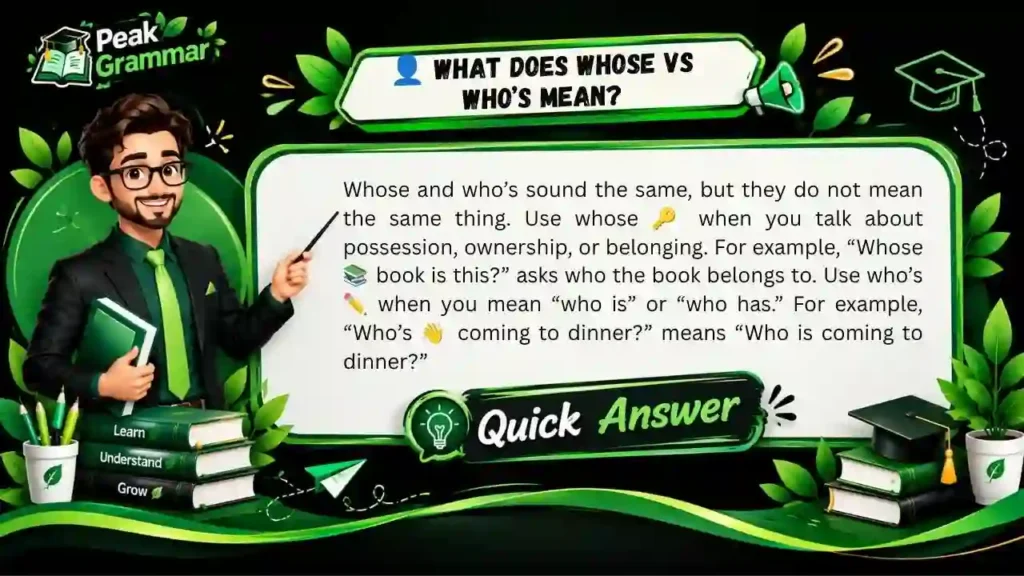
Whose and who’s sound the same, but they do not mean the same thing. Use whose 🔑 when you talk about possession, ownership, or belonging. For example, “Whose 📚 book is this?” asks who the book belongs to. Use who’s ✏️ when you mean “who is” or “who has.” For example, “Who’s 👋 coming to dinner?” means “Who is coming to dinner?”
The easiest way to remember the difference is simple: whose = possession, while who’s = who is/who has. If you can replace who’s with “who is” or “who has,” use who’s. If the sentence asks who something belongs to, use whose. ✅
📝 TLDR
- 🔑 Whose = shows possession or belonging
- ✏️ Who’s = who is
- ⏳ Who’s = who has
- 🚫 Whose does not need an apostrophe
- ✅ Use the who is/who has test for “who’s”
- 💡 Use whose when something belongs to someone
You Might Also Like That: IDEK Meaning
📊 Whose vs Who’s at a Glance
The main difference between whose and who’s comes down to meaning and grammar. Whose works as a possessive word, while who’s works as a contraction. The apostrophe in who’s joins words together; it does not show ownership. This simple point explains why “Who’s phone is this?” is incorrect when you want to ask about the owner.
| Feature | Whose 🔑 | Who’s ✏️ |
| Meaning | Shows possession | Who is / who has |
| Grammar | Possessive form | Contraction |
| Apostrophe | ❌ No | ✅ Yes |
| Example | Whose bag is this? | Who’s calling? |
| Quick test | Belonging to whom? | Who is / who has? |
💡 Good Information
Both words can appear in questions and statements, so their position alone does not tell you which one to choose. Look at the meaning instead. If you can expand who’s into “who is” or “who has,” the contraction works. If you need to show ownership or a connection to someone or something, choose whose. This rule makes the whose vs who’s difference much easier to understand.
🔑 What Does “Whose” Mean?
Whose is the possessive form of who. It asks who owns something or shows that something belongs to or connects with a person, animal, organization, or thing. For example, “Whose 🧥 jacket is this?” asks who the jacket belongs to. You can also use whose in statements, such as “I met the student whose 📖 book won the prize.”
You do not add an apostrophe to whose. It already works as a possessive word. You can use it in questions, descriptions, and relative clauses. The key idea remains the same: whose = belonging to whom. 🔑
📌 Common Uses of Whose
Use whose when you want to show:
- 🔑 Ownership: Whose car is this?
- 👤 Relationship: The woman whose son called me.
- 🏢 Association: A company whose products are popular.
- 🐕 Connection: The dog whose owner lives nearby.
This makes whose useful beyond simple ownership questions. It can connect a person, animal, organization, or thing to something related to them. That wider use also explains why you may see whose in both everyday questions and more formal writing.
✏️ What Does “Who’s” Mean?
Who’s is a contraction. It can mean “who is” or “who has.” For example, “Who’s at the door?” means “Who is at the door?” Likewise, “Who’s finished the work?” can mean “Who has finished the work?” The apostrophe shows that letters have been removed from the longer expression.
Remember that who’s does not normally show possession. The apostrophe may make it look possessive, but it serves a different purpose here. When you see who’s, try expanding it to who is or who has. If the expanded sentence makes sense, you have found the correct form. ✅
🗣️ Who’s = Who Is or Who Has
There are two main meanings of who’s:
- 👋 Who’s = who is: “Who’s coming tonight?”
- ⏳ Who’s = who has: “Who’s finished the project?”
This gives you an easy way to understand who’s meaning. In both cases, the apostrophe joins words in a contraction. It does not create a possessive form. If you can expand the word into who is or who has, choose who’s.
🧠 The Easiest Way to Remember Whose vs Who’s
The easiest whose vs who’s trick is the replacement test. Whenever you see who’s, replace it with who is or who has. If the sentence still sounds correct, use who’s. For example, “Who’s waiting outside?” becomes “Who is waiting outside?” ✅ The meaning stays clear, so who’s is correct.
Now try “Whose phone is ringing?” Replace it with “Who is phone is ringing?” ❌ That does not work. The sentence asks about ownership, so whose is correct. This simple test can help you choose the right word quickly. ⚡
🔍 A Simple Decision Guide
Use these steps when you are unsure:
- 🔑 Does the sentence show possession or belonging? → Use whose.
- 👤 Can you replace the word with who is? → Use who’s.
- ⏳ Can you replace it with who has? → Use who’s.
- ❌ Does neither replacement work? → Check the sentence again.
This quick method works for most everyday examples and helps you avoid common who’s vs whose mistakes.
📝 Whose vs Who’s Examples
Examples make the difference between whose and who’s much easier to see. Compare these sentences: “Whose 🎒 bag is this?” asks about ownership, while “Who’s 👋 carrying the bag?” means “Who is carrying the bag?” Another example is “The girl whose 📱 phone rang apologized.” Here, whose connects the phone with the girl.
You can also use both words in the same sentence: “Who’s going to tell us whose 🏠 house this is?” The first word means “who is,” while the second shows possession. Seeing both forms together can make the rule easier to remember.
📚 More Example Sentences
Whose 🔑:
- Whose keys are these?
- Whose idea was that?
- Do you know whose car this is?
- The teacher whose class I joined was helpful.
Who’s ✏️:
- Who’s at the door?
- Who’s responsible for this?
- Who’s coming with us?
- Who’s finished the assignment?
These examples cover questions, statements, ownership, and contractions so you can see how each word works naturally.
🚫 Common Whose vs Who’s Mistakes
People often confuse these words because who’s contains an apostrophe, and many writers connect ’s with possession. However, who’s is a contraction, not a possessive form. A common mistake is writing “Who’s phone is this?” when the writer wants to ask who owns the phone. The correct sentence is “Whose 📱 phone is this?”
Another common mistake is writing “Whose coming to dinner?” The correct form is “Who’s 👋 coming to dinner?” because you can expand it to “Who is coming to dinner?” Checking the meaning can quickly fix both errors. ✅
⚠️ Watch for These Errors
| ❌ Incorrect | ✅ Correct |
| Who’s phone is this? | Whose phone is this? |
| Whose coming today? | Who’s coming today? |
| Who’s idea was that? | Whose idea was that? |
| Whose responsible? | Who’s responsible? |
| Who’s name is on it? | Whose name is on it? |
A useful rule is to avoid guessing from the apostrophe. Instead, check whether the sentence needs possession or a contraction such as who is/who has.
❓ Why Doesn’t “Whose” Have an Apostrophe?
Many people ask why whose does not contain an apostrophe even though it shows possession. The reason is that whose is already a possessive form. English does not add an apostrophe to every possessive word. Compare his, hers, theirs, its, and whose. These forms do not need an apostrophe.
The apostrophe in who’s has a different job. It shows that letters have been removed from who is or who has. So, who’s uses an apostrophe because it is a contraction, while whose does not because it is a possessive form. 🧠
💡 Remember This Rule
Think of the apostrophe as a signal for a contraction in who’s:
- who + is → who’s
- who + has → who’s
- whose → possessive form
Do not add an apostrophe to whose. ❌ Whose’ is not the correct spelling. If you are showing ownership or association, simply use whose.
🐾 Can “Whose” Be Used for Things?
Yes, whose can refer to more than people. You can use it with animals, organizations, places, and things when you want to show a relationship or connection. For example, “The company whose 🏢 products sell worldwide is expanding.” You can also say, “I read a book whose 📖 ending surprised me.” In both examples, whose connects something with a related person or thing.
This use may seem unusual at first, but it follows the same basic rule. Whose expresses possession, connection, or association. It does not require the noun to be a person. 🌎
📌 Examples With Things
- 🏢 A company whose products are popular
- 📖 A book whose ending surprised me
- 🏠 A house whose roof needs repair
- 🐕 A dog whose owner moved away
These examples show why whose can work naturally with both living and nonliving nouns.
❓ Whose vs Who’s in Questions
Both whose and who’s can appear in questions, but they ask different things. Use whose when you want to know who owns or has a connection to something. For example, “Whose 🎒 backpack is this?” asks about the owner. Use who’s when you mean who is or who has, such as “Who’s 👋 waiting outside?”
A simple pattern can help: whose + noun often asks about possession, while who’s often introduces a description, action, or state. Always check the meaning before choosing the spelling. 🔍
📝 Question Examples
- Whose car is parked outside?
- Whose phone is ringing?
- Who’s at the door?
- Who’s coming with us?
- Who’s responsible for this?
- Who’s finished the work?
🔗 Whose vs Who’s in Relative Clauses
You can use both words in longer sentences, especially in relative clauses. Use whose to show possession or connection: “I met the woman whose 👩 son won the award.” Here, whose connects the woman with her son. Use who’s when it means who is or who has: “I met the woman who’s 👋 waiting outside.”
This difference becomes clearer when you expand who’s. If “who is” or “who has” fits, use who’s. If the sentence needs to show possession or association, use whose. ✅
📚 Compare the Two
Whose 🔑:
“The student whose book was missing asked for help.”
Who’s ✏️:
“The student who’s waiting outside needs help.”
In the first sentence, whose shows a connection between the student and the book. In the second, who’s means who is.
🧭 Whose vs Who’s: A Simple Decision Guide
When you need to choose whose or who’s, do not rely on how the words sound. Start by checking the meaning. If you need to show ownership, possession, or association, choose whose. If you can expand the word to who is or who has, choose who’s.
🔎 Use This Quick Checklist
- 🔑 Possession? → Whose
- 👤 Who is? → Who’s
- ⏳ Who has? → Who’s
- 🚫 Need an apostrophe for possession? → No, use whose
- ✏️ Need a contraction? → Use who’s
This simple decision guide covers most common whose vs who’s questions.
🧪 Whose vs Who’s Practice Quiz
Test your understanding by choosing whose or who’s in each sentence:
- ___ jacket is lying on the chair?
- ___ coming to the party tonight?
- Do you know ___ car this is?
- ___ finished the project?
- The woman ___ dog won the show was excited.
- ___ responsible for the missing files?
- ___ phone is ringing?
- Can you tell me ___ at the door?
✅ Answers
- Whose
- Who’s
- Whose
- Who’s
- Whose
- Who’s
- Whose
- Who’s
Try the who is/who has test whenever you feel unsure. If the sentence needs ownership, choose whose. 🎯
📊 Collective Data: Whose vs Who’s
The easiest way to bring everything together is to remember the core functions of each word. Whose focuses on possession or association, while who’s always comes from a longer expression. This distinction remains the same whether you write a short question, a formal sentence, or a relative clause.
| Word | Core Meaning | Main Function | Example |
| 🔑 Whose | Belonging to whom | Possession/association | Whose bag is this? |
| ✏️ Who’s | Who is | Contraction | Who’s coming? |
| ⏳ Who’s | Who has | Contraction | Who’s finished? |
💡 Key Takeaway
If you remember only one thing, remember this: whose = possession, while who’s = who is/who has. That single rule covers the main difference between whose and who’s.
❓ FAQs About Whose vs Who’s
Is it whose or who’s?
It depends on the meaning. Use whose 🔑 for possession or association. Use who’s ✏️ when you mean who is or who has.
Is who’s possessive?
No. Who’s is a contraction of who is or who has. It does not normally show possession.
Does whose need an apostrophe?
No. Whose is already a possessive form, so you should not write an apostrophe.
Can who’s mean “who has”?
Yes. Who’s can mean who has, as in “Who’s finished the work?”
Can whose refer to things?
Yes. You can use whose with people, animals, organizations, and things to show possession or association.
Are whose and who’s homophones?
Yes. They usually have the same pronunciation, but their meanings and grammatical functions differ.
What is the easiest way to remember whose vs who’s?
Replace who’s with who is or who has. If that works, use who’s. If the sentence shows possession, use whose.
🏁 Conclusion
The difference between whose 🔑 and who’s ✏️ becomes simple once you focus on meaning. Whose shows possession, ownership, or association, while who’s means who is or who has. Although the two words sound alike, they perform different jobs in a sentence. Remembering that distinction will help you avoid common spelling and grammar mistakes.
When you are unsure, use the quick test: expand who’s into “who is” or “who has.” If the sentence works, choose who’s. If you are talking about something belonging to someone, choose whose. Keep this rule in mind, and you can handle most whose vs who’s questions with confidence. ✅